An award lands on your desk. It is signed, it is reasoned, it disposes of every claim and counterclaim, and it comes from a tribunal the parties themselves chose. It reads like the end of the dispute. Commercially, very often, it is not. In India an award can be taken before a court, that challenge can succeed in whole or in part, the court may in defined situations modify what the tribunal awarded rather than set it aside, there is a further route above it, and enforcement is a separate fight altogether. The award in your hands looks precisely the same whether it stands untouched, is under challenge today, or was set aside two years ago.
This is one of the quietest gaps in commercial legal work. Judgments come with a habit of verification attached: any competent researcher asks whether a judgment has been appealed, distinguished or overruled before relying on it. Awards do not attract the same reflex. They circulate as documents, passed between parties, counsel, lenders and diligence teams, and they get treated as settled facts about the world. An award is not a settled fact. It is a stage in a process that may still be running.
An Award Is a Stage, Not an End
Start with what is genuinely final about an award. Once the tribunal has signed it, the tribunal's mandate is substantially at an end. Beyond limited powers to correct a clerical or computational slip, to interpret a specific point on request, or to make an additional award on a claim that was presented and left undecided, the tribunal cannot revisit what it has done. It cannot be persuaded to change its mind. In that narrow sense the award really is the end: the arbitration is over.
What is not over is the legal life of the award. The Arbitration and Conciliation Act 1996 gives a party a route to apply to a court to set the award aside on the limited grounds the statute permits. That supervisory role is deliberately narrow. The application is not an appeal, and the court is not invited to rehear the dispute, reweigh the evidence, or substitute its own commercial view for the tribunal's. Indian courts have repeatedly stressed how confined the scope for interference is, and that confinement is exactly what makes arbitration worth choosing in the first place.
But confined is not closed. A limited ground, made out on the facts, is enough to bring an award down. And even a challenge that eventually fails takes time to fail, and during that time the practical standing of the award is uncertain in a way that matters to anyone pricing risk, advising on exposure, or deciding whether to treat a sum as recoverable.
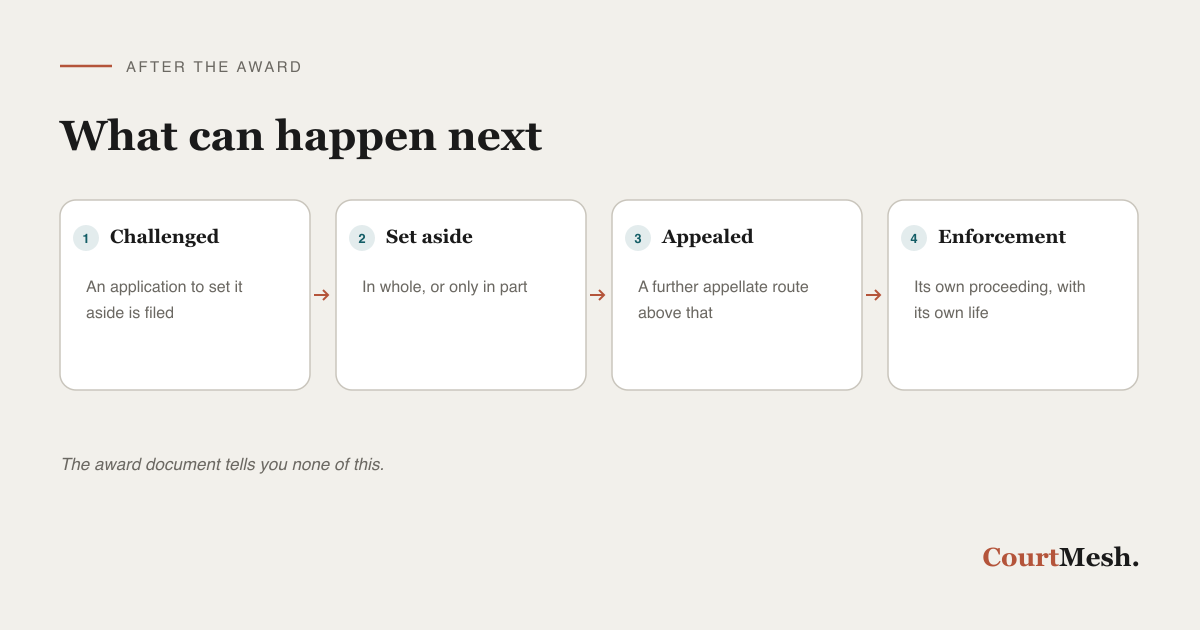
Four separate things can follow an award
It helps to keep the possible sequels apart in your head, because they run in different forums, on different timelines, and they answer different questions. Confusing them is how people end up satisfied by the wrong answer.
Going back to the tribunal
Before any court is involved, the Act allows a party to return to the tribunal for correction of a clerical or computational error, for interpretation of a specific point, or for an additional award on a claim that was presented but not decided. Small in scope, but it means the text of the award you are reading may not be the final text of the award.
The challenge before a court
An application to set aside the award, made to the court having jurisdiction, on the limited grounds the statute permits. It can be dismissed, it can succeed and take the whole award down, it can succeed as to a part that is severable from the rest, and since 2025 the court may in defined situations modify the award instead of setting it aside. Each of those outcomes leaves you in a materially different position.
The further appellate route
The Act provides a further route from certain orders made in these matters, so the first court's view is not necessarily the last one either. An award that survived the first round can still be revisited above it, and an award that was set aside can be restored. The position genuinely does flip.
Enforcement as its own proceeding
Where the award stands, it is enforced in the same manner as a decree of the court. That is a separate proceeding, before its own court, with its own record, its own objections and its own timeline. An award that is unchallenged and entirely sound can still be a long way from any money actually moving.
Since 2025 a court may modify an award, not only set it aside
For most of the life of the 1996 Act the orthodox position was binary. A court hearing a challenge could set the award aside or leave it alone, and there was nothing in between, on the reasoning that a supervisory court which rewrote an award would be doing the tribunal's job. High Courts had not been consistent about it, and the question went to a Constitution Bench. In Gayatri Balasamy v ISG Novasoft Technologies (2025) a five judge bench of the Supreme Court held, by a four to one majority, that courts do have a limited power to modify an arbitral award.
- Severance. Where the award is severable, the court may sever the invalid portion from the valid portion, which is close to what courts had already been doing on a partial set aside.
- Correction of apparent errors. The court may correct clerical, computational or typographical errors, and other manifest errors that appear erroneous on the face of the record, provided the correction does not require an evaluation of the merits.
- Post-award interest. The court may modify post-award interest in the circumstances the decision recognises.
- Article 142. The Supreme Court may do complete justice under Article 142, exercised with great care and caution and consistently with the objects of the Act. This limb belongs to the Supreme Court alone and is not a general power available to every court hearing a challenge.
The word doing the work in that holding is limited, and the decision is not a route back to a merits review of the award. It also carried a dissent, which is a fair signal of how contested the ground remains, and the shape of the power will be worked out in the cases that follow. What it changes for a reader of an award is narrow and immediately practical: modified is now a state an award can be in. An order that did not set an award aside is no longer, by that fact alone, an order that left the award unaltered.
Awards made outside India run on a different track
If the award was made outside India, the shape of the enquiry changes. It is not brought before the Indian courts by way of a challenge in the same manner. Instead, the question of whether the award will be recognised and enforced here arises when the award holder comes to enforce it, and the objections are taken at that stage. The practical consequence for a reader is identical: the court proceeding, and not the award document, tells you what the award is currently worth in India.
The Award Itself Tells You None of This
An award is a closed document. The tribunal signs it, dates it, and stops. Nothing is ever written on it afterwards. There is no endorsement recording that an application to set it aside was filed, no note that a court interfered with the third head of claim, no stamp saying that execution has been pending for four years. The award simply is what it was on the day it was signed, in every copy, forever.
Compare that with a judgment. A reported judgment sits inside an apparatus. It has a citation, it gets noticed and discussed, and its later history is at least the kind of thing that a diligent researcher knows to go and look for. An award has none of that scaffolding around it. It arrives as a file in a data room, or an attachment forwarded by a client, or an annexure to somebody's affidavit. The copy handed to you in year three is byte for byte the copy the tribunal signed in year one, and the entire intervening history is invisible in it.
What makes this genuinely dangerous is that the award is usually the most persuasive document in the file. It is long, it is reasoned, it was written by people the parties selected for their expertise, and it speaks in the settled voice of a decision-maker who has heard everything. That authority is real. It is also entirely silent on the one thing you need to know, which is whether the award has survived contact with the courts.
An award tells you what the tribunal decided. It cannot tell you what the courts have done about it since.
What Can Actually Happen to an Award
Below are the positions an award can occupy at any given moment. They are worth reading as a checklist, because the difference between them is not academic. Each one has a distinct consequence for anybody relying on the award, and several of them are indistinguishable from one another unless you go and look at the court record.
| Where the award stands | What that means | What it means for someone relying on it |
|---|---|---|
| Stands, unchallenged | No application to set the award aside has been made, or the time available for making one has run out without a challenge being brought. | The strongest position an award can be in. Even so, treat it as a finding you have made rather than an assumption you have inherited, and confirm it against the record rather than from the absence of anyone mentioning a challenge. |
| Under challenge, pending | An application to set the award aside has been filed and the court has not yet decided it. Whether enforcement is halted while that happens is a separate question the court decides on its own terms. | Treat the award as contested. The sums, the findings and the declarations in it may not survive, and any position built on them carries the risk of the challenge succeeding. |
| Challenge dismissed | The court has declined to set the award aside. The award has survived that round intact. | Considerably stronger, but not necessarily concluded. Check whether the dismissal has itself been carried further, and record the date to which your conclusion is current. |
| Set aside in whole | The court has set the award aside. What the tribunal decided no longer stands as an operative determination between the parties. | You cannot rely on it at all. Advice, valuations, provisions and settlement positions built on the award all need to be revisited, and the underlying dispute may be alive again. |
| Set aside as to a severable part | The court has interfered with part of the award and left the remainder standing. | The most easily missed outcome of the lot. The award still exists and still reads as a whole, but the specific head of claim or finding you are relying on may be precisely the part that went. The court's order governs, not the award. |
| Modified by the court | Following Gayatri Balasamy v ISG Novasoft Technologies (2025), the court has exercised the limited power to modify rather than to set aside: severing a part, correcting an error apparent on the face of the record, or altering post-award interest. | The award in your hands is no longer the operative document, and nothing about it looks different. A search that asked only whether the award was set aside would come back clean while the figure you are relying on, or the interest running on it, had changed. Work from the order. |
| Restored or reversed further up | A court above has taken a different view from the court below, restoring an award that had been set aside, or unsettling one that had been upheld. | The position can invert after the first round. An award confirmed at the first level is not settled until the further route has been exhausted or has gone unused. |
| In enforcement | The award holder has moved to enforce it in the same manner as a decree, and execution is running against the judgment-debtor. | The award stands as a legal matter, but nothing may have been realised. Legal validity and commercial recoverability are different questions and both of them matter. |
| Disposed on settlement or withdrawal | The parties have compromised, or the applicant has walked away, and the challenge or the execution has been disposed of on those terms. | The record may show a disposal without the award ever having been tested on its merits. Read the disposal order, because what the parties agreed is the operative position, not what the award said. |
Notice how far the first column and the third column can drift apart. Two awards can be in states that look identical from the outside, one of them worth its full face value and the other worth nothing, and the only thing separating them is a court order that exists somewhere in a record you have not looked at. The distinction lives in the court record, and nowhere else.
Who This Catches Out, and How
The failure mode is always the same shape. Somebody treats the award as the current position because it is the last document they were given, and the last document you were given is almost never the last thing that happened. It shows up in three different kinds of work.
Due diligence on a counterparty
A target company discloses an award in its favour and books the amount as recoverable. Or it discloses an award against it, notes that a challenge has been filed, and characterises the exposure as remote on that basis. Both statements are checkable and neither is self-proving. If the challenge to the favourable award succeeded eighteen months ago, an asset on the balance sheet has evaporated. If the challenge to the adverse award was dismissed and the counterparty is now in execution, a contingent liability has become an imminent one. Disclosure schedules are written at a moment in time and the record keeps moving after they are signed.
Advising on exposure
A client asks what a dispute is likely to cost, and hands you the award as the starting point. If you do not establish whether it has been challenged, you are advising on a number that may already have been unsettled by a court. Worse, you may not know whether enforcement has been halted while the challenge runs, or on what conditions, which is frequently the difference between a problem that requires provisioning this quarter and one that does not. The client cannot tell you this reliably either. Clients routinely know that they filed something and are hazy about what the court then did with it.
Research into how a dispute was resolved
This is the subtlest one. You are looking at how a similar dispute was resolved, perhaps to calibrate a negotiating position or to understand how a class of claim tends to be treated. An award reached a particular conclusion on a particular clause. If a court later set that award aside, or interfered with the very finding you found instructive, then the lesson you are drawing is the opposite of the lesson available. You are learning from an outcome that did not hold.
The award is the beginning of the enquiry
Treat an award the way you would treat a first instance judgment: as a document whose later history you are obliged to establish before you rely on it. The question is never simply what did the tribunal decide. It is what did the tribunal decide, what have the courts done about it since, and where has any of it actually got to. The first question is answered by the award. The other two are answered only by the court record.
What Goes Wrong When the Award Has Moved
The consequences of getting this wrong are not evenly distributed. Some of them surface immediately and are merely embarrassing. Others sit quietly inside a transaction or a piece of advice for years and surface at the worst possible moment, usually when somebody on the other side has done the checking that you did not.
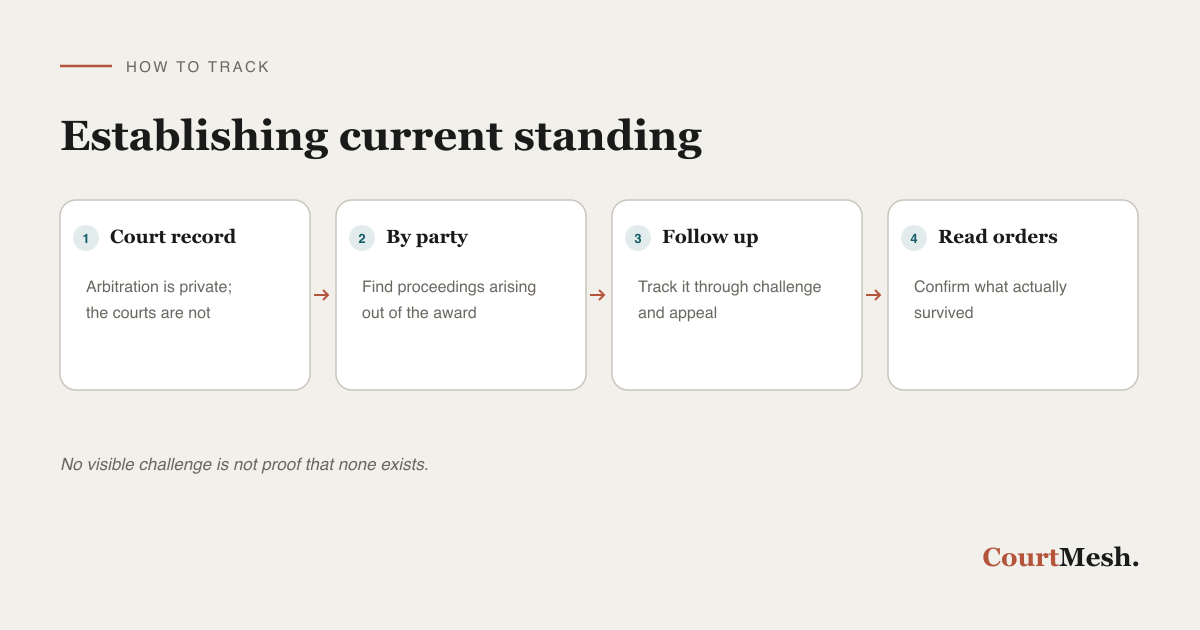
How to Establish an Award's Current Standing
Two questions, answered separately
There are two distinct enquiries here and running them together is where most people come unstuck. The first is whether the award has been challenged and what the courts have done about it. The second is whether it is being enforced and how far that has got. An award can be legally unimpeachable and commercially worthless because execution has stalled, and an award can be sitting in a live challenge while the award holder presses on with enforcement. Answer both. Neither one implies the other.
Fix the parties before you search anything
Everything downstream is a name search, so the names have to be right. Establish the exact legal names of both sides as they would appear in a cause title, along with former names, group entities, and any assignee or successor in interest. An arbitration between two operating companies can produce court proceedings in the name of a holding company, and a search that misses the entity misses the matter entirely.
Search both parties across the court record
The arbitration itself was private. The proceedings arising out of the award are not. Search each party across courts, rather than guessing at a single forum, because a challenge, a further matter above it, and an execution can each sit in a different place. Search the group and not only the named party, and search for both sides, since either of them may be the one who moved first.
Identify which matters actually arise out of the award
A commercially active party will show a lot of litigation that has nothing to do with your award. Nomenclature for arbitration-related matters varies from court to court, so match instead on the combination of parties, the timing relative to the award, the subject matter, and the forum that would have had jurisdiction. Open the cause title and the earliest order to confirm the connection before you rely on it.
Read the order, not the label
This is the step that cannot be skipped or delegated to a status field. Open the actual order. Was the application dismissed, allowed in full, or allowed only as to a part? If it was allowed in part, exactly which part? Was the award modified rather than set aside, and if so in what respect and by how much? Was the matter remitted to the tribunal? Was enforcement halted, and if so on what conditions? A one word status tells you that something happened. Only the order tells you what.
Follow the matter upward
A dismissal at the first level is a milestone, not a conclusion. Look for a further matter in the appellate forum, and note whether the time for bringing one has run. An award that was set aside can be restored, and one that survived can be unsettled, so your answer is only good until the next order, which is precisely why it has to carry a date.
Check enforcement as its own track, then keep watching
Execution runs on its own clock and its own record, and it frequently tells you more about a counterparty's real position than the award ever will. Look for enforcement or execution proceedings separately from the challenge. Then record what you concluded, record the date you concluded it on, and put a standing watch on the parties so that a new filing reaches you rather than waiting to be discovered.
None of this is exotic. It is the same discipline that any careful practitioner already applies to a judgment before citing it, transplanted onto a document that does not customarily attract it. The work is mostly retrieval, and the judgement at the end of it, about what the orders actually mean for your client, is the part that stays with you.
What you can and cannot see
Arbitral proceedings in India are largely private, and awards are frequently never published anywhere. What is visible to an outside researcher is mainly the court proceedings arising out of an award, which is to say the challenge, anything above it, and the enforcement. That has two consequences you must hold on to. First, the absence of a visible challenge is not proof that no challenge exists: a matter may have been filed and not yet reflected, it may sit under a name you did not search, or the record you are looking at may simply be incomplete. Second, where anything is in doubt, the court record governs, and the operative order governs over any label, summary or status field describing it. Read the order at source and treat everything else as a pointer to it.
Where CourtMesh Helps, and Where It Does Not
The hard constraint in all of this is that you cannot search an arbitration. It was private, it produced no public docket, and no platform can hand you a register of Indian awards because no such register exists to be handed over. What you can search is the public court record that forms around an award the moment somebody takes it to court, and that record is where the answers to both of your questions live.
That is the part CourtMesh is built for. You can search a party across roughly 310 million cases drawn from official government portals, spanning the Supreme Court, all 25 High Courts, District Courts and Tribunals, which is where proceedings arising out of an award become visible even though the arbitration behind them was never public. Filters for court, year, disposition and case status help you separate the arbitration-related matters from the rest of a busy party's litigation. Case status, including next hearing dates and disposal, is drawn from eCourts and the National Judicial Data Grid, so you can tell a live matter from a concluded one. A Watchlist alert on a monitored party is meant to bring a fresh filing, a new challenge or an execution petition, to you as it appears on the record, rather than leaving it to be noticed the next time somebody thinks to look. An alert can only ever be as prompt as the publication it depends on.
What it does not do is equally worth stating plainly. CourtMesh does not hold arbitral awards and it does not track private arbitrations, because neither of those is public information. It will not tell you whether an award is enforceable, and it does not give legal advice. Court records also update on their own schedule, so an absence of results is never a finding in itself. The platform surfaces the public court record around an award; reading the orders and deciding what they mean is the part that stays with the advocate.
Find out what happened after the award
An award is where the enquiry starts, not where it ends. Before you rely on one, find out whether it was challenged, what the court did, whether anything went further, and how far enforcement has actually got. CourtMesh helps you get there: search a party across roughly 310 million cases from official government portals covering the Supreme Court, all 25 High Courts, District Courts and Tribunals, filter by court, year, disposition and case status to isolate the matters that arise out of the award, follow every result through to the order at source, and put a Watchlist alert on the parties so a new filing reaches you as it appears on the record. The judgement about what it all means remains yours. We make sure you are not making it from a document that stopped being current years ago.
Explore CourtMesh