A bail hearing rarely turns on a grand proposition of law. It turns on facts: the role the accused is said to have played, the gravity of what is alleged, how long they have already spent in custody, and whether letting them out puts the trial at risk. Which is why one of the most persuasive things an advocate can place before a court is not a principle at all. It is an order, ideally from the same court, in which an accused who was similarly placed, on comparable facts and a comparable role, was granted bail. That is a parity argument, and it lives or dies on whether you can find that order.
The difficulty is that finding it is genuinely hard. Bail orders are voluminous, and as a body they are poorly searchable. They are passed in enormous numbers, across the Supreme Court, the High Courts, and the district judiciary. Many are short. A great many are never reported in any digest. And, crucially, most of them do not stand for a citable rule. They record a fact pattern and a conclusion. The analogous order that would carry your parity argument may be sitting in the record right now, and never surface, simply because you cannot search for the situation it describes.
This piece is about why that search is so hard, what a court is really comparing when it weighs parity, and a practical method for building a parity search that is honest about its limits. None of it is a shortcut. Parity is decided by the court, not by any database. But the analogous order is usually out there, and finding the right one is a research problem worth doing well.
Why a Parity Argument Carries Weight
Parity, at its simplest, is the idea that persons who are similarly situated should be treated alike. In a bail context it usually surfaces in one of two ways. The first is parity with a co-accused: the applicant points out that another person arraigned in the same matter, whose alleged role and antecedents are no better than their own, has already been granted bail. The second is broader. The accused relies on an order in a different matter altogether, where the facts, the offence context, and the role attributed were materially similar, and bail was granted.
In both forms the submission is powerful for the same reason. It moves the argument off the abstract and onto the concrete. Instead of asking the court to accept a general submission that the accused deserves bail, it asks the court to be consistent with a conclusion a court has already reached on comparable facts. Consistency is something courts take seriously. An accused who can show that they are no differently placed than someone already enlarged on bail has handed the court a reasoned, fact-anchored basis to do the same.
It is worth being precise about how far the argument reaches. Parity is a consideration, not an entitlement, and a bail order relied on for parity is persuasive precedent rather than binding authority. A court is not bound to grant bail merely because a co-accused received it, and it retains the discretion to distinguish the applicant on the facts. But framed honestly, on genuinely comparable facts, parity is among the more grounded submissions available, because it asks the court to do something it is already inclined to do, which is to treat like cases alike.
Parity is not a demand to be treated like a co-accused. It is a request to be treated consistently with the facts a court has already found sufficient.
Bail Research Is a Fact-Pattern Search, Not a Proposition Search
Most legal research is proposition research. You are looking for the authority that settles a rule: the test the courts apply to a particular question, the meaning given to a phrase, the principle that governs a situation. That kind of search suits keywords reasonably well, because a proposition tends to be described in a fairly stable vocabulary. The words that name the rule show up in the orders that decide it, so typing those words tends to find them.
Bail parity research is the opposite. The precedent you need is not a proposition of law at all. You are looking for a situation. You want an order about an accused whose circumstances resemble your client's: a comparable role in a comparable kind of allegation, at a comparable stage, with a comparable spell in custody behind them. The proposition, that a similarly placed accused may be granted bail, is not in dispute. What you need is the factual twin, and factual twins do not announce themselves in any fixed set of words.
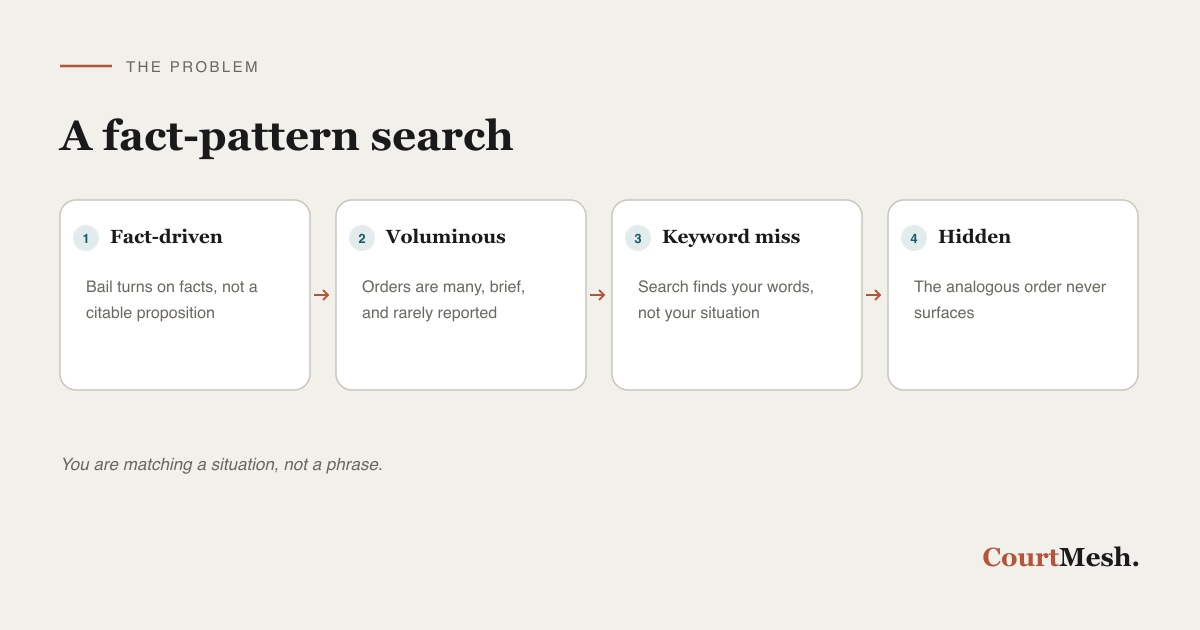
Bail orders compound the difficulty in their own particular ways. They are passed in vast numbers, far more than are ever collected in any digest or reporter. They are frequently brief, sometimes only a paragraph or two, so there is little text for a keyword to catch on. They are written by many hands, each with a different way of describing the same thing. And because they turn on facts rather than doctrine, the very detail you care about, the role, the stage, the custody period, is exactly the detail most likely to be phrased in a way you did not think to search for.
Why Keyword Search Struggles With Bail Orders
A keyword tool does something narrow and literal. It finds documents that contain the words you typed, or close variants of them, and ranks them by how often and how prominently those words appear. It has no model of what the words mean. So it cannot know that 'no overt act has been attributed to the applicant' and 'the accused is said to have played only a peripheral role' are describing the same thing. To the index they are two unrelated strings. Search for one, and the order containing the other never appears, however perfectly it fits your facts.
This is not a flaw you can type your way around. The natural instinct is to add more terms, or to try synonyms, but a fact pattern is not a synonym problem. The number of ways a court can describe a peripheral role, an incomplete investigation, or a clean set of antecedents is effectively open ended, and you cannot enumerate them in a search box. Worse, the more terms you add, the more you narrow the result set to orders that happen to share your exact vocabulary, which quietly filters out the very orders that describe your situation in different words.
The same fact, a hundred phrasings
A peripheral role might be written as 'no specific overt act attributed', 'named in the FIR without any particular role', 'mere presence alleged', or 'role confined to an introduction'. You cannot type every version, and the ones you miss stay hidden.
The detail you need is incidental
Bail orders are not indexed around the facts you care about. A custody period may appear only as a date of arrest buried mid-paragraph. The offence context may be implied rather than named. Keyword search rewards prominent words, not the incidental detail that actually decides similarity.
Brevity leaves nothing to match
Many bail orders run to a paragraph. A short order that grants bail on facts just like yours may simply not contain enough text for any keyword to land on, so it never enters your results at all.
What a Court Actually Compares in a Parity Argument
Parity is never mechanical. A court does not grant bail simply because someone else in the matter got it. It asks a harder question: is the applicant genuinely similarly placed, in the particulars that matter, to the person already granted bail? That is a comparison across several dimensions at once, and superficial likeness on any one of them does not make the cases parallel.
The dimensions of a genuine comparison
The factors below are the ones a court tends to weigh, and they are also, not coincidentally, the ones a keyword search cannot match on. The left column is what the court is comparing, the middle is what it is really looking at, and the right is why a search based on words alone tends to miss it.
| Factor in the comparison | What the court is weighing | Why keyword search misses it |
|---|---|---|
| Role of the accused | Whether the applicant is a principal actor or peripheral, and what specific act is attributed to them | The same role is described in countless ways, from 'no overt act attributed' to 'named without a specific part', none of which share keywords |
| Nature of the allegations | The kind of wrongdoing alleged and its gravity, not merely the offence label | Two orders on the same offence can describe entirely different conduct; the label matches while the facts diverge, and the facts are what matter |
| Stage of the matter | Whether investigation is complete, a chargesheet is filed, or trial has begun, and whether custodial interrogation is still needed | Stage is expressed in shifting language, from 'investigation complete' to 'chargesheet already filed' to 'cognizance taken', so no single term captures it |
| Period already in custody | How long the accused has been detained, weighed against the likely length of the trial | Custody is often recorded only as a date of arrest, not a duration, so a search for a period in months simply does not find it |
| Antecedents | Whether the accused is a first offender or has prior involvement, and whether they are named in other matters | 'Clean antecedents', 'no criminal history', 'first offender' and 'not previously involved' all mean the same thing to a court and nothing to a keyword |
| Flight risk and roots | Whether the accused is likely to abscond, and how settled they are in the jurisdiction | Described as 'deep roots in society', 'permanent resident', 'not a flight risk' or 'settled family', with no shared vocabulary to search on |
| Risk to the trial | Whether release risks tampering with evidence or influencing witnesses | Phrased as 'no likelihood of tampering', 'evidence already collected' or 'witnesses are official', each of which a literal search treats as unrelated |
Matching on meaning, not words
Every dimension a court compares in a parity argument is a matter of meaning, not vocabulary. Role, stage, custody, antecedents: each is expressed in language that shifts from one order to the next. That is precisely why fact-pattern research is a semantic problem. You are trying to match situations that are described differently, and a tool that matches only words will keep missing the orders that matter most.
A Practical Method for Building a Parity Search
The way through is to stop searching for words and start searching for the situation. Meaning-based search, sometimes called semantic search, lets you describe a fact pattern in plain language and retrieves matters that are conceptually similar, regardless of the exact words they use. Instead of guessing which phrasing an unknown order might have used, you describe your client's position and let the tool surface orders that resemble it. The method below builds on that, but the judgement at every step stays with you.
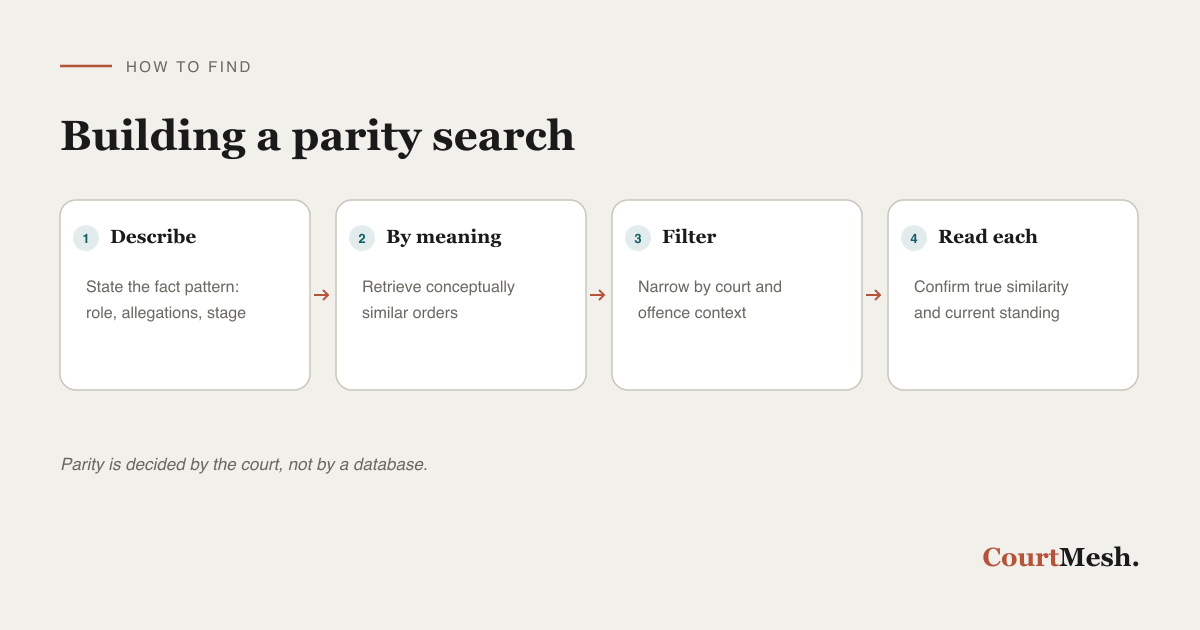
Write the fact pattern in plain terms
Set down your client's position the way you would explain it to a colleague. Suppose the accused is alleged to have only introduced two parties to a transaction, is not said to have handled any funds, has no prior involvement, and has already spent several months in custody with the chargesheet filed. That description, not a string of keywords, is your query.
Search on meaning, not vocabulary
Put the fact pattern into a meaning-based search rather than a keyword box. You are asking for orders that resemble the situation, so you do not have to anticipate whether the order you want said 'peripheral role' or 'no overt act attributed'. Let conceptual similarity do the work that guessing phrasings never could.
Narrow by court and offence context
Parity is strongest before the same court, so filter to the forum that will hear your matter, and to the offence context and stage that fit your facts. Filtering by court, case type and year turns a broad set of candidates into a shortlist worth reading.
Read every candidate order at source
A result is a lead, not a finding. Open each order and read it in full. Confirm that the role, the allegations, the stage, the custody period and the antecedents really do line up with your client's, and not just on the surface. Similarity you have not read is not similarity you can argue.
Confirm the order is currently good
Check that the order still stands: that it has not been stayed, set aside, or overtaken on appeal, and that nothing in its reasoning has since been unsettled. An order that has been disturbed is worse than no order, because relying on it invites the other side to point that out.
Reading the Candidate Order: Confirming True Similarity
A meaning-based search can bring a promising order to the surface, but whether it actually supports a parity argument is a question only you can answer, by reading it. Read each candidate against the same dimensions the court will use, one at a time, and ask:
- Is the role attributed to the accused in the order genuinely comparable to your client's, or only loosely alike?
- Is the offence context the same in substance, not just the same label?
- Was the order passed at the same stage, with the same considerations about custodial interrogation and the state of the investigation?
- Is the custody period comparable, and were the antecedents no better than your client's?
- Did the court grant bail for reasons that would apply to your facts, or for a reason peculiar to that accused?
If an order survives all of that, you have something worth placing before the court. If it fails on even one material dimension, it is not parity, and putting it forward as though it were invites the court, and your opponent, to draw exactly that distinction. A parity argument built on an order that does not truly match is weaker than no parity argument at all.
The Honest Limits of a Parity Search
None of this makes parity a certainty, and it is important to be clear about what a search can and cannot do. Better retrieval finds you better candidates. It does not decide the matter, and it does not lower the bar for what you still have to verify yourself.
Before you rely on any order
Treat every order a search returns as a candidate, not a conclusion. A search retrieves; it does not vouch. Whether an order is truly analogous, and whether it still stands, are questions settled only by reading it, and the responsibility for getting that right sits with the advocate who puts it before the court.
Where CourtMesh Fits
CourtMesh is built for exactly this kind of search. Its AI semantic search lets you describe a fact pattern or an issue in plain language and retrieve conceptually similar matters, regardless of the exact words the orders use. That is the capability a fact-pattern search needs. You describe your client's position, and the tool surfaces orders that resemble it, rather than only those that happen to share your keywords. Every result links straight to the actual order, so reading each one at source is a click away, not a separate hunt.
The coverage is there to make the search worth running. CourtMesh draws on roughly 310 million cases from the Supreme Court, all 25 High Courts, the District Courts, and Tribunals, sourced only from official government portals. Filters for court, case type, year, judge, acts and sections, disposition, and case status let you narrow a broad set of candidates down to the forum and offence context that fit your matter, which is the shortlist you actually want to read.
What it does not do is just as important. CourtMesh does not predict whether bail will be granted, it does not score an accused's chances, and it does not promise to surface every comparable order in existence. It retrieves. The judgement about whether an order is truly analogous, and whether it is currently good, stays where it belongs, with the advocate. Used that way, as a way to find candidates you then read and verify, it turns a search you could never do by hand into one you can actually do.
Find the order that matches your facts
A parity argument is only as strong as the order behind it, and that order is only useful if you can find it and stand behind it. CourtMesh helps you search by fact pattern instead of by keyword, across the Supreme Court, all 25 High Courts, District Courts and Tribunals, with every result linked to the order at source so you can read and verify it yourself. Describe the situation, surface the candidates, and do the judgement that only an advocate can do.
Explore CourtMesh