Ask any Indian legal database what the courts have held about a builder who failed to hand over possession, or about an insurer that repudiated a claim on a non disclosure ground, and you will be handed High Court and Supreme Court authority. That authority is real and it matters. But it is not where the overwhelming majority of these disputes are actually fought and decided. They are decided by consumer commissions, in a structure that runs alongside the ordinary courts rather than beneath them, and that most legal research platforms have never seriously indexed.
For the advocates who practise there, this is not a side channel. It is a complete working jurisdiction with its own procedure, its own vocabulary and its own settled habits of reasoning. A practitioner who appears before a District Commission every week knows how it tends to treat a delayed possession complaint, what evidence it expects on a defect, and which arguments the opposite party will run on maintainability. That knowledge exists. It is simply not written down anywhere a researcher can reach.
The result is the same structural gap that afflicts District Courts and tribunals, reproduced in one of the highest volume forums in the country. The decisions exist. They matter to practice. They are hard to search. This article is about why that is so, and how to research consumer jurisprudence properly given that the record is incomplete and will remain so.
What this article deliberately does not tell you
You will not find pecuniary jurisdiction thresholds, section numbers or limitation periods here. Those are precisely the details that get amended, notified and revised, and precisely the details that are dangerous when quoted from a blog post that has gone stale. Read them from the bare Act as it currently stands, and from the rules and notifications in force. What follows is about the shape of the forum and the shape of its record, which changes far more slowly.
A Parallel System, Running at Enormous Volume
Consumer adjudication in India runs on its own machinery. The Consumer Protection Act 2019 provides for a three-tier structure: a District Commission at the district level, a State Commission at the level of each state and union territory, and the National Commission, generally known as the NCDRC, at the top. A complaint is instituted before the commission that has jurisdiction over it, and appeals travel upward through the tiers, with a further route beyond the National Commission in the cases where one lies.
Described that way it sounds like a small specialist bench. It is not. Defective goods of every description. Deficiency in service across almost every service a person buys. Insurance repudiation, which is a whole practice area in itself, covering life, health, motor and property policies. Builder delay and non delivery of possession. Medical services. Banking, lending and payment failures. Electricity and telecom billing. Travel, hospitality and, increasingly, e commerce. If it is a transaction an ordinary person enters into, a complaint about it can end up before a consumer commission.
Two features shape everything that follows. The forum was built so that a complainant can reach it without a lawyer, and the procedure is summary in character. Neither is a defect. Both are the point. But together they mean this forum produces an enormous quantity of decided matter in a form the legal information industry was never built to handle.
Volume is the design, not a side effect
A forum meant to give ordinary consumers a real remedy has to be able to absorb ordinary consumer disputes at the rate at which they occur. That is a very high rate, and it is spread across every district in the country rather than concentrated in a handful of principal seats.
The record is short by construction
Summary procedure produces short orders. A commission resolving a repudiated mediclaim writes what it needs to dispose of the complaint and no more. That is efficient adjudication and inconvenient research material.
The same questions recur endlessly
Because consumer transactions are standardised, so are the disputes. The same policy exclusion, the same builder agreement clause, the same billing practice generates hundreds of similar complaints. This is exactly the condition under which consistency of approach matters most.
The consumer commissions decide, every working day, the disputes that ordinary people actually have. Almost none of that reasoning is recorded anywhere a researcher can reach it in a single search.
Why This Body of Decisions Is Under Indexed
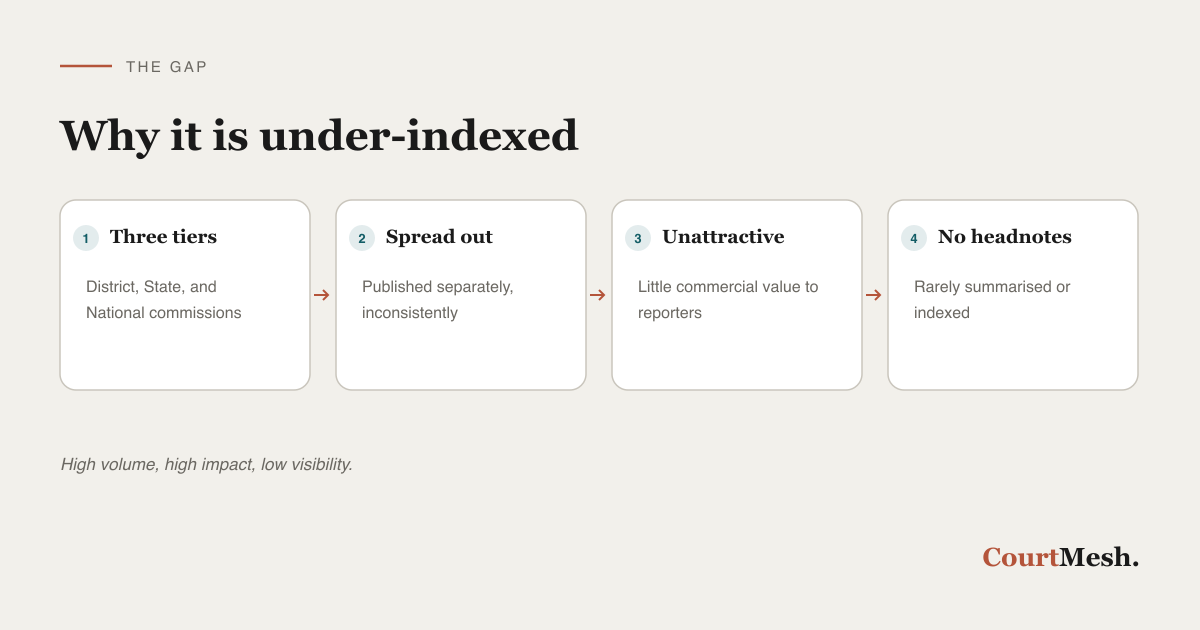
It is tempting to read the gap as neglect, as though somebody simply forgot about consumer law. The truth is more structural than that. Four separate forces push in the same direction, and each would be enough on its own to keep this material poorly indexed.
There was never a commercial market for it
Legal publishing in India grew up around precedent, and precedent has a buyer. An advocate will pay for a curated, headnoted, citable body of authority because citable authority is the currency in which arguments are settled before a bench. Every incentive in that model points upward, towards the courts whose reasoning binds or persuades others for decades. Consumer commission orders are individually small, locally focused and, in the classical citable sense, thin. There has never been a business reason to curate them at scale, so nobody did. The economics of law reporting stop at almost exactly the point where the volume of decided matter begins to climb.
The material is scattered across a very large number of bodies
This was not one forum publishing in one place, and for most of the period the corpus covers it was not even one system. The National Commission is a single national body with a single publishing surface, and its output is by some distance the easiest part of this corpus to reach. Below it sit State Commissions, each publishing on its own terms and in its own format, and below them district level commissions across the country. For two decades a researcher faced a large number of separate collections, each with its own search form, its own case numbering convention and its own idea of how a party name should be recorded.
That position changed on 1 January 2025, and any article on this subject written before then now describes a world that has partly moved on. On that date e-Jagriti became operational nationally, consolidating the separate systems the consumer commissions had been running, including the e-Daakhil filing portal and the Confonet case management application, into a single platform available across all States and Union Territories and covering the district commissions, the State Commissions and the National Commission together. Filing, fee payment, case status and case history now run through one national surface rather than through hundreds of local ones.
e-Jagriti fixed the plumbing. It did not fix the research record.
It is worth being exact about what consolidation does and does not do, because both overstating and ignoring it lead somewhere wrong. What it fixes is the fragmentation of access: one place to file, one place to look a matter up, one set of conventions going forward, across all three tiers. What it does not fix is everything else in this section. It does not headnote anything. It does not turn a scanned order into searchable text. It does not retrospectively normalise two decades of matters decided under the older systems and the older statutory vocabulary. And it does not move the fact that makes a matter comparable to yours, the project, the policy clause, the product model, out of the body of an order and into a field you can filter on. A practitioner researching today is still working mostly on the pre-consolidation record, and that record is as uneven as it ever was.
Publication practice is genuinely inconsistent
A common surface does not make the material behind it uniform. Some commissions publish promptly and completely. Some publish final orders but not interim ones. Some publish in scanned image form that no text search can reach without optical character recognition, with all the quality problems that brings. Upload lag varies from place to place and from season to season, and older matters may be present, partially present or absent altogether. None of this reflects badly on the commissions, which were set up to decide complaints rather than to maintain a research corpus. It does mean any index built on top of them inherits every unevenness in the underlying publication.
Almost none of it is headnoted
This one is easy to underestimate. A headnote is not decoration. It is the mechanism by which a body of decisions becomes searchable by issue rather than by words. When an editor records that a decision turns on, say, the effect of a delay in intimating a claim, that editorial act is what lets the next researcher find it without knowing the party names. Strip out the headnoting layer and you are left with full-text search over raw orders, which works only if you happen to guess the phrasing the commission used. In a forum where drafting conventions vary widely between benches, that is a real limitation.
Put those four together and you get a predictable outcome. The forum that decides the largest number of disputes affecting ordinary people directly is the forum whose reasoning is hardest to locate. That is not anybody's fault in particular. It is what happens when a jurisdiction is designed for accessibility and an information industry is designed for citability, and nothing in between is anybody's job.
The Recurring Issues, and Why Each One Resists Research
The difficulty is not uniform. Different categories of consumer matter are hard to research for different reasons, and knowing which problem you are facing tells you which workaround to reach for. The table below sets out the issue types that come up most often in practice, what the complaint typically turns on, and what specifically makes that category difficult to research.
| Recurring issue type | What the complaint usually turns on | What makes researching it hard |
|---|---|---|
| Insurance repudiation | Whether the repudiation was justified on the policy terms, the adequacy of disclosure, and the insurer's conduct at the claim stage | Intensely fact specific and litigated in every commission in the country. The reasoning that matters sits in short orders that are rarely reported, so the comparable case can only be reached by full-text search on phrasing you have to guess. |
| Builder delay and possession | Delay in handing over, the effect of clauses in the agreement, and whether refund with compensation or possession with compensation is the appropriate relief | One project generates many separate complaints before the same or different benches. Finding the related orders means knowing the project name and the developer's various entity names, neither of which is reliably captured in case metadata. |
| Defective goods | Proof of the defect, whether expert opinion is required, and replacement as against refund | Enormous volume of individually small matters, almost none of it published in any curated form. Product names, models and batch details appear in the body of the order but seldom in any searchable field. |
| Medical services | The applicable standard of care, consent, and whether the complaint discloses a deficiency at all rather than a difference of clinical judgement | Sensitive matters in which names are often abbreviated or withheld. The reasoning is specialised and does not surface reliably through keyword search, and the line between a deficiency and an unfavourable outcome is drawn in language that varies bench to bench. |
| Banking and financial services | Unauthorised transactions, charges and deductions, service failures, and the conduct of recovery | The same conduct is frequently agitated before more than one forum at once, so commission reasoning has to be read alongside orders from elsewhere that no single search covers together. |
| Electricity, telecom and utilities | Billing disputes, disconnection, and maintainability where a separate statutory mechanism exists for the same grievance | The decisive question is often maintainability, resolved in short threshold orders. Threshold orders are the least likely part of any record to be published, so the reasoning you need is the reasoning least likely to be available. |
| E commerce, travel and hospitality | Identifying the correct opposite party as between platform, seller and service provider, and the effect of cancellation and refund terms | The forum's approach is still developing, so recent orders carry the most weight. Recent orders are exactly the ones least likely to have been indexed anywhere yet. |
Read down the last column and a pattern emerges. In some categories the problem is volume and the absence of curation. In others it is metadata, because the fact that decides the matter never reaches a searchable field. In others again it is timing, because the developing position is the useful one and is always the least indexed. A single research technique will not solve all three.
Why It Matters Anyway
A reasonable objection at this point is that none of this is precedent in the strict sense, so why chase it. The objection misunderstands what research is for. Precedent is one thing a practitioner needs. Knowing how the forum in front of them actually decides is another, and in a high volume summary jurisdiction it is frequently the more useful of the two.
Consistency of approach on recurring issues
Because consumer disputes are standardised, commissions develop settled approaches to recurring questions. How a particular kind of policy exclusion tends to be treated. What the forum expects by way of proof of a defect. Whether a given category of grievance is entertained at all or sent elsewhere. None of that is written into the statute and none of it appears in a Supreme Court judgment, but all of it determines what happens to your complaint. A practitioner who has read twenty orders on the same issue is advising from a different position than one who has read the bare Act and a headnote.
The persuasive value of a comparable complaint
An order from another commission on facts closely resembling yours is worth having in front of you even where it binds nobody. It shows the forum that the position you urge has been accepted elsewhere on comparable facts, which is a materially stronger submission than urging it in the abstract. It also tells you what the reasoning looked like when it succeeded, and what the opposite party said when it failed. That is preparation, not authority, and preparation is what wins summary matters.
Knowing what the other side will run
Opposite parties in consumer matters are frequently repeat players. An insurer, a bank, a developer or a service provider facing the same category of complaint hundreds of times develops a standard defence and runs it consistently. Reading the orders in which that defence has previously been advanced tells you what is coming, how the commission has responded to it before, and which of your facts need to be led carefully. This is the most practical use of consumer commission research and it has nothing to do with citation at all.
The reported law and the working law diverge sharply here
In consumer practice the gap between what is reported and what is actually applied is wider than in almost any other area. The reported material tells you the settled propositions. The unreported commission record tells you how this forum, on these facts, has in fact been deciding. Both are necessary. Treating the second as beneath notice because it is not citable is a research failure wearing the costume of rigour.
Hierarchy, Weight and What Actually Binds What
Precisely because this material is persuasive rather than binding in most configurations, it has to be handled with care. Getting the weight wrong in a written submission is worse than not citing the order at all, because it invites the commission to correct you on something you volunteered.
The structural position is simple enough at a conceptual level. The tiers stand in an appellate relationship, so what comes down from a higher tier carries weight over what sits below it in that chain. An order of the National Commission occupies a very different position from an order of a District Commission, and both a different position again from a judgment of a High Court or the Supreme Court on the same question. Within a tier, commissions do not bind one another: a State Commission in one state does not compel a State Commission in another to follow it, and two district level commissions stand in the same relation.
Most of what you find will therefore be persuasive material, and you should present it as such. Say where the order came from, say what tier it sits at, and say what you are asking the commission to take from it. An order offered honestly as an illustration of how a comparable complaint was approached is useful. The same order offered as though it settled the question is an argument waiting to be dismantled.
There is also a nomenclature trap worth knowing about. The consumer protection statute that preceded the 2019 Act called the district level body a Forum rather than a Commission, so a great deal of older material is filed, titled and indexed under the earlier vocabulary. A researcher who searches only current terminology will silently miss everything decided under the older regime, which is a substantial part of the available corpus and includes reasoning that is still applied.
The Practical Research Problem
Consider what a consumer practitioner actually has to do. A complainant walks in with a repudiated claim, or possession long overdue, or a bank that debited an account without authority. Before drafting, the practitioner wants to know four things: how this category of grievance has generally been treated, what the opposite party's standard defence looks like, what evidence the forum expects, and what relief is realistically available.
Every one of those questions is answered by reading decided matters, and every one runs into the wall already described. The National Commission material that is reachable is the appellate residue rather than the daily practice. And the fact that would make a matter comparable to yours, the specific project or policy clause or product, is usually buried in the body of an order rather than sitting in any field you can filter on.
So practitioners rely instead on memory, on colleagues, and on the small private collection of orders they have accumulated over years of appearing. That works, and it is genuinely valuable expertise, but it does not scale, it does not transfer to a junior, and it fails the first time the practitioner takes a matter in an unfamiliar category or before an unfamiliar commission.
A Method for Researching Consumer Jurisprudence
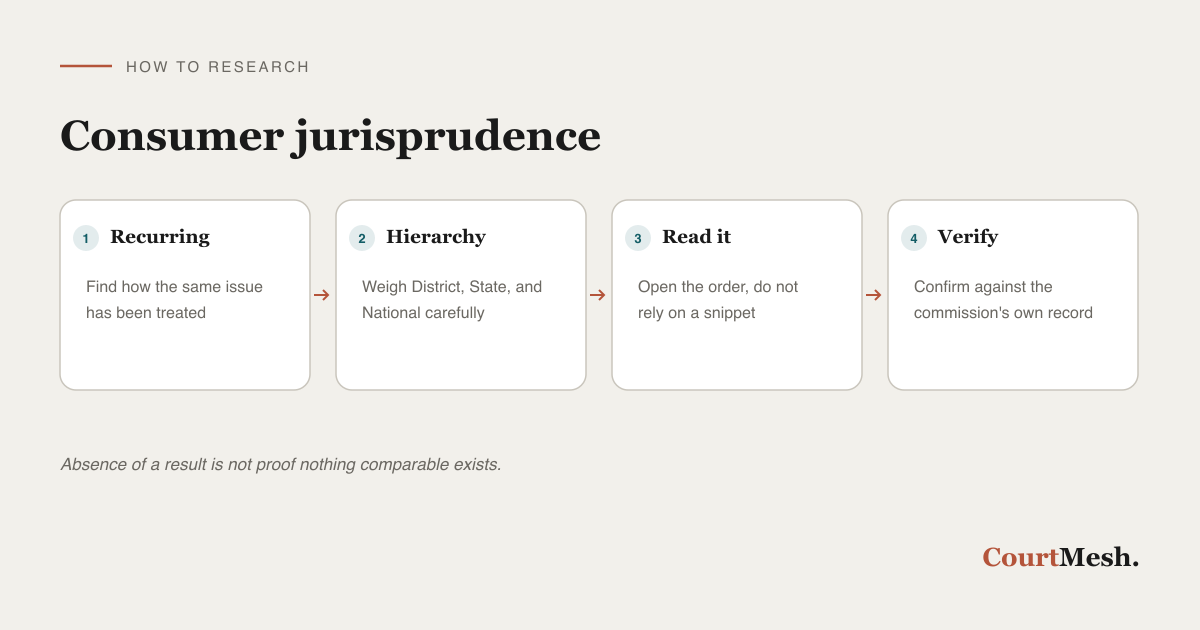
None of the above makes consumer research impossible. It makes it a different discipline from appellate research, one that assumes gaps rather than completeness and builds verification into the workflow. The following sequence carries most of the weight, whatever tools you use.
Start from the issue, not from a citation
You will rarely have a case name to look up, because the material is not organised that way. Write the question in the terms the commission would use: deficiency in service in relation to what, on which facts, against what anticipated defence. Semantic search helps here precisely because you are describing a situation rather than matching a phrase.
Work the appellate trail as well as the commission record
The higher a consumer matter has travelled, the better the record gets. A High Court or Supreme Court decision arising out of a complaint is far better indexed than the commission order beneath it, and will usually set out what the commission held and why. This is the most reliable route into the reasoning of a forum whose own record is patchy, and it is badly underused.
Search the opposite party, and search the thing as well as the party
Repeat players generate matters under names that vary. Run the entity name in every plausible form, with and without Private Limited, in common transliterations and former names. Then search the subject matter itself: the project, the product or model, the scheme or policy. In consumer matters the identifying detail is often the thing rather than the party.
Read the order at source, in full
Never rely on an extract. Consumer orders are short, so every sentence is load bearing, and the paragraph distinguishing your facts from theirs is frequently the one an abstract leaves out. For the commissions themselves, source means the commission's own record, which since January 2025 means e-Jagriti for case status and case history across all three tiers. Note what was actually pleaded, because the disposal often turns on how the complaint was framed rather than on any general proposition.
Place every order in the hierarchy before you rely on it
Record the tier, the commission and the date, and be explicit with yourself about whether the order binds, persuades or merely illustrates. Then check whether it went further. An order that reads perfectly for your case is worth nothing if it was set aside on appeal, and here the appellate outcome is often easier to find than the order itself.
Note what you searched, and what you could not
Write down the forums queried, the variants used and the date of the search. This matters more here than in appellate research, because the honest answer is frequently that comparable material may exist and simply may not be published. Recording the scope protects the client, who then knows what the research establishes, and it protects you.
Be exact about where the consumer record lives, and where it does not
This needs stating without hedging, and the honest version puts the limit on us rather than on the commissions. CourtMesh does not index the district, State or National consumer commissions. They are not among the sources the corpus draws from, so nothing in this article should be read as an offer to search them. For the commissions go to e-Jagriti and to the record of the commission concerned. Separately, and this holds for any index over any forum, an index can never be more complete than the publication practice of the bodies it draws from. If you search anywhere and find nothing, you have learned that nothing was found. You have not learned that no comparable complaint has been decided. The order may never have been uploaded, it may be a scan no text search can reach, or it may be filed under terminology you did not try. Where the answer matters, the official record of the commission concerned prevails. Treat a nil result as an instruction to look harder, never as a finding.
Where a Broad Index Helps, and Where It Does Not
CourtMesh holds roughly 310 million cases spanning the Supreme Court, all 25 High Courts, District Courts and Tribunals, drawn from official government portals only, with no third party intermediaries in the chain. It supports both keyword search and AI semantic search, with filters for court, case type, year, judge, acts and sections, disposition and case status, and every result links through to the actual decision so you can read it rather than trust a summary of it.
What that means for a consumer practitioner has to be stated carefully, and the plainest part comes first. The consumer commissions are not in that list, and CourtMesh does not index them. Not the district commissions, not the State Commissions, not the National Commission. That is a boundary on what we have built, and it would be dishonest to present it as a consequence of how the commissions publish. Their record sits with them and on e-Jagriti, and that is where you go for it. What a broad index over the court record does offer a consumer practitioner is the layer above: the matters that left the commissions and reached a High Court or the Supreme Court, which is a genuinely useful and badly underused route into consumer reasoning, and a different thing from covering the forum.
What a broad index genuinely helps with
The appellate trail. Consumer matters that have travelled to a High Court or the Supreme Court are well covered, and those decisions frequently recite what the commission below held. Searching that layer by issue, act and disposition is a fast route into consumer reasoning, and it is the part most researchers skip.
What no index can fix
An order that was never uploaded, a scan too poor to extract text from, or a matter recorded under a name nobody would think to search. These are upstream problems in the published record. A better search engine narrows the gap. It does not close it, and any platform telling you otherwise is selling a confidence it cannot support.
CourtMesh is a research and search platform. It surfaces decisions and links you to them so you can read and assess them yourself. It does not give legal advice, it does not tell you what a complaint is worth, and it is not a substitute for the judgement of the advocate handling the matter. The value it adds is reach and speed at the search stage. Everything after that is professional work no tool performs for you.
The honest summary is short. The historical gap described above sits upstream of any platform, e-Jagriti has closed part of it going forward, and we do not index the commissions ourselves. The correct response to all three facts is the same, and it is not to pretend otherwise. Use e-Jagriti and the commission's own record for the commission layer, work the appellate trail where the commission record runs thin, read every order at source, be exact about persuasive weight, and leave the last word with the commission that passed the order.
Search the layers below the headline courts
Most legal research tools are excellent at the courts that produce citable precedent and vague about everything else, which leaves the forums where ordinary disputes are actually decided almost invisible. CourtMesh was built the other way round: one search across the Supreme Court, all 25 High Courts, District Courts and Tribunals, drawn only from official government portals, with keyword and AI semantic search, filters to narrow what comes back, and a link to the actual decision on every result. It will never tell you that a matter does not exist, because no honest system can. It will let you ask the question once instead of a dozen times, and show you where the answer came from so you can verify it at source.
Explore CourtMesh