A contract gets signed, celebrated, saved to a shared drive, and forgotten. Months later a renewal has triggered, a notice window has closed, or an obligation has quietly turned into a breach, and nobody saw it coming. The signature was never the finish line. It was the starting gun.
Consider a hypothetical that will feel familiar to anyone who has managed a contract portfolio. A company signs a three-year services agreement with a vendor it is broadly happy with. Buried in the termination clause is an evergreen provision: unless either party serves written notice ninety days before the term ends, the agreement renews automatically for a further three years. The person who negotiated it has since changed roles. The renewal date sits in nobody's calendar. The notice window opens, stays open for a while, and then closes. By the time procurement revisits the relationship, the company is contractually committed to another full term with a counterparty it had planned to replace. No one did anything wrong in an obvious way. Everyone did the ordinary thing, which was nothing.
This is not a drafting failure. The clause did exactly what it said it would do. It is a lifecycle failure, and lifecycle failures are among the most common and the least discussed category of contract problem in Indian legal and business teams, which is a poor combination for something that is often expensive to unwind.
Signature Is Not the Finish Line
Most of the attention a contract receives happens before it is signed. Drafting, redlining, negotiation, approvals, and the final push to execution absorb the energy of the legal team and the business. That focus is understandable. Getting the words right matters. But it produces a quiet distortion: the phase that receives the most tooling and the most care is the phase that is over the fastest. The phase that lasts for years, the life of the contract after signature, is the one most teams manage with the least structure.
A signed contract is a set of live promises with dates attached. It obliges you to do things, to pay on triggers, to deliver against milestones, to maintain insurance or confidentiality, to give notice in a particular form within a particular window. Every one of those is a future event that someone has to remember, monitor, and act on. The document does not remind you. It sits in a folder being quietly true while the world moves on.
What actually begins when the ink dries
The moment a contract is executed, it starts generating work that stretches across its entire term:
- Obligations to perform and monitor. Deliverables, service levels, reporting duties, confidentiality, insurance, and compliance covenants that continue for the life of the agreement.
- Milestones and payment triggers. Amounts that fall due on dates or on events, price escalations that step up on an anniversary, credits that must be claimed in time.
- Renewal and termination windows. The specific dates on which you can exit, renew, or renegotiate, and the periods in which a decision is actually available to you.
- Notice periods. The requirement to communicate a decision in a defined form, to a defined address, within a defined number of days, failing which the right lapses.
- Auto-renewal, or evergreen, clauses. Provisions that commit you to a further term automatically unless someone acts in time to stop them.
None of these is exotic. They appear in ordinary commercial agreements: supply contracts, software subscriptions, leases, distribution agreements, licensing deals, and services engagements. What makes them dangerous is not complexity. It is that they are silent. A missed obligation does not announce itself. A closing notice window does not send an email. The cost of the post-signature phase is that it runs on dates the document knows and the organisation forgets.
A contract does not fail loudly. It fails on a date nobody was watching.
The Specific Ways Contracts Slip
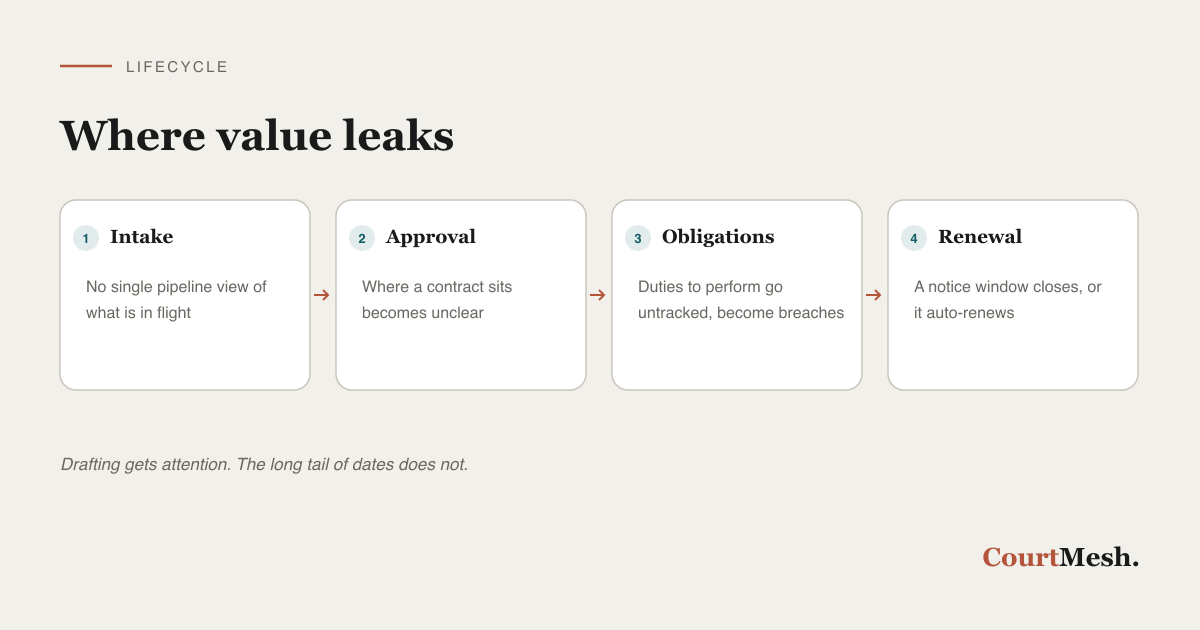
When contracts fall through the cracks, they tend to do it in a small number of recognisable ways. Naming them helps, because each has a different cause and a different fix.
Silent auto-renewal, the evergreen trap
An evergreen clause renews a contract automatically at the end of its term unless a party opts out in time. It exists for a sensible reason: continuity, so that a working relationship does not lapse by accident. But it inverts the default. Doing nothing does not pause the relationship, it extends it. If the opt-out window passes unnoticed, you are committed to another full term, often on the same pricing and the same terms you may have wanted to renegotiate. The clause is not hidden or unfair. It simply assumes someone is watching the calendar, and frequently no one is.
The missed notice window
Rights under a contract are often time-boxed. A right to terminate for convenience, to renegotiate pricing, to exit on a break date, or to decline renewal usually has to be exercised within a defined period and in a defined manner. Miss the window and the right does not merely become inconvenient to use, it disappears until the next cycle, which may be years away. Notice provisions compound the problem: notice must often be in writing, sent to a named address, and served a set number of days in advance. A decision made on time but communicated late, or communicated in the wrong form, can be as ineffective as no decision at all.
Obligations that quietly become breaches
Between signature and expiry, a contract imposes continuing duties. You may be required to maintain a level of insurance, to report usage quarterly, to keep information confidential, to meet a service level, or to hit a delivery milestone. A binding agreement under the Indian Contract Act, 1872 makes these promises enforceable; it does not make them visible. When they are tracked nowhere, they are remembered only when something goes wrong. A missed milestone becomes a default. A lapsed insurance covenant becomes a breach discovered during a dispute. An indemnity obligation that was never operationalised becomes a liability nobody priced. The failure is rarely deliberate. It is that the obligation lived in a document, not in anyone's workflow.
No visibility and no owner
Two structural gaps sit underneath the others. The first is visibility: at any given moment, it is often impossible to say where a particular contract is. Is it in legal review, waiting on a counter-signature, executed but unfiled, or live and generating obligations? The second is ownership. When a contract portfolio belongs to everyone, it belongs to no one. The person who negotiated a deal moves teams, and institutional memory leaves with them. Without a single owner and a single view, contracts are managed reactively, one crisis at a time, which is the most expensive way to manage anything.
Why Spreadsheets and Shared Drives Fail Here
The instinctive response to all of this is a tracker. Someone builds a spreadsheet: contract name, counterparty, start date, end date, renewal date, owner. For a while it works. Then, predictably, it stops. The failure is not laziness. It is that a spreadsheet is structurally the wrong tool for the job it is being asked to do.
It never surfaces what is due
A spreadsheet is passive. It holds dates but does not act on them. Nothing in a row of cells reaches out ninety days before a notice window to tell you the window is opening. You have to remember to look, which is precisely the thing that fails.
It cannot escalate
When a date approaches and the owner is on leave, has changed roles, or simply misses it, the spreadsheet does nothing. There is no fallback, no reminder to a second person, no escalation. Silence is its only response to an approaching deadline.
Versions and ownership drift
The file gets copied, renamed, emailed, and edited in parallel. Two versions diverge, and the authoritative copy becomes unclear. Columns are filled inconsistently by different hands. Within months, no one fully trusts what the tracker says.
It dies quietly when unmaintained
A tracker is only as good as the discipline maintaining it. The moment updating it becomes someone's forgettable side task, entries stop being added, dates go stale, and the sheet degrades into a record of the past rather than a warning about the future.
Shared drives make the document problem worse, not better. Finding the current, executed version of a contract among drafts, near-final versions, and scanned copies is its own daily friction. And a folder, like a spreadsheet, is inert. It stores the contract. It has no concept of what the contract requires or when.
The core problem is passivity
Every one of these tools shares a single flaw: it waits to be checked. A contract portfolio does not need a better place to store dates. It needs something that surfaces the right date to the right person before the window closes, without anyone remembering to go and look. The shift that matters is from passive storage to active surfacing.
What a Real Contract Lifecycle System Does
Contract lifecycle management, often shortened to CLM, is the practice and the tooling for managing a contract across its whole life, not just up to signature. A real lifecycle system is built around the phases where value and risk actually leak, and it does four things in particular.
Intake and a single pipeline view
Every contract request, draft, and executed agreement enters one place. At a glance you can see what is in the pipeline, what stage each contract is at, and what is live. Nothing lives only in an individual inbox, and the portfolio becomes visible for the first time.
Structured multi-stage approvals
Approvals follow a defined path rather than an ad hoc chain of forwarded emails. The right people review in the right order, sign-off is recorded, and there is never ambiguity about whether a contract is cleared to sign or still waiting on someone.
Capture of key dates and obligations at signing
At the point a contract is executed, the terms that matter are captured as structured data: renewal date, notice window, break dates, payment triggers, milestones, and continuing covenants. The critical terms move out of the prose and into a system that can act on them.
Proactive surfacing before dates fall due
The system watches the dates it has been given and raises them ahead of time, to a named owner, before the notice window opens and before the obligation falls due. The default changes from remembering to being reminded.
The through-line is that a lifecycle system is active where a spreadsheet is passive. It does not wait to be consulted. It converts the quiet, dangerous dates buried in a contract into visible, owned, time-bound actions. Mapped against the stages of a contract, the picture looks like this.
| Lifecycle stage | What leaks here | How a lifecycle system catches it |
|---|---|---|
| Intake and request | Contracts started over email; no record a request even exists; work duplicated or lost | A single intake point and pipeline view so every contract is visible from the first request |
| Drafting and negotiation | Version confusion; unclear which draft is current; approvals chased informally | One place for versions with a defined, recorded approval path |
| Approval and signing | No clarity on whether a contract is cleared to execute; bottlenecks invisible | Structured multi-stage approvals that show exactly what is pending and with whom |
| Execution and handover | Key dates and obligations left in the prose and never captured anywhere actionable | Capture of renewal dates, notice windows, and obligations as structured data at signing |
| Active life and obligations | Milestones, payments, and covenants missed; obligations quietly become breaches | Obligation tracking with reminders raised to a named owner ahead of each date |
| Renewal and termination | Notice windows close unnoticed; evergreen clauses renew silently | Renewal and notice-window alerts surfaced well before the deadline |
How to Bring an Existing Portfolio Under Control
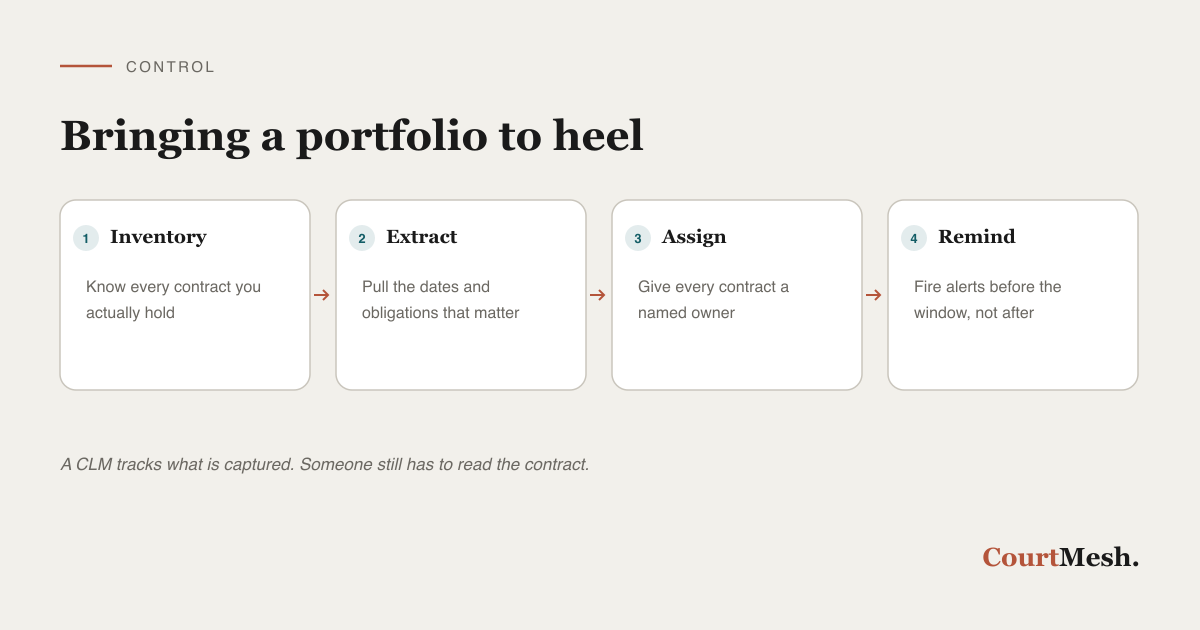
Most teams do not start from zero. They start from a drawer, a drive, and a dozen live contracts whose terms nobody has looked at since signing. Getting an existing portfolio under control is not a single project, it is a sequence, and it is very doable if approached in order.
Inventory what you actually have
Pull every live contract into one list: counterparty, type, start date, and end date. You cannot manage a portfolio you cannot see. Expect to find agreements you had forgotten and at least one whose current status surprises you.
Extract the dates and obligations that matter
For each contract, pull out the terms that carry risk: renewal date, notice period and window, break dates, payment and escalation triggers, and any continuing obligations such as insurance, reporting, or confidentiality. This step turns a pile of documents into a set of manageable commitments.
Assign a single owner to every contract
Each contract needs one accountable person, not a team and not a shared inbox. Ownership is what converts a surfaced reminder into an actual decision. Where the original owner has moved on, reassign deliberately rather than leaving it unowned.
Set reminders that fire before the window, not after
For every renewal date and notice window, set an alert with enough lead time to review the relationship, consult the business, and serve notice in the required form. A reminder that arrives after the window has closed is a record of a loss, not a warning.
Done once, this converts a reactive scramble into a routine. The portfolio stops being a source of unpleasant surprises and becomes something you steer.
An honest note on what a CLM system does and does not do
A contract lifecycle system is an operational tool, not a source of legal advice. It tracks the dates and obligations you capture; it does not interpret the contract for you. It will surface a renewal date, but it will not tell you whether renewing is wise. The quality of what it surfaces depends entirely on what is captured at intake: a notice window that is never entered is a notice window the system cannot warn you about. A lifecycle system meaningfully reduces the chance that a date is missed. It does not remove the need for someone to read the contract, understand it, and decide. Used well, it handles the remembering so that your people can focus on the judgement.
Where CourtMesh Fits
CourtMesh CLM is built for the post-signature reality described here. It provides contract intake and a pipeline view so the whole portfolio is visible in one place, multi-stage approval workflows so sign-off follows a defined path, and obligation and renewal tracking so the dates that matter are surfaced before they fall due rather than after. Counterparty management keeps the record of who you are dealing with alongside the agreements themselves.
It is also part of one platform. CourtMesh brings CLM together with legal Research and My Cases under unified billing and a single access control model, so contracts, matters, and research live behind one login rather than scattered across disconnected tools. Access controls and team collaboration let you decide who sees which contracts, and make ownership explicit rather than assumed.
To be clear about the claim: CourtMesh does not draft your contracts for you, does not give legal advice, and cannot guarantee that no obligation is ever missed. What it does is centralise the contract portfolio and surface obligations and renewals before they fall due, which is precisely the failure the opening scenario turned on.
Stop losing contracts to dates nobody was watching
The renewal nobody caught is not a rare disaster, it is the predictable result of managing live contracts in inboxes and spreadsheets that wait to be checked. Bring the portfolio into one place, capture the dates and obligations that carry risk, and let them be raised to a named owner while there is still a decision to make. CourtMesh CLM does the intake, the approvals, and the obligation and renewal tracking. What it will not do is read the contract for you, and it does not pretend otherwise.
Explore CourtMesh