Before you sign a large contract, extend credit, onboard a vendor, or put capital into a company, you will read its numbers. The balance sheet, the profit and loss, the bank statements, perhaps a set of audited accounts. All of that tells you one kind of thing, and only one: what the counterparty has chosen to declare about itself. It does not tell you how that counterparty behaves when a deal turns sour, whether it pays what it owes without first being taken to court, or whether two of its group companies are already before a tribunal fighting to stay solvent. For any of that, you have to read a different record: its litigation history.
A financial statement is a self portrait. It is prepared by the counterparty, on the counterparty's timetable, within the discretion that accounting standards allow. A litigation record is the opposite kind of document. It is written by adversaries, adjudicated by judges, and filed whether the counterparty likes it or not. It captures the moments a company would least like to advertise: the supplier it did not pay, the loan it did not service, the cheque that bounced, the regulator it fell out with, the creditor that finally lost patience and moved to wind it up. That is why, for a decision that turns on trust, litigation history is often the most honest paper a counterparty leaves behind.
This article is for the person who has to make that decision: in-house counsel, a risk or credit team, a founder about to sign, an investor about to commit. It is about what a counterparty's litigation history can tell you, how to read it without over reading it, why it is so hard to assemble in India, and, just as importantly, where its limits are. A litigation search sharpens due diligence. It does not replace it, and anyone who treats it as a substitute is setting themselves up to be wrong at exactly the wrong moment.
The core of it
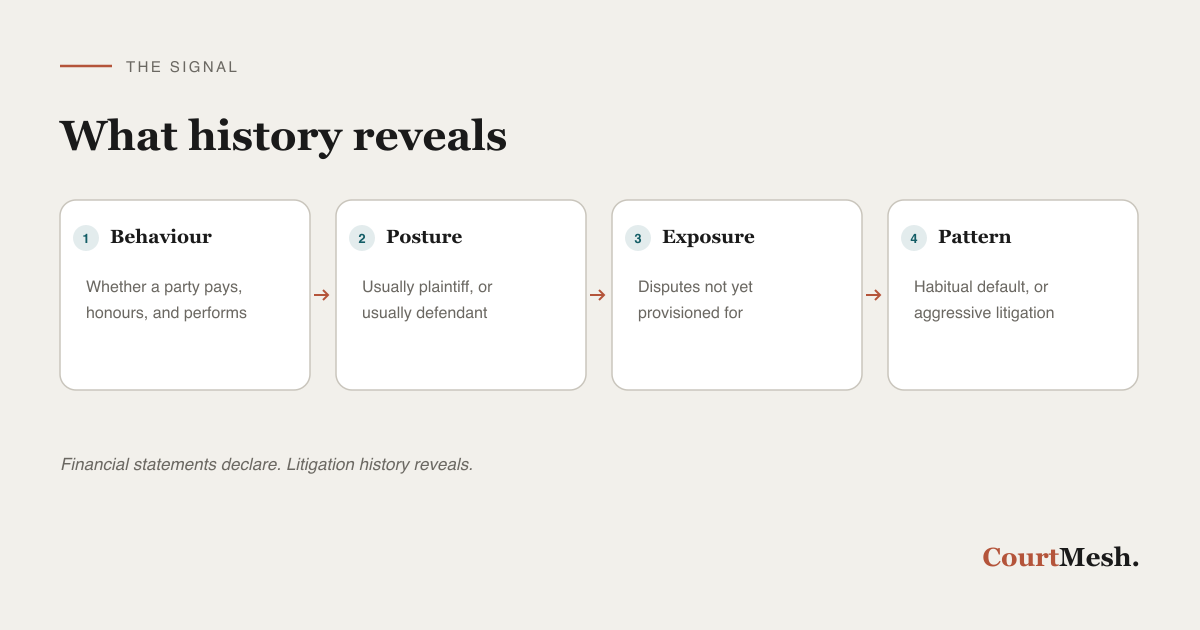
Financial statements tell you what a counterparty declares. Litigation history tells you how it behaves. Numbers are a claim the company makes about itself; a court record is a claim other people have made against it, tested in front of someone impartial. For the questions that actually decide whether a relationship is safe, whether a party pays, honours its contracts and keeps its promises, behaviour is the better predictor, and behaviour is what litigation captures.
The Record a Balance Sheet Cannot Show You
Financial statements are built to net things out. A dispute over an unpaid invoice, a contested tax demand, a guarantee that may or may not be called: each of these can sit inside a single line described as a contingent liability, or a provision, or nothing at all, depending on how the counterparty and its auditors judged the probability on the reporting date. That judgement might be perfectly defensible. It might also be optimistic. Either way, the number hides the texture. It does not tell you that the contingent liability is a decree the company has been resisting for three years, or that the provision reflects the fourth recovery suit filed against it this financial year.
Litigation history restores that texture, and it does three things that a set of accounts structurally cannot.
It is behavioural, not declarative
Accounts describe a position. Litigation describes conduct. Whether a company pays on time, whether it fights every dispute to exhaustion, whether it settles quietly or litigates loudly: that is character, and character repeats. A counterparty that has been sued for recovery by five different suppliers is telling you something about how the sixth relationship, yours, is likely to go.
It is often lagging and contingent
A dispute becomes a case months or years after the conduct behind it, and it can sit unresolved long before it ever hardens into a firm liability in the accounts. Litigation therefore surfaces trouble that has already happened but has not yet been provisioned for, and exposure that is real but still contingent. It shows you the storm while it is still weather, not after it has become a number.
It reveals pattern, not just position
One matter is an event. A dozen matters of the same kind is a pattern, and patterns are what predict risk: habitual default, an appetite for aggressive litigation, chronic friction with a regulator. A single snapshot cannot show a habit. A litigation history, read across several years, can.
A balance sheet is what a company says about itself. A litigation record is what the world has had to say back.
What You Are Actually Looking For
A litigation search is not useful because it produces a long list. It is useful when you can read the list. A large, established company will have hundreds of matters, most of them routine, and a pile of results proves nothing on its own. The skill is in separating the matters that carry a signal from the matters that are simply the background noise of doing business at scale. A few dimensions do most of that work.
Volume, and especially recency
Start with how much, and how recent. A company that has accumulated a scatter of matters across two decades is not the same as one that has collected a cluster of fresh recovery suits in the last eighteen months. Old, disposed matters describe the past. A rising rate of new filings, particularly of the same kind, describes a trajectory. Recency is where the predictive value concentrates, because it is closest to how the counterparty is behaving now, which is the thing you are actually trying to price.
Posture: usually the plaintiff, or usually the defendant
Then look at which side of the matter the counterparty tends to sit on. A party that is usually the plaintiff, pursuing others to enforce its rights, tells a different story from a party that is usually the defendant, being pursued. Neither is automatically bad. A company that sues to recover its dues may simply be disciplined about its receivables. But a counterparty that appears again and again as the defendant in recovery and payment matters is showing you, in the most direct way available, how it treats the people it owes money to. When you are about to become one of those people, that is close to the most relevant thing you can know.
The categories that carry the loudest signal
Finally, the type of matter counts for more than the raw number of matters. Certain categories sit very close to the questions a diligence exercise is really asking, and they deserve to be weighted accordingly. The table below maps the ones that recur, and what each tends to indicate. Read it as a guide to interpretation, not a scoring sheet: every one of these signals has an innocent explanation as well as a worrying one, and the work is in telling which you are looking at.
| What you find | What it may indicate | How to weigh it |
|---|---|---|
| Recovery matters (suits for recovery of money, proceedings before a DRT) | The counterparty is being pursued for money it allegedly owes. Possible cash flow stress, disputed payables, or a strained relationship with its lenders or suppliers. | A single suit is often just commercial friction. A recurring pattern, with the counterparty as defendant, is a direct signal about whether and how it pays. |
| Cheque dishonour (proceedings under Section 138 of the Negotiable Instruments Act) | Cheques issued by the counterparty have been dishonoured. About as direct a behavioural signal on meeting payment obligations as the record offers. | Weigh volume and recency heavily. Repeated Section 138 matters naming the counterparty as accused point towards habitual default, once you have confirmed it is genuinely the same entity. |
| Insolvency (proceedings under the IBC 2016 before the NCLT or NCLAT) | The counterparty, or a creditor moving against it, has invoked the insolvency machinery. Existential rather than incidental. | An admitted application against the counterparty changes the whole risk picture. Even a pending, not yet admitted petition is material and worth understanding before you commit. |
| Regulatory and tribunal friction (matters before the ITAT, CESTAT, SAT or TDSAT) | Running disputes with the tax authorities, the securities regulator, or a sector regulator. | For a large company, some of this is routine. Clusters, escalation, or matters that go to the heart of the business model are the ones to probe, not the ones to tally. |
| Director and group level matters (matters naming directors personally, or sister concerns) | Exposure that reaches past the signing entity: personal proceedings against promoters, guarantees invoked, or a corporate group under coordinated stress. | The entity in front of you can look clean while the group around it does not. Common promoters and cross guarantees are how a neighbour's problem quietly becomes yours. |
None of these is a verdict. A cluster of tax appeals may reflect nothing worse than a large company taking ordinary positions that the department happens to contest. A single insolvency petition may have been filed tactically and later withdrawn. The purpose of the categories is not to convict the counterparty on sight. It is to tell you which threads are worth pulling before you rely on the relationship.
Why This Picture Is So Hard to Assemble in India
If the value of a litigation history is clear, so is the catch. Assembling one, completely and correctly, is genuinely difficult in India, and the difficulty is structural rather than a matter of effort. A counterparty's matters are not filed in one place under one name. They are scattered across layers of courts and a row of separate tribunals, published on portals that were never designed to be read together, under names that vary from one filing to the next.
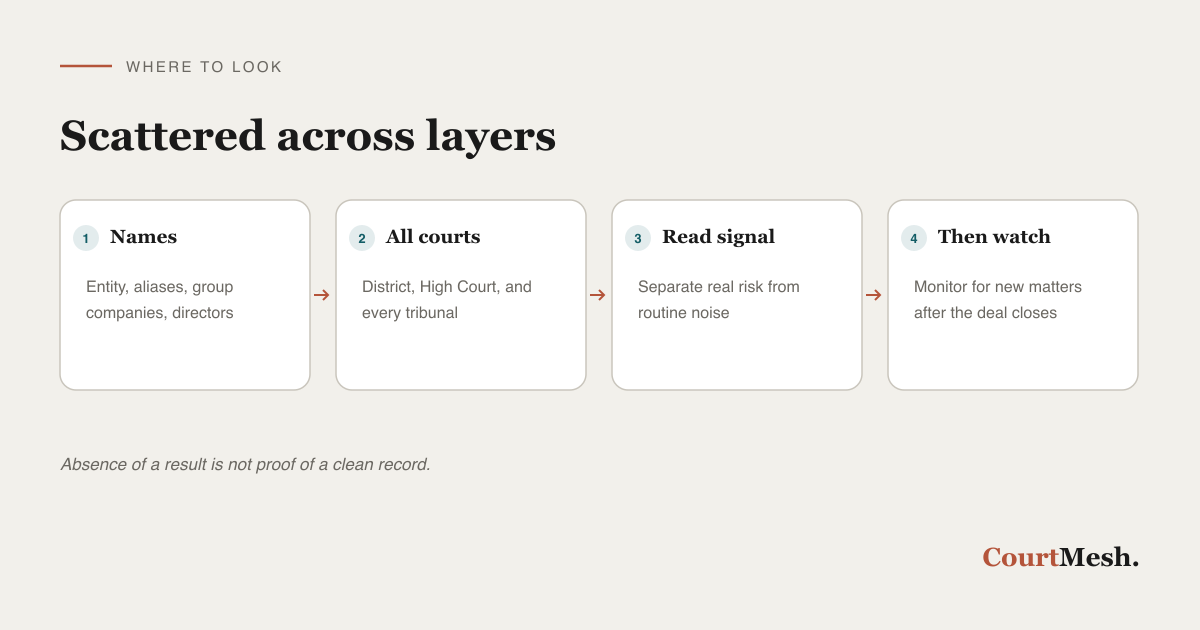
Start with fragmentation. A single company's exposure can sit in the High Court of the state where it is based, in the District Courts of every place it does business, before the NCLT if it is under insolvency stress, before a DRT if a secured lender has moved against it, before the ITAT for a direct tax dispute and CESTAT for an indirect tax one, and before SAT or TDSAT if it operates in a regulated sector. Each of those forums publishes on its own portal, with its own search form, its own case numbering, and its own idea of what a party name looks like. There is no single official window that answers the question you actually have, which is simply: what is this party involved in, everywhere?
Then there is the name problem, which quietly defeats more searches than fragmentation does. The same company appears as Acme Traders Pvt Ltd in one cause list, Acme Traders Private Limited in another, and plain Acme Traders in a third. Transliteration multiplies the variants further, because a name carried from another script into English can be spelled several defensible ways, and different data entry operators at different establishments will have chosen differently. Search one spelling and you retrieve one slice. The matters filed under the other spellings sit there, real and unretrieved, and the search box tells you nothing is wrong, because from its point of view nothing is.
Corporate groups make this harder again. A serious counterparty rarely litigates under a single tidy name. It operates through subsidiaries, associates, special purpose vehicles and promoter held entities, and a problem parked inside one of them will not surface if you only searched the flagship. Directors add a further layer: matters that name individuals personally, whether as promoters, guarantors, or the accused in a Section 138 proceeding, will not appear under the company name at all. A search that stops at the entity on the signature page has, by design, not looked where a good deal of the risk actually lives.
On top of all this sits inconsistent publication. Courts upload late, and they upload unevenly. An order passed today might be online tomorrow, next month, or not at all. Metadata is entered by hand at thousands of establishments, so case types, act tags and party names carry the variability that hand entry always carries. The consequence is unavoidable and worth stating plainly: even a diligent, well constructed search across every portal is working from a record that is itself incomplete and imperfect. That single fact drives everything about how the result should be read, which is the subject of the most important section in this article, further down.
A Workflow That Holds Up
None of the above makes the exercise futile. It makes it a discipline. A counterparty litigation search in India is reliable to the extent that it is done deliberately, with its coverage stated and its limits understood. The sequence below carries most of the weight, whatever tool you use to run it.
Build the full list of names before you search anything
The quality of the whole exercise is set here. Write down the signing entity, then every variant of its name: with and without Private Limited, with and without the common abbreviations, plausible transliterations, and any former name. Then add the corporate group: known subsidiaries, associates, promoter held vehicles. Then add the key individuals: directors, promoters, and anyone standing as a personal guarantor. You are searching a web of related names, not a single string, and the names you fail to list are the matters you will never find.
Search every layer, not just the one you assume matters
The question, what is this party involved in, cannot be answered by the High Courts alone, because most litigation is filed below them. Cover the Supreme Court, the High Courts, the District Courts, and the tribunals that govern your counterparty's sector: the NCLT and NCLAT if solvency is in any doubt, a DRT where there is secured lending, the ITAT and CESTAT for tax exposure, SAT or TDSAT for a regulated business. A search that skips a layer has a blind spot exactly the shape of that layer.
Separate signal from noise, matter by matter
A raw list is not an answer. Apply the dimensions set out earlier, then be ruthless about the difference between a matter that would change your decision and one that is simply the ordinary friction of operating at scale. On a large counterparty the handful that matter will be a small fraction of what comes back, and finding them is the whole exercise.
Write down what you searched, and what you did not
State the coverage inside your own notes or report: the names and variants you ran, the forums you covered, the date of the search, and the plain fact that court publication in India is neither immediate nor complete. This is not defensive paperwork. It is what lets the next reader, including a future version of you, know exactly what the search does and does not establish.
Turn the one-time search into a standing watch
The riskiest matters are often the ones filed just after you finished checking. Because publication runs late and disputes arise continuously, a search is a snapshot with a short shelf life. On any relationship that stays live, credit extended, a vendor onboarded, an investment held, set up monitoring so that a new matter against the counterparty surfaces when it appears in the source registries, rather than when it has already become a problem you have to explain.
The Caveat That Matters Most
Everything above is worth doing. None of it is worth trusting blindly, and the single most dangerous mistake in this entire exercise is to read silence as safety.
A nil result is not a clean chit
If you search a counterparty and find nothing, you have learned exactly one thing: that nothing was found. You have not learned that nothing exists. The matters may be filed under a spelling or a transliteration you did not try. They may sit under a subsidiary or a director's name you did not think to search. They may not have been uploaded by the court yet, or at all. They may be in a forum outside the corpus you queried. Every one of those is a false negative that looks identical to a genuinely clean record, and you cannot tell them apart from the search alone. Treating a clear screen as a clean bill of health is a serious professional mistake. A litigation search of this kind informs due diligence. It does not replace formal due diligence, a search report from qualified professionals, or legal advice, and it should never be presented to a decision maker as though it did. Where the answer matters, verify against the official record of the relevant court, which prevails over anything a search tool shows you. A nil result is a reason to look harder, not a reason to stop.
A Word on Searching Individuals
One part of this deserves care rather than enthusiasm. A good deal of the value in a counterparty search comes from looking past the company to the people behind it: its directors, promoters and guarantors. That is legitimate, and often necessary. It also means processing personal data about identifiable individuals, and in India that now engages the Digital Personal Data Protection Act 2023.
Search individuals for a reason, and only that reason
The DPDP Act 2023 is built around purpose limitation: personal data should be processed for a specific, lawful purpose, and not quietly repurposed. Screening a director in the context of a genuine transaction or credit decision is a defensible purpose. Compiling a standing dossier on individuals for no particular reason, or reusing what you gathered for one deal in an unrelated one, is not the same thing. Keep the search tied to the decision that justifies it, hold what you find no longer than you need it, and treat it with the confidentiality it deserves. This is a brief flag rather than advice on your specific DPDP obligations, which turn on your own facts.
From a Dozen Searches to One
This is the problem CourtMesh was built to reduce, and it is worth being precise about the word reduce. The fragmentation described above is real, and no tool can wish it away. What a single window can do is collapse the mechanical part of the exercise, the twelve portals and the twelve search grammars, into one query, so that your effort goes into reading the result rather than assembling it.
CourtMesh lets you search any party by name across the Supreme Court, all 25 High Courts, the District Courts and the tribunals, over a corpus of roughly 310 million cases drawn only from official government portals. Filters for court, case type, year, judge, the acts and sections cited, disposition and case status let you move from a raw list towards the matters that actually bear on your decision. The name problem does not disappear, but running the variants becomes a task of minutes rather than an afternoon of switching between forms.
For the part of the workflow that outlasts the deal, there is the watchlist. You can monitor a counterparty by name and be alerted when a new matter surfaces against it in the source registries, which turns the one-time search into the standing watch that live exposure demands. It is private and scoped to your organisation: only your own team sees whom you are monitoring, which matters more than it first appears when the party you are watching is an active diligence target whose attention you would rather not attract.
Two things this is not, said plainly. It is not a claim that coverage is exhaustive; no honest system can promise that every matter from every court is present, for the upstream reasons this article has laboured. And it is not a substitute for a formal due diligence report or a legal opinion. It is a far better instrument than a dozen browser tabs for finding out what a counterparty is involved in, and for keeping that answer current. It remains an input to a professional judgement, not the judgement itself.
Read the record before you rely on the relationship
A balance sheet tells you what a counterparty wants you to see. Its litigation history tells you how it has actually behaved, and that is the signal you cannot get any other way before you sign, lend, onboard or invest. CourtMesh brings that record into one search across the Supreme Court, all 25 High Courts, the District Courts and the tribunals, drawn only from official government portals, with a private watchlist that keeps the answer current after the deal closes. It will never tell you a counterparty is clean, because no honest search can. It will let you ask the question once, across every layer, and see where the answer came from, so your due diligence rests on what the record actually shows rather than on the first slice of it you happened to retrieve.
Explore CourtMesh