Ask an Indian legal database for a Supreme Court judgment and you will have it in seconds: the full text, a citation, a headnote, and a list of the decisions that have since followed or distinguished it. Ask the same database what happened last week in a Section 138 matter before a magistrate at Thane, or whether a corporate debtor has an application admitted and pending before a particular bench of the NCLT, and you are suddenly doing a different kind of work. Opening portals one at a time. Guessing at spellings of a party name. Reading a cause list by eye.
This is not a small inconvenience at the edge of legal research. It is the central shape of the problem. The Indian legal information industry has built superb coverage of the courts that produce citable precedent, and thin, uneven coverage of the forums where most advocates actually spend their working lives. The data is best exactly where litigation is rarest, and worst exactly where it is thickest.
This article is about why that inversion exists, what it costs, and what can and cannot be done about it, including by us.
A note on the title
The "90%" in the headline is a figure of speech, not a measurement. We have not counted it, and we are not going to quote a number we cannot stand behind. That reticence is itself part of the story: precise, current, nationwide figures on what is filed and pending below the High Courts are genuinely hard to come by, which is a symptom of the same problem this article describes. Treat the number as rhetoric. Treat the argument as structural.
Where the Litigation Actually Is
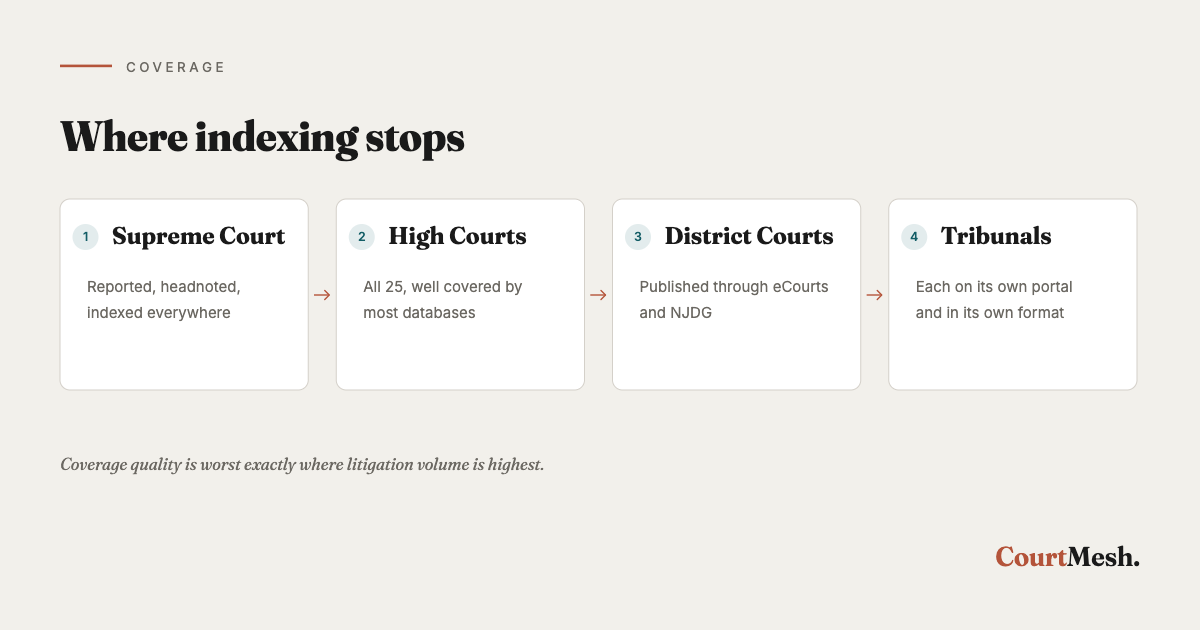
Indian adjudication is usually drawn as a pyramid. At the apex sits the Supreme Court. Below it, twenty-five High Courts. Below them, the district judiciary: District and Sessions Courts, civil judges, magistrates, spread across the district and taluka establishments of every State. Running alongside this hierarchy rather than beneath it is a second structure entirely: the specialised tribunals. NCLT and NCLAT for insolvency and company matters. ITAT for direct tax. CESTAT for indirect tax and customs. SAT for securities. TDSAT for telecom and broadcasting. DRT for debt recovery.
Volume follows the same shape: narrow at the top, enormously wide at the base. A cheque bouncing prosecution under Section 138 of the Negotiable Instruments Act. A suit for recovery. A bail application. A rent matter. A partition dispute. These are the ordinary substance of Indian litigation, and they are filed, contested and disposed of at the district level. Most will never be appealed. Almost none will ever be reported.
Data quality runs the other way, widest at the apex and thinnest at the base. That inversion is not an oversight. It is the predictable result of how legal information came to be produced and sold in this country, and the mechanism is worth understanding, because it tells you which parts of the problem are fixable and which are not.
Why the Gap Exists: Precedent Has a Market, the Trial Court Record Does Not
Legal publishing in India, as everywhere, grew up around precedent. A law report is a curated product: somebody decides which judgments are worth reporting, an editor writes a headnote, the text is checked against the official record, and the decision is given a citation that becomes the coin in which arguments are paid. That work is expensive and worth doing, because the output sells. An advocate will pay for a well indexed body of citable authority, since citable authority is what persuades a bench.
Every incentive in that model points upward. The Supreme Court and the High Courts produce reasoned judgments that bind or persuade other courts, and so carry commercial value for decades. Coverage of them is excellent, and the official surfaces reinforce it: the Supreme Court alone publishes through several of its own portals, while High Court judgments and orders come through the eCourts judgment search as well as each court's own website.
Apply the same model to the district judiciary and it collapses. Trial court output is enormous in volume and, in the classical sense, thin in precedential value. A magistrate's order in one Section 138 matter does not bind a magistrate down the corridor. There is no market for a headnoted, curated collection of it. The economics of law reporting therefore stop, quite rationally, at exactly the level where citation stops.
Reported precedent is a product
Headnotes, citations and editorial curation cost real money. Publishers invest where the output can be sold, which means where the output is citable. That is the apex courts, and always has been.
District court output is voluminous and local
The district judiciary produces orders at a scale no editorial process could curate, and almost none of it is citable authority. There was never a commercial reason to index it well, so nobody did.
Tribunal orders sit in a grey zone
They are frequently reasoned, often highly specialised, and they decide real commercial outcomes. But each tribunal publishes on its own terms, and the material never fitted the law report model.
The result is an inverse relationship that nobody designed and everybody lives with: the further a matter sits from the Supreme Court, the more likely it is to be the kind of matter an advocate is actually handling this week, and the harder it is to find.
An advocate cites the reported law and litigates the unreported record. Only one of those two has ever been properly indexed.
It is worth being fair to the system here, because the picture has changed. The eCourts programme genuinely altered the position: before it, district court information was not merely badly indexed, it was substantially unavailable to anyone not physically present at the court. NJDG made case status visible at national scale for the first time. What follows is a criticism of what remains, not a denial of what has been built.
One Country, Many Portals
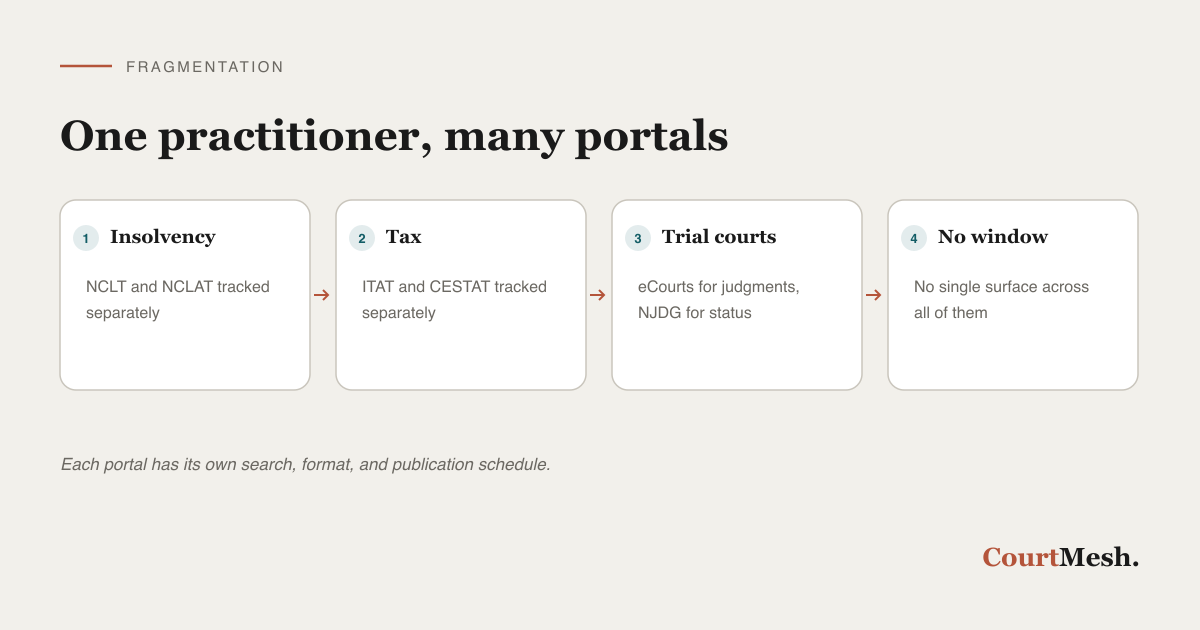
The second problem is structural rather than commercial, and it is arguably the worse of the two, because it degrades even the data that has been published. There is no single official surface for Indian case data. There are many. District court data lives principally in the eCourts ecosystem: judgments and orders, where uploaded, are searchable through judgments.ecourts.gov.in, while case status, listing and next dates flow through the National Judicial Data Grid at njdg.ecourts.gov.in. That is already two surfaces for what a practitioner thinks of as one question, namely what is happening in my matter.
The tribunals are harder still, because each one is its own island. The NCLT publishes at nclt.gov.in, bench by bench. The NCLAT publishes at nclat.gov.in. The ITAT publishes at itat.gov.in, again bench by bench. CESTAT, SAT, TDSAT and the DRTs each run their own portal, with their own search form, their own case numbering conventions, their own idea of what a party name looks like, and their own upload rhythm. None was built to talk to any of the others, because none was ever asked to.
| Court layer | Where the official record lives | What it publishes | Practical difficulty |
|---|---|---|---|
| Supreme Court | main.sci.gov.in, scr.sci.gov.in, verdictfinder.sci.gov.in, eSCR | Judgments and orders, with reportable decisions carried into eSCR with headnotes and citations | Low. Several official surfaces, well structured, mirrored by every publisher. |
| High Courts (all 25) | judgments.ecourts.gov.in, plus each High Court's own site | Judgments and orders; the reportable subset flows into the law reports | Low to moderate. Format, metadata and upload practice vary from court to court. |
| District Courts | judgments.ecourts.gov.in for text, njdg.ecourts.gov.in for status | Orders and judgments where uploaded, cause lists, case status, next dates and disposals | High. Publication is uneven, metadata is thin and hand entered, and almost nothing is citable, so nobody curated it. |
| NCLT | nclt.gov.in | Bench-wise orders under IBC 2016 and the Companies Act 2013 | High. Bench-by-bench publication, its own numbering, no shared index with the forum above it. |
| NCLAT | nclat.gov.in | Appellate orders in insolvency and company matters | Moderate. Reasonably consolidated, but a separate system from the NCLT it hears appeals from. |
| ITAT | itat.gov.in | Bench-wise orders in direct tax appeals | Moderate to high. Large volume, bench-wise organisation, inconsistent tagging of the provisions in issue. |
| CESTAT, SAT, TDSAT, DRT | Each tribunal's own official portal | Indirect tax and customs, securities, telecom and broadcasting, and debt recovery orders respectively | High. Every portal is its own island, with its own search grammar and its own silent failure modes. |
Read that table as a practitioner rather than an engineer and the cost is obvious. An insolvency practitioner working a single corporate debtor tracks the NCLT for admission and the resolution process, the NCLAT for the appeal, possibly a DRT for a secured creditor's parallel proceeding, and the relevant High Court for a writ. Four forums, four portals, four search grammars. A tax practitioner tracks the ITAT for the direct tax appeal and CESTAT for the indirect tax matter on entirely separate systems, then follows the appeal upward to a High Court on a third. Nobody has one window. Everyone has a dozen browser tabs and a spreadsheet somebody updates by hand on Monday mornings.
This is why a district court case search in India is not really a single search at all. It is a sequence of searches, each in a different box, each with different rules, and the practitioner is the integration layer. The same fragmentation defeats the most basic research question there is: has this party been in litigation before? Answering it properly means asking that question, correctly, in a dozen search boxes, each with its own tolerance for spelling, initials and suffixes like Pvt Ltd against Private Limited, and each with its own quiet way of returning nothing when you get it slightly wrong.
Tribunals Are Where Whole Domains of Commercial Law Actually Get Decided
There is a lingering assumption, inherited from the law report model, that tribunal output is somehow second class: administrative, fact bound, not really jurisprudence. For entire domains of Indian commercial practice, that assumption is simply wrong.
Consider insolvency. The Insolvency and Bankruptcy Code 2016 vested the working machinery of corporate insolvency in the NCLT, with appeals to the NCLAT. Whether an application is admitted, how a resolution plan is treated, how a moratorium operates, how the Code interacts with the Companies Act 2013: for an advocate advising a creditor or a corporate debtor, the operative body of learning on these questions is a body of NCLT and NCLAT orders. Supreme Court authority sits above it and settles the large questions. It does not tell you what a particular bench did last month on facts that look exactly like yours.
Consider direct tax. The ITAT is, in practice, the final fact finding authority in the direct tax appellate chain, with appeals beyond it confined to questions of law. An enormous quantity of the reasoning that determines how the statute applies to real assessees is therefore ITAT reasoning, bench by bench. The same pattern holds for CESTAT in indirect tax and customs, for SAT in securities, for TDSAT in telecom and broadcasting, and for the DRTs in recovery. In each of these domains the tribunal is not a waystation on the road to the real law. For most matters, it is where the matter ends.
The working law and the reported law are not the same body of material
For an insolvency, tax, securities or telecom practitioner, tribunal orders are the working law. They may not be precedent in the classical, citable, headnoted sense, and a bench is not bound by them the way it is bound by a Supreme Court judgment. But they are what tells you how this forum, on these facts, has in fact been deciding. Ignoring them because they are not reported is a research failure dressed up as rigour.
This is also why the claim that a platform covers the Supreme Court and the High Courts thoroughly is weaker than it sounds. It is a claim about the appellate residue of Indian litigation. It says nothing about where the litigation started, and for whole practice areas nothing about where it ended either.
What the Gap Costs in Practice
The consequences are not abstract. They surface as concrete professional risk, most often in three places.
Due diligence that only sees the appellate layer
A litigation search run for a transaction, an investment or a lending decision is meant to answer a simple question: what is this counterparty involved in? If it draws on sources that are strong at the Supreme Court and the High Courts and weak below, it will systematically return the wrong picture. It will miss the recovery suits, the Section 138 prosecutions, the trial court injunctions, the tribunal proceedings that have not yet reached an appellate forum. The report will look clean. The company may not be.
Counterparty checks that miss the base of the pyramid
The same distortion affects conflict checks and background checks. A party with an unblemished appellate record may be carrying a substantial volume of matters at the district level or before a tribunal. A search that never looked there has not found nothing. It has not looked.
Tracking done by hand
Case status tracking is the daily tax on all of this. Next dates, listings, transfers between benches, disposals: across a portfolio of any size, keeping this current over eCourts, NJDG and several tribunal portals is somebody's job, done manually, with the reliability that manual work has. Limitation under the Limitation Act 1963 does not care that an order was uploaded quietly on a Saturday and nobody refreshed the tab.
The Honest Part: Why This Data Is Genuinely Hard
It would be convenient, for anyone who sells legal data for a living, to present all of this as a failure of will: that the incumbents could not be bothered, and that a sufficiently determined aggregator makes the problem disappear. That is not true, and pretending otherwise would set an expectation nobody can meet. Coverage of District Courts and tribunals is harder than coverage of the apex courts for reasons that sit upstream of any aggregator, in the publishing behaviour of the forums themselves.
- Publication is late. An order pronounced today may be uploaded tomorrow, next week, or considerably later. The lag varies by court, by bench and by season.
- Publication is incomplete. Not every order that is passed is uploaded. Interim orders in particular are inconsistently published, and practice varies widely between establishments.
- Metadata is inconsistent. Party names, case types, act and section tags, judge names and disposition fields are entered by hand at thousands of establishments. The same company appears as five different parties. The same statute is tagged three different ways.
- Formats vary. Some orders are searchable text. Some are scanned images of varying quality. Some are digitally signed PDFs with their own quirks. Extraction quality follows the input.
- Conventions differ by forum. Case numbering, bench identifiers and status vocabulary are not standard across the district judiciary or across the tribunals. Normalising them is real work, and normalisation is never perfect.
- Sources are sometimes simply wrong. Typographical errors, misfiled orders and status fields that were never updated exist in the official record itself, and any faithful mirror of that record inherits them.
An aggregator can make this materially better. It can pull from every official surface rather than one, normalise what is normalisable, reconcile the same matter across portals, and put the result behind a single search. It cannot manufacture an order that was never uploaded, and it cannot correct a record it has no independent means of knowing is wrong.
Absence of a matter is not evidence that the matter does not exist
This is the single most important paragraph in this article. If you search any aggregator, including CourtMesh, and find nothing against a party, you have learned that nothing was found. You have not learned that nothing exists. The matter may not have been uploaded by the court. It may be tagged under a spelling you did not search. It may sit in a forum outside the corpus you queried. Anyone who treats a nil result as a negative finding in due diligence, and writes it into a report as a clean chit, is making a serious professional mistake. A nil result is a prompt to look harder, not a conclusion. Where the answer matters, verify against the official record of the issuing court, which always prevails over anything shown on CourtMesh or on any other platform.
How to Work With Imperfect Coverage
None of this makes the data useless. It makes it evidence rather than proof, and evidence has to be handled accordingly. A few working habits carry most of the weight, whatever tooling you use.
Search the party, not just the case number
Case numbers are precise but brittle, and in diligence you usually do not have one. Party name searching is how you find matters you did not already know about, which is the entire point. Run every plausible variant: with and without Private Limited, with and without initials, common transliterations, former names.
Search every layer, not just the one you think matters
If the question is what a counterparty is involved in, the High Courts alone cannot answer it. Cover the district judiciary and the tribunals that govern that counterparty's sector: NCLT if it is a company under stress, ITAT and CESTAT if the exposure is tax, DRT if there is secured lending, SAT if it is a market participant.
Record what you searched, and what you did not
State the coverage in the report itself: forums queried, name variants used, date of search, and the plain fact that publication by the courts is neither immediate nor complete. This protects the client, who then knows what the search establishes, and it protects you.
Treat status data as indicative and verify what is dispositive
A next date pulled from NJDG is good enough to plan around. It is not good enough to stake a limitation computation on. Anything that decides a right gets verified against the issuing court's own record, every time.
Re-run searches instead of trusting a snapshot
Because publication runs late, a search today may return matters that did not appear last month, including matters already pending when you last looked. On a live exposure, the search is a subscription, not an event.
These habits are the difference between a search that can support a professional opinion and a search that merely decorates one.
What a Single Window Actually Changes
Everything above is the reason CourtMesh was built the way it was. It holds roughly 310 million cases spanning all four layers: the Supreme Court, all 25 High Courts, the district judiciary and tribunals including NCLT, NCLAT, ITAT, CESTAT, SAT, TDSAT and DRT. The sources are the official portals in the table above and nothing else, with no third-party intermediaries: the Supreme Court's own surfaces and eSCR, judgments.ecourts.gov.in for High Court and District Court judgments and orders, njdg.ecourts.gov.in for case status, and each tribunal's own site.
What that buys is one search across the layers instead of a dozen. Filters for court, case type, year, judge and date range apply across the corpus rather than being re-learned in each portal's grammar. Case status tracking, including next hearing dates and disposals, is sourced from eCourts and NJDG as those systems publish it, and follows the matter instead of waiting for somebody to remember to check. The party name question, the one fragmentation makes so expensive, becomes a single query.
Two things it does not mean, stated plainly:
Not every case is AI analysed
Only a subset of the corpus carries full AI-derived analysis. The corpus is very large; the analysed portion is not the same thing as the whole, and we will not pretend it is. Anyone who tells you 310 million cases have each been read and reasoned about is selling you something.
Coverage is not represented as complete
CourtMesh does not claim to hold every matter from every court. It cannot, for the upstream reasons set out above. A single window over official sources is a better instrument than a dozen browser tabs, and it is still an instrument rather than an oracle.
The honest summary is this. The district and tribunal layers are hard, for structural reasons no vendor can wish away: an economics of legal publishing that never had a reason to look down the pyramid, and a set of official portals never designed to be read together. The correct response is not to pretend otherwise. It is to pull from every official source available, be explicit about what is and is not covered, and leave the last word with the court that issued the order.
Search where the litigation actually is
Most legal research tools are excellent at the layer of Indian litigation that produces citable precedent, and vague about everything underneath it. CourtMesh was built the other way round: one unified search across the Supreme Court, all 25 High Courts, the district judiciary and tribunals, drawn only from official government portals, with case status tracking sourced from eCourts and NJDG. It will never tell you that a matter does not exist, because no honest system can. It will let you ask the question once instead of a dozen times, and show you where the answer came from so you can verify it against the issuing court's record.
Explore CourtMesh