There is a particular pair of phone calls every recovery advocate has made. The first is the good one: the judgment has come, the suit has succeeded, the client is delighted. The second, some months later, is the one you dread, where you explain that nothing has actually arrived, the judgment-debtor has not paid, and the matter is now in execution. To the client these two calls do not fit together. They were told they had won, and winning, in their understanding, meant getting paid.
The gap between those calls is the subject of this piece. A decree declares what one party owes another and carries the authority of the court behind it. What it does not do is move a single rupee on its own. Between the decree and the recovery sits a separate proceeding with its own filing, its own numbering, its own next dates, and its own capacity to run for years and end in nothing. Practitioners know this. Clients almost never do, and that mismatch is where relationships are quietly damaged.
The client measures success in recovery, not in a favourable order. An advocate who did everything right in the suit can still end up with an unhappy client, because the thing the client was actually buying never arrived. Execution is where that happens, and it is also the stage that gets the least attention, the least seniority and the least tracking of any part of the matter.
Why a Decree Is Not Self-Executing
The first thing to be clear about is a structural feature of civil procedure in India, and it surprises clients every time. Under the Code of Civil Procedure 1908, a decree does not enforce itself. Nobody at the court reads it, looks up the judgment-debtor and arranges for payment. The court has decided the dispute; it has not undertaken to collect. The decree-holder must come back and ask for enforcement, and must keep asking until something is realised.
This is not an oversight in the design. A civil court adjudicates rights between parties and puts the machinery of enforcement at the disposal of whoever wishes to use it. But the practical consequence is significant: the burden of converting a decree into money sits entirely on the decree-holder, and in reality on the decree-holder's advocate. If nobody applies, nothing happens.
What execution actually is
Execution is the proceeding in which the decree-holder asks the court to give effect to the decree against the judgment-debtor. It begins with an application, commonly called an execution petition, and once registered it behaves like a matter in its own right. It gets a number. It gets listed. It gets adjourned. It can be contested, and frequently is. It is also subject to its own limitation, computed on the facts, so a decree-holder who waits too long can find the door closed on enforcement while the decree itself remains untouched.
The Code contemplates several routes by which a money decree may be enforced: attachment and sale of the judgment-debtor's property, movable or immovable; attachment of debts owed to the judgment-debtor by a third party, which is the garnishee route and reaches things like bank balances and receivables; and other modes provided for particular circumstances. Which route is available and appropriate is a legal and factual judgement turning on the decree, the debtor, and what can actually be reached.
- The decree is a determination of rights, not a transfer of money
- Enforcement begins only when the decree-holder applies for it
- The execution proceeding is separate from the suit and has its own life
- The choice of enforcement route depends on what assets can actually be reached
- Enforcement is not open-ended; it carries its own limitation on the facts
A decree tells you what you are owed. Execution is the entirely separate business of finding out whether there is anything left to take it from.
The distinction clients almost never appreciate
The Shape of an Execution, Stage by Stage
The number of separate steps in an execution is itself part of the problem. Each is an opportunity to stall, and each generates dates somebody has to be watching. What follows is the shape of the process in general terms; the particular steps, forms and timelines in any matter are governed by the Code, by the practice of the court concerned, and by the terms of the decree.
The decree is drawn up and execution is applied for
The decree must be drawn up and a certified copy obtained, then an application filed setting out what remains unsatisfied and the mode of enforcement sought. The first half is pure administration, which is why it sits undone for weeks after a win.
A mode of enforcement is chosen
The decree-holder must specify how the decree is to be enforced: attachment of property, a garnishee route against money owed to the debtor by others, or another mode the Code provides. Choosing well requires knowing something real about the debtor's position.
The judgment-debtor is put on notice
The court process reaches the judgment-debtor, who may show why the decree should not be enforced as sought. Service takes time, and a debtor who is hard to serve is usually a debtor who is hard to recover from.
Attachment or the equivalent step is sought
If property is identified, the decree-holder seeks to have it attached so it cannot be dealt with pending enforcement. The step is only as good as the identification behind it. Attaching property that turns out not to be the debtor's, or to be already encumbered, achieves only delay.
Objections are raised and litigated
The judgment-debtor may object, and so may third parties claiming the attached property is theirs. Objections are not a formality. They are decided by the court and can require evidence, so the execution sprouts a contested proceeding inside itself.
The decree is transferred if the assets sit elsewhere
Where the property lies outside the jurisdiction of the court that passed the decree, the decree may need to be sent to a court that can reach it. That transfer is a step in itself, with its own paperwork, its own delay and a fresh set of dates in a new court.
Realisation, or another round
If everything holds, the property is sold or the debt recovered and the decree is satisfied in whole or in part. If it does not, the decree-holder is back at the mode-of-enforcement question with less time and a more alert judgment-debtor.
Notice what is absent from that list. Almost none of it concerns the merits, which were settled when the decree was passed. Execution is a logistical and factual exercise: what does this person own, where is it, who else has a claim on it, and which court can reach it. An advocate who was brilliant on the law of the suit is not, by that fact alone, equipped for the very different work of enforcement.
Where Execution Actually Stalls
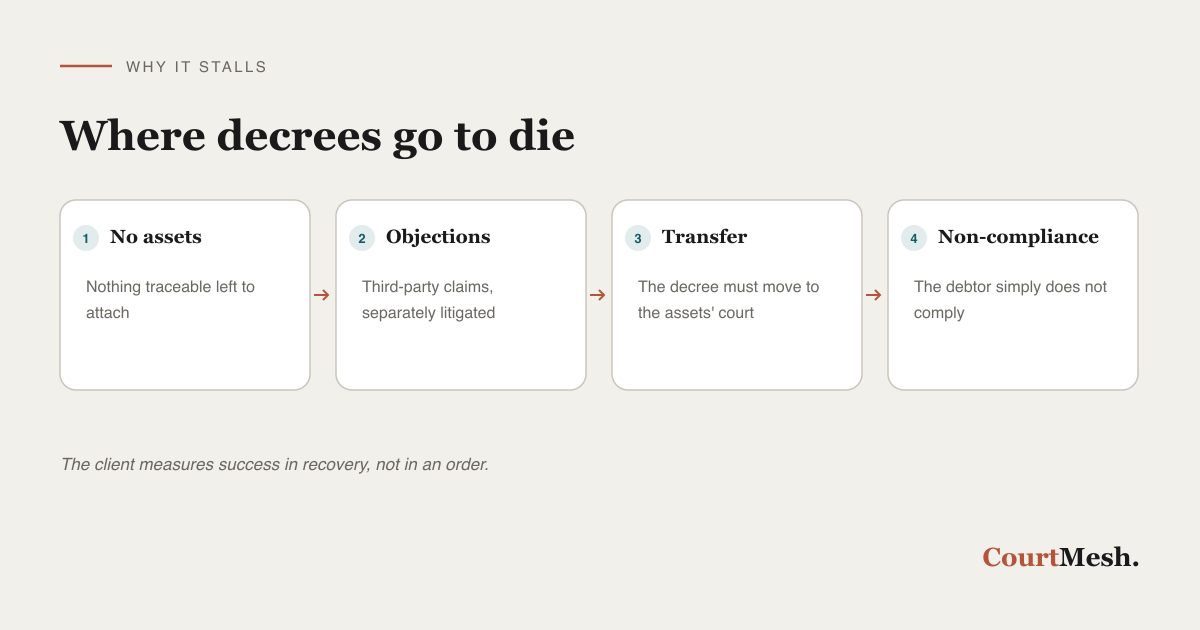
Executions rarely collapse in a single dramatic moment. They stall. A date passes without a step being taken, then another, and the file moves down the pile because livelier matters sit above it. The reasons are worth naming individually, because they are not variations on a single problem.
No attachable assets identified
The most common reason of all. The decree-holder knows the judgment-debtor owes money but cannot point the court at anything specific to attach, and an execution petition with nowhere to go simply waits.
The assets have already moved
A debtor who saw the suit coming has had years of notice. Property gets transferred, businesses restructured, accounts emptied, and by the time the decree arrives the visible estate has thinned considerably.
Objections and third-party claims
Somebody comes forward to say the property attached is not the debtor's at all. Whether the claim is genuine or engineered, it has to be decided, and deciding it takes its own hearings and its own time.
The assets are in another jurisdiction
The court that passed the decree cannot reach property lying elsewhere. Getting the decree before a court that can is an additional step, and the matter effectively restarts in an unfamiliar forum.
Plain non-compliance
Some judgment-debtors simply do not comply and wait to see whether anyone follows through. Each round requires a fresh application, a fresh listing and a fresh order, and the process grinds accordingly.
Competing claims on the same debtor
A debtor in trouble is rarely in trouble with only one creditor. Other decree-holders, secured lenders, statutory dues and insolvency proceedings can all be reaching for the same limited pool.
The asset problem is the real problem
Strip away everything else and most failed executions come down to one thing: nobody knows what the judgment-debtor actually has. The petition is filed, the court asks what is to be attached, and the honest answer is that the decree-holder does not know. What follows is an expensive fishing exercise conducted years after the facts, against a debtor who has had the whole suit to prepare. This is why experienced practitioners treat asset identification as a question for the beginning of a matter. The best time to think about enforcement is before the plaint is filed, not after the decree is passed. What the counterparty owns, what security exists, whether the entity is a shell: these decide whether the suit is worth bringing, and are far easier to explore before litigation puts the other side on guard.
Objections as a strategy, not an accident
Objections in execution are frequently tactical. A judgment-debtor who has lost on the merits still has one asset left, which is time, and objections convert time into leverage. A third-party claim over attached property, whether from a relative, an associate concern or a genuine purchaser, forces a separate determination with hearings and orders of its own, and while it runs nothing is realised. The answer is not indignation but preparation: material supporting the attachment, a clear record of what was attached and when, and the willingness to keep appearing. Objections are beaten by attendance and documentation more often than by argument.
Mapping Each Stall to What It Demands
Naming the stall is only half of it. Each cause carries a different obligation for the decree-holder, and diagnosing it correctly is what determines whether the next step is worth taking at all. None of this substitutes for advice on the particular decree.
| Why the execution stalls | What it demands of the decree-holder |
|---|---|
| No attachable assets identified | Factual investigation into what the judgment-debtor holds, ideally begun long before the decree, and a route chosen on what can be reached. |
| Assets dissipated before or during the suit | Early attention to the debtor's position, so protective steps are considered while there is still something to protect, and a clear-eyed reassessment of what remains. |
| Objections by the judgment-debtor | Persistence and appearance on every date, a documented record of each step, and readiness to meet the objection on evidence rather than waiting for it to lapse. |
| Third-party claims over attached property | Material supporting the basis on which the property was said to be the debtor's, and the resources to run a contested proceeding inside the execution. |
| Assets outside the court's jurisdiction | Handling the transfer as a step in its own right, then tracking the resulting proceeding in the new court as a separate matter with its own dates. |
| Plain non-compliance | Repeated applications and a willingness to keep the matter alive over a long period, which is a resourcing decision as much as a legal one. |
| Insolvency or competing creditors | Knowing early that other proceedings exist, including any before the National Company Law Tribunal under the Insolvency and Bankruptcy Code 2016, and taking advice on what that means. |
The right-hand column has a theme running through it. Almost every entry asks for the same two things: information about the judgment-debtor that should have been gathered earlier, and sustained attention over a long period. Neither is glamorous. Both are what separate a realised decree from a framed one.
Why Execution Gets Neglected
If execution is where recovery actually happens, why is it so consistently the weakest-resourced part of a matter? The reasons are organisational rather than legal. Execution is neglected for structural reasons, not careless ones, which is precisely why it responds to a change of system rather than a resolution to try harder.
It is unglamorous
No argument to win, no bench to persuade, no judgment to circulate afterwards. Execution is logistics, and logistics attracts neither the best juniors nor the senior attention a trial commands.
The energy is spent
By the time the decree comes the team has been on the matter for years. The instinct after a win is to move to the next fight, not to start a new proceeding on the same file.
The economics are awkward
Fee arrangements are often built around the suit, with execution treated as an afterthought. Work nobody has clearly costed tends to become work nobody clearly owns.
It moves slowly and invisibly
Long adjournments mean weeks pass with nothing to report. A matter producing no news slips out of view, and out-of-view matters are the ones that get missed.
It is treated as an appendix
Most offices file the execution behind the old matter rather than opening it as its own file with its own dates and owner, so it inherits the attention a closed matter receives.
Nobody is chasing
The client believes the matter is over and stops asking. With no client applying pressure and no system applying it instead, the file goes quiet, and quiet files are where dates die.
What the Gap Does to the Client Relationship
This part gets underestimated. A client who receives a favourable judgment and no money does not experience a partial success. Over time they experience a failure, and they attribute it to their advocate. The distinction between the suit and the execution, so obvious to a practitioner, is invisible to them. From where they sit, they paid for a result, a judge agreed with them, and nothing changed.
No client has ever framed a decree. They measure the matter by what reached their account, and if nothing did, they will remember the whole exercise as money spent for a piece of paper.
How the win is actually judged
The damage compounds because of how communication usually goes. During the suit there was regular contact: hearings, drafts, dates, conferences. After the decree it thins out, precisely when the client is at their most expectant. Months pass. When they finally ask, the answer is that the execution is pending and the next date is some way off. That answer is entirely accurate and completely unsatisfying.
There is a straightforward professional fix, and it costs nothing but candour. Tell the client what a decree is before they ever hold one. A client told at the outset that recovery is a separate exercise, that it depends on what the other side actually owns, and that a decree is not a guarantee of payment, receives the same news later as a known risk rather than a broken promise.
The second fix is visibility. A client who is told the next date without having to ask stays with you through a slow execution. One who has to chase concludes, not unreasonably, that nobody is working on it. The perception of neglect does more damage than the delay. The concrete failures worth guarding against are these, and every one is operational rather than legal:
What this article is not
This describes why executions stall. It is not advice on how to execute any particular decree. No article and no software can tell you which enforcement route to pursue, what to attach, or whether a decree is worth executing at all. Asset tracing is a factual exercise requiring proper investigation, and the choice of route is a legal judgement on the terms of your decree, the conduct of the judgment-debtor and the applicable law. CourtMesh does not trace assets, does not value recovery prospects, and guarantees no outcome. What a case-tracking tool can do is help you see the proceedings that exist on the public record and the dates attached to them. The court record and the orders of the executing court always govern, and responsibility for every step remains with the advocate on record.
What Running an Execution Properly Requires
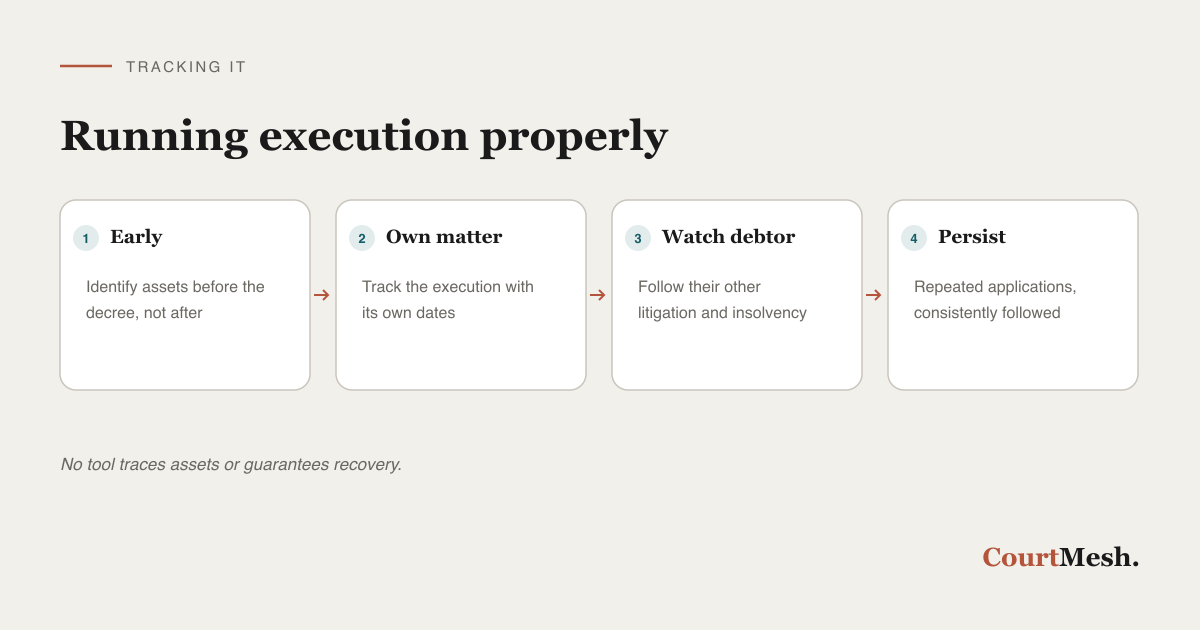
None of these problems are solved by a better argument. They are solved by treating enforcement as real work, begun early and sustained. In practice that comes down to a handful of habits, none complicated, all easy to skip.
Ask the recovery question before you file
Form a view on whether the counterparty has anything worth pursuing and where it sits. A decree against an entity with nothing behind it costs years and yields paper. That assessment belongs at the start, when the client is deciding whether to litigate at all.
Tell the client what a decree is and is not
Set the expectation in writing that a favourable judgment is a milestone and enforcement a separate exercise with its own timeline and uncertainty. This one conversation prevents most of the relationship damage that comes later.
Open the execution as its own matter
Do not file it behind the closed suit. Give it a file, an owner and a place in your list of live matters, so it is reviewed with everything else rather than remembered occasionally.
Track its dates like any other hearing
The execution generates next dates exactly as the suit did, and they deserve the same diarising and the same attendance. Most stalled executions are just a series of dates nobody was watching.
Watch what else the judgment-debtor is doing
New suits, recovery proceedings brought by others and insolvency applications all say something about the debtor's position and how much competition your decree faces. Knowing late is far worse than knowing early.
Follow through on non-compliance
When the judgment-debtor does nothing, the answer is another application, then another. Executions are often won by the side still turning up after two years. Persistence here is not a virtue, it is the method.
Report to the client on a rhythm
Send an update on a fixed cadence, even when the update is that the matter is listed and nothing has moved. Clients read silence as abandonment, not as slowness.
Treating the transferred decree as a new matter
One habit deserves separate emphasis, because this is where files are lost most often. When a decree is sent to another court for enforcement against assets there, the proceeding effectively begins again somewhere unfamiliar: a new number, a new bench, a new set of dates and often new local counsel. If the office still thinks of it as part of the original suit, it gets the diligence given to a closed file, which is to say none. Open it and monitor it as its own live matter from the day it moves.
Where CourtMesh Fits
Nothing above requires software, and plenty of practices run enforcement well on discipline alone. But two specific parts of the job are made easier by being able to see the public record properly, and those are the parts CourtMesh is built for.
The first is treating the execution as a live matter. An execution proceeding is itself a case on the record, and CourtMesh tracks case status, next-hearing dates and disposals sourced from eCourts and NJDG across the Supreme Court, all 25 High Courts, District Courts and Tribunals. In My Cases it sits alongside your other live matters with its own deadlines rather than behind a suit everyone considers finished. A transferred decree can be tracked in the receiving court in the same way, so far as that court's record is published, which is exactly where files tend to disappear.
The second is seeing the judgment-debtor's wider litigation picture. Searching a party across roughly 310 million cases drawn from official portals can surface the other proceedings a judgment-debtor is involved in, including insolvency proceedings before the National Company Law Tribunal. That is not asset tracing and should not be mistaken for it. It is a view of the public record, and often the earliest signal that the position has changed. Watchlist alerts carry the idea forward, flagging new filings involving a party you are monitoring as and when those filings appear on the record, so that news reaches you rather than waiting to be discovered. What an alert can tell you is bounded by what the source has published, which is never instantaneous and is not always complete.
Visibility, not recovery
Be precise about the claim being made. What CourtMesh offers is visibility, not recovery: the execution tracked as a live matter with its own next dates, and the judgment-debtor's other proceedings on the public record made searchable. The legal judgements, the factual investigation and the persistence remain entirely yours.
The honest version of this argument is more useful than the inflated one. Execution is difficult for reasons no software addresses: debtors hide assets, objections buy time, courts are slow, and some decrees were never worth much because the money had already gone. What a system removes is narrower but real, the avoidable failure of a decree going unexecuted because the file stopped being visible after the win. The law of execution is not the hard part. Sustained attention over a long and unrewarding stretch is, and attention is the one thing that can be systematised.
Track the execution, not just the win
A decree only becomes a result when somebody keeps working on it. CourtMesh tracks case status, next-hearing dates and disposals from eCourts and NJDG across the Supreme Court, all 25 High Courts, District Courts and Tribunals, so an execution can be followed as a live matter with its own dates rather than filed behind a closed suit. Search a party across roughly 310 million cases from official portals to see the other litigation a judgment-debtor is caught up in, including proceedings before the NCLT, and set a Watchlist alert so new filings involving them come to you as they appear on the record. The judgment was the milestone. Recovery is the mandate.
Explore CourtMesh