Most of what a court decides never reaches a law reporter. A judgment is pronounced, signed, and filed into the record, and there it stays: correct, binding on the parties, sometimes squarely on the very question you are researching, and yet invisible to anyone who searches only the reported case law. The reported decisions are a curated slice. The unreported ones are the rest of the field.
When we picture legal research in India, we picture reporters, digests, and citations. That vocabulary carries a quiet assumption inside it: that the judgments worth finding have already been chosen for us, summarised, and given a reference. For a large part of what the courts actually decide, none of that ever happens. This piece is about that larger and quieter body of decisions. What it means for a judgment to go unreported. Why the authority you need is so often sitting inside it. Why it is so hard to find. And how to locate an unreported judgment, obtain a copy a court will accept, and confirm it still stands.
What It Actually Means for a Judgment to Be Reported
Start with the word itself. A judgment is reported when a law reporter selects it, prepares a headnote for it, and publishes it with a citation. Each of those three steps is a decision made by an editor, not something that happens automatically to every decision a court hands down.
A reporter is an editor, not an archive
A law reporter is a publication with an editorial board behind it, reading incoming judgments and deciding which ones deserve to be printed. Everything that follows from that decision, the headnote, the catchwords, the citation that lets anyone pull the same decision from the same shelf every time, is editorial work rather than anything the court itself does.
Selection
An editorial board decides the decision is worth carrying, usually because it settles a question, interprets a provision, or resolves conflicting views.
Headnote and catchwords
An editor summarises the facts, the issue, and the principle, and tags the decision so it can be found under a topic in a digest.
Citation
The decision is given a fixed reference so it can be cited, cross-referenced, and pulled from the same place by anyone who follows it.
There is a second layer built on top of all this. Once a decision has a citation, other judgments can point to it, and digests can gather it with related decisions under a common heading. A reported case therefore arrives pre-connected: it comes with a summary, a place in a topic, and a web of cross-references leading in and out of it. That connectedness is what makes reported research feel effortless, and it is exactly what an unreported decision is missing. None of it changes what the court decided. The reporter does not make the judgment. It makes the judgment findable, and it does so only for the decisions an editor has judged worth the effort.
Why Reporting Is Selective by Design
Reporting has to be selective, and it is worth being honest about why. Three forces pull in the same direction.
Editorial judgement
Reporters aim to carry decisions that develop the law. A judgment that simply applies a settled principle to its own facts, however carefully, usually does not earn a place, because it adds nothing a reader could not already find.
Commercial reality
Reporters are businesses. They compete on speed, on the quality of their headnotes, and on how well their digests connect one case to another. Space, editorial time, and reader attention are finite, so they are spent on the decisions most likely to be cited.
The cost of headnoting
Preparing a good headnote is skilled, slow work. Reading a judgment closely, extracting the principle, and classifying it correctly takes real effort, and that effort can only be spent on a limited number of decisions.
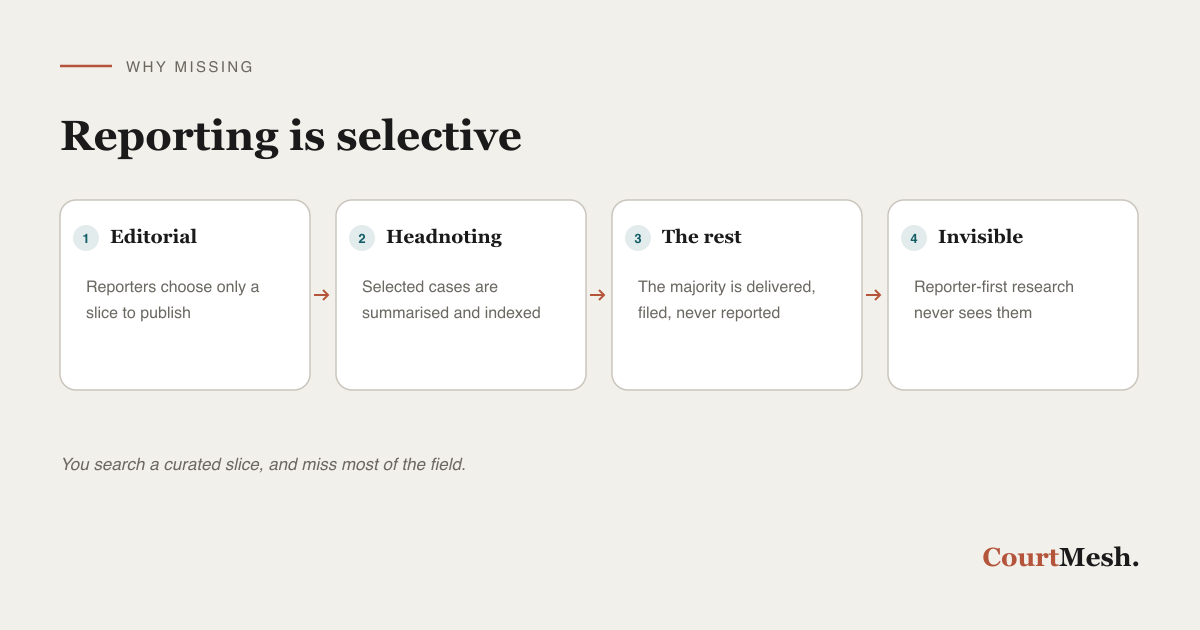
Put together, these forces mean that only a small fraction of everything the courts decide is ever reported. That is not a flaw in the reporters. Selectivity is the entire point of a reporter. A publication that printed everything would be an archive, not a reporter, and it would be useless for finding the decisions that matter. But selection has a consequence, and that consequence is the whole subject of this article.
The Invisible Majority
If only a small fraction of decisions are reported, then the overwhelming majority are unreported. An unreported judgment is not a lesser judgment. It was delivered by a court, it is part of the record, and it decided the matter in front of it. The only thing it lacks is a reporter's attention: no editor selected it, no headnote was written for it, no citation was assigned to it.
Here is the trap. Traditional legal research starts from the reported side. You open a digest, look up a topic, and follow the catchwords to reported cases. You search a reporter's index. You follow a citation from one judgment to another. Every one of those paths runs entirely inside the reported slice. A decision that was never reported has no digest entry to list it, no headnote to match your topic, and no citation to follow. It is not that the research is done badly. It is that the method can only ever surface what was selected in the first place.
A judgment does not become law because a reporter printed it. It was already the law the moment the court pronounced it. Reporting decides what you can find, not what is binding.
Picture a bench applying a familiar provision to an unusual set of facts, and doing it in a way that is almost identical to the matter on your desk. If that decision was reported, an editor will have written a headnote, tagged it with catchwords, and placed it in a digest under a topic you would think to check. If it was not, none of that exists. The reasoning you need is on the record, complete and available, and yet no index in the traditional toolkit will ever point you to it. You could research the topic thoroughly, correctly, for hours, and never come near the one decision that is closest to your facts.
An Unreported Judgment Can Still Decide Your Point
The reason all of this matters in practice is simple: an unreported decision can be used. In India, an unreported judgment can still be cited before a court. Its authority comes from the bench that delivered it and the principle it settles, not from whether a reporter chose to carry it. Visibility and authority are different things, and reporting governs only the first.
That said, using an unreported decision comes with a practical discipline that a reported citation does not demand. When you cite a reported case, the reporter volume is itself the accepted source. When you rely on an unreported one, you generally have to produce the judgment itself, and courts commonly expect an authenticated or certified copy, so that the bench and the other side are reading the actual decision rather than your description of it.
How courts receive unreported decisions
Practice is not uniform. Many benches will consider an unreported judgment readily, provided a proper copy is produced and its later history is disclosed. Others are cautious about a decision handed up without authentication or without its current standing. The safe assumption is that you must produce the judgment in a form the court will accept, and be ready to show that it has not been disturbed on appeal or by a later bench.
None of this makes unreported decisions any less authoritative. It simply means that the work of proving the decision and standing behind it, which the reporter quietly does for a reported case, now falls to you.
Why Unreported Judgments Are So Hard to Find
If unreported decisions can decide a point, why does almost nobody search them well? Because everything that makes a reported case easy to find is exactly what an unreported one lacks.
The last two points are the heart of the problem. Traditional tools let you search what editors wrote about judgments: the headnotes, the catchwords, the digest topics. They do not let you search what the judges actually wrote in them. An unreported decision has no editorial layer at all, so the only way to surface it by its content is to search the full text of the judgment itself. And because these decisions sit across the Supreme Court, twenty-five High Courts, the district courts, and a long list of tribunals, each with its own portal, its own search box, and its own quirks of formatting, no single traditional index has ever covered them in one place. The result is a body of decisions that is technically public and practically invisible.
| What differs | Reported judgment | Unreported judgment |
|---|---|---|
| How you find it | Listed in digests and reporters; searchable by headnote and catchword | No digest entry; found by full-text search, case number, or party name |
| Headnote | Written by an editor, with catchwords and the principle summarised | None; you read the full judgment to locate the point |
| Citation | A fixed reporter citation of volume, year, and page | Often only a case number or a neutral reference, if any |
| How you rely on it | Cite the reporter, which is itself the accepted source | Produce the judgment, usually an authenticated or certified copy |
| What copy you need | The reporter volume or its recognised electronic version | An authenticated or certified copy from the issuing court's record |
| Why it is where it is | An editor selected it for its precedential value | It was delivered and filed like every other decision, never selected |
The shift in mindset
Searching reported case law asks a lookup question: which selected decisions match my topic? Searching for unreported decisions asks a harder and more honest one: which decision, anywhere, actually decided this point? The first is a lookup against an index someone else built. The second is a true search, and it is where the on-point authority is so often hiding.
A Practical Method for Finding an Unreported Judgment
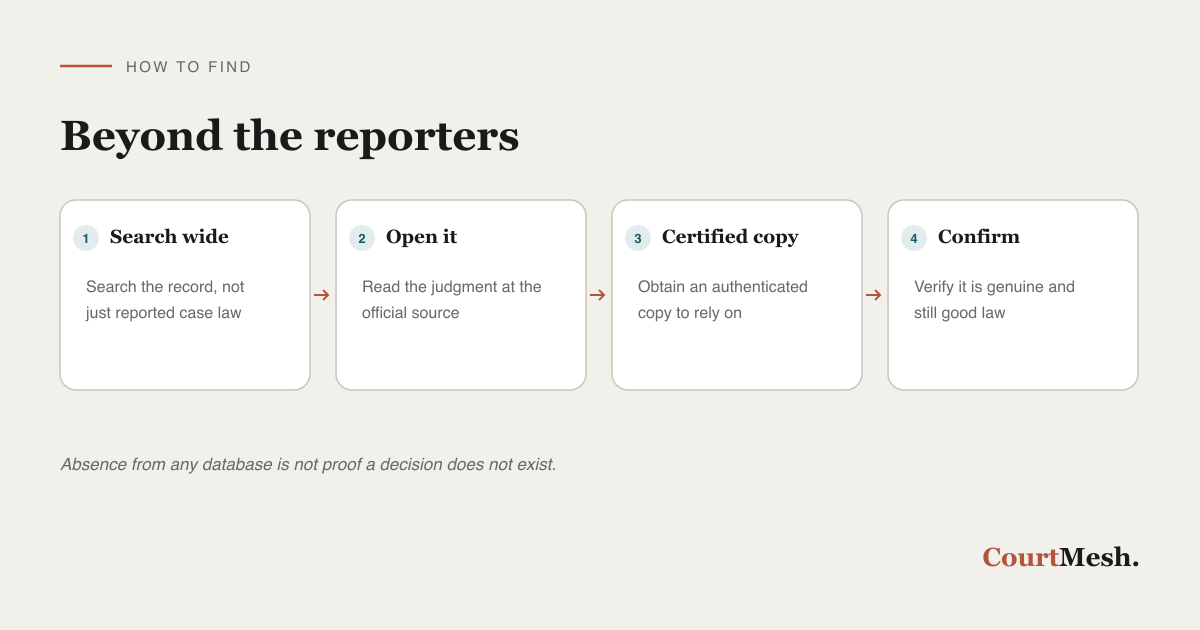
Finding an unreported decision is a different exercise from looking up a reported one. You are not matching a topic to a headnote. You are searching for the words the court used, wherever the decision happens to live, and then doing the verification a reporter would otherwise have done for you. A workable method runs like this.
Search the full text, not the headnotes
Begin with the actual language of the point: the operative phrase, the statutory provision, the factual pattern. Because an unreported decision has no headnote, it can only surface on the words inside it. Full-text search across the judgments themselves, rather than editorial summaries, is what makes the unreported side visible at all.
Widen beyond reported case law and beyond one court
The decision on your point may sit in a High Court you were not looking at, a district court, or a tribunal. Search across courts and forums rather than a single portal, and narrow by facts, provision, or year rather than by citation, because there is no citation to narrow by.
Confirm it is genuinely on your point by reading it
With no headnote to trust, you cannot judge a candidate from a summary. Open the judgment and read it. Check that the facts, the issue, and the reasoning actually match your question, and that the match is not merely a keyword coincidence.
Trace the decision back to its court
Note the case number, the court, the bench, and the date of pronouncement. These are what let you locate the decision on the issuing court's own portal and, later, obtain a proper copy. An on-point decision you cannot tie back to an official record is of little use in court.
Obtain a copy the court will accept
For anything you intend to rely on before a bench, obtain an authenticated or certified copy from the issuing court, or the official copy from its portal. An aggregated PDF is fine for reading and for deciding whether a decision is worth pursuing; it is not a substitute for the copy a court expects.
Confirm it is current before you stand behind it
Check that the decision has not been stayed, reversed on appeal, or overruled by a later bench, and that you are relying on its final form. An unreported decision comes without the later editorial notes that sometimes flag this for a reported case, so the checking is yours to do.
Obtaining a Reliable Copy and Verifying It
What 'verify' actually involves
Verification of an unreported decision has two halves: confirming that the copy in front of you is genuine, and confirming that the decision still stands. Neither is done for you, and each matters as much as finding the judgment in the first place.
- Match the copy against the official record: the parties, the case number, the court, the bench, and the date should all line up with the issuing court's own portal.
- Prefer an authenticated or certified copy for anything you will rely on, and treat an aggregated copy as a pointer to that record rather than a replacement for it.
- Trace the decision's later history: any appeal, any stay, and any later bench that has taken a different view.
- Note how the relevant forum treats unreported decisions and what it requires before one is received, so there are no surprises when you rely on it.
Before you rely on an unreported decision
An unreported judgment has to be produced in an authenticated form, and its current standing has to be confirmed, before you build an argument on it. Absence from any database, including CourtMesh, is not proof that a decision does not exist; it may simply not have been digitised or indexed yet. And where an aggregated copy and the issuing court's record differ, the official record of the court prevails. Treat every aggregated copy as a lead to be verified against the court's own record, never as the last word.
Where CourtMesh Fits In
The reason unreported decisions have stayed out of reach is structural rather than legal. The reported slice is indexed, headnoted, and searchable. Everything else is scattered across official portals with no common index sitting on top of it. CourtMesh is built to close that gap on the discovery side, so that the search itself is no longer confined to what a reporter chose to carry.
CourtMesh aggregates judgments from official government portals only, across the Supreme Court, all twenty-five High Courts, the district courts, and tribunals: roughly 310 million cases in one place. Those portals carry far more than any reporter publishes, so the search reaches well past reported case law into the unreported majority. You can search by keyword, or by AI semantic search that matches on the meaning of your point rather than an exact phrase, and then narrow the results with filters.
- Court
- Year
- Judge
- Acts and sections
- Disposition
- Case status
Every result links to the actual judgment, so you go from a search hit to the decision itself in a single step. You read it to confirm it is genuinely on your point, and you pick up the case number, bench, and date you need to trace it back to the official record. From there the discipline is unchanged: for anything you will rely on, obtain the authenticated or certified copy, and confirm the decision still stands. CourtMesh is built to help you find and open the judgment. It does not give legal advice, and an aggregated copy is not a substitute for the certified copy a court expects.
Search beyond the reported slice
The decision that settles your point may never have been reported, and reporter-first research will never show it to you. CourtMesh lets you search the full text of judgments from official portals across the Supreme Court, all twenty-five High Courts, the district courts, and tribunals, so you can find decisions no reporter carried, open the judgment, and then obtain and verify a proper copy. Start your search on CourtMesh, and stop mistaking the curated slice for the whole field.
Explore CourtMesh