A recent order surfaces in your search. It is squarely on point, it is confidently worded, and it comes from a bench you respect. You lift the proposition, drop it into the draft, and move on. There is only one problem. The order was a stay, and on the question you are citing it for the court had decided nothing at all. This is one of the quietest ways that careful research goes wrong, and it is entirely avoidable.
Not every order a court passes decides something. A great many of them are provisional by design. They hold a position, pause a process, or grant urgent relief while the real contest is still to be heard. An interim order can read with all the authority of settled law and settle nothing. Cited as though it were a final judgment, it becomes the weak point in an otherwise sound argument, and the advocate on the other side, or the bench, is the one who finds it.
What Makes an Order Interim, and What Makes It Final
A final judgment is the court's concluded decision. After hearing the parties, and taking the evidence or the arguments as the stage requires, the court applies its mind to the merits, decides the matter or a discrete issue within it, and records its reasons. It disposes of what was before it. The decision can be carried up in appeal or taken in review, but within that forum the question has been answered.
An interim order does something much narrower. It regulates the position while the matter is still pending. It is passed at an intermediate stage, often at speed, to keep the litigation workable and to prevent harm before the court can hear the dispute in full. It does not dispose of the matter. It lives inside a case that is still alive, and it is provisional by design. It can be modified, vacated, or reversed when the matter is finally heard, and the bench that passes it will usually take care to say that it is expressing no concluded view on the merits.
The test is what the order does, not how it reads
The distinction is functional, not stylistic. An interim order can run to many pages, survey the authorities, and read with all the assurance of a final judgment. A final judgment can be a couple of paragraphs. Length, tone, and the seniority of the bench tell you nothing about whether the matter was concluded. What tells you is what the order actually does. Did it dispose of the matter, or did it hold the position until the next date? Answer that one question and you know what you are holding.
The Common Kinds of Interim Order
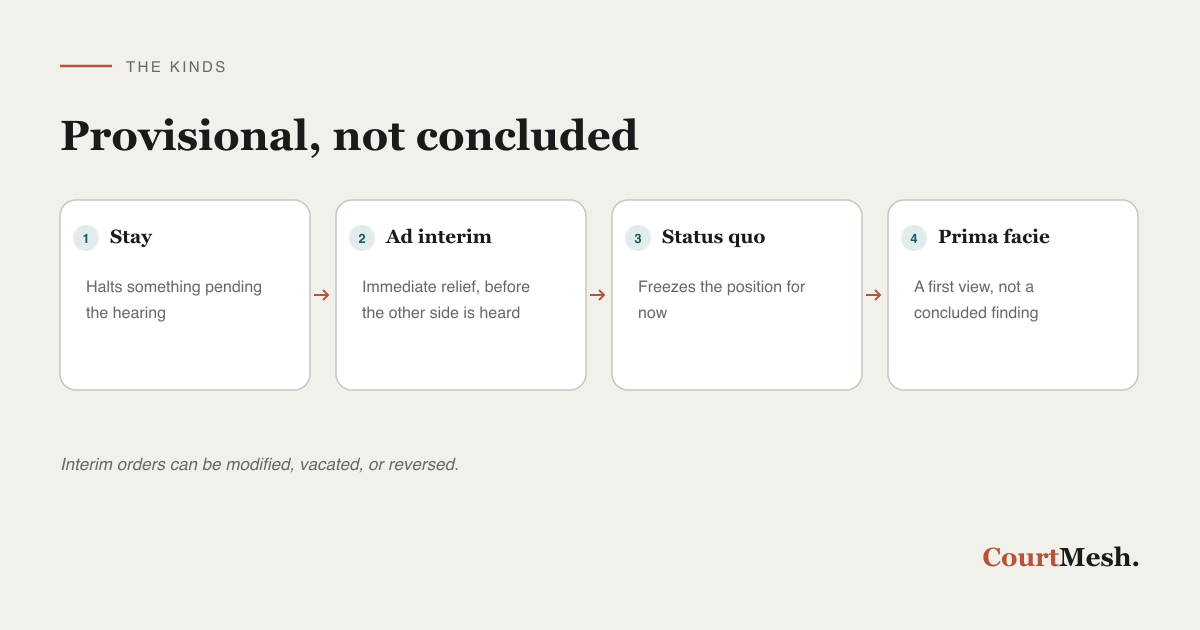
Interim orders come in a handful of recognisable forms. Each arises in a different situation and each carries its own limited significance. The labels below are the ones you will meet most often in Indian practice, and it is worth being able to recognise each on sight.
Stay
A bench pauses proceedings, or suspends the effect of an order or judgment, while a challenge to it is heard. It freezes a position so that the court can look at it properly. The underlying dispute has not been concluded.
Ad interim injunction
Urgent relief granted at the very first hearing, frequently before the other side has been heard at all. It exists to hold the position until the injunction application can be decided on fuller material, and it is the most provisional order of the lot.
Temporary injunction
The injunction familiar from the Code of Civil Procedure 1908, granted after hearing the application and ordinarily operating until the suit is disposed of or the court orders otherwise. It rests on a prima facie case, the balance of convenience, and the risk of irreparable injury, not on a final finding about who is right.
Status quo direction
A direction that neither side alter the existing position while the matter is pending. It preserves the field so that the eventual decision is not rendered meaningless. It buys time; it does not pick a winner.
Bail order
In criminal matters, now governed by the Bharatiya Nagarik Suraksha Sanhita 2023 which has replaced the Code of Criminal Procedure 1973, an order granting or refusing bail speaks to a person's liberty during the proceedings. It does not decide guilt, and its observations are made on a prima facie view for that limited purpose.
Directions pending final hearing
Case management and protective directions that regulate the parties' conduct or preserve the subject matter until the matter is finally heard. They keep the litigation orderly. They do not conclude the questions in it.
How Much Authority Does an Interim Order Carry
What unites these orders is the standard on which they are passed. At the interim stage the court is not deciding who is right. It is asking whether a party has made out a prima facie case, where the balance of convenience lies, and whether refusing relief would cause harm that cannot later be undone. Those are provisional questions, and the answers are provisional too. A view formed on them is not a finding on the merits, and it was never meant to travel out of the matter as a statement of law. That is why an interim order carries so little weight as authority on a point of law, however commanding it reads.
| Kind of order | What it actually decides | Weight as authority |
|---|---|---|
| Stay | That an effect is suspended while a challenge is heard. | Low. It reflects a prima facie view and the balance of convenience, not a concluded finding, and it can be vacated at any time. |
| Ad interim injunction | That the position is held until the application can be decided. | Very low. Granted urgently on limited material and routinely reconsidered once both sides are heard. |
| Temporary injunction | That a party is restrained while the suit runs. | Limited. It rests on a prima facie case and the balance of convenience, not on a final adjudication of rights. |
| Status quo direction | That neither side may alter the existing position. | Low. It preserves a position. It says nothing about who is ultimately entitled to what. |
| Bail order | That an accused is released, or not, while the proceedings continue. | Confined to that question. Any observations on the material are made on a prima facie view for the purpose of bail, not as findings on guilt. |
| Direction pending final hearing | That conduct or the subject matter is regulated until the hearing. | Low. It manages the litigation. It does not conclude the issue in dispute. |
Read the right hand column again. In every row the order decides something about the conduct of the litigation or the position of the parties while the case runs. In no row does it settle the point of law you might be tempted to cite it for. That gap, between what the order actually decides and what you want it to say, is exactly where the error lives.
A stay stops the clock. It does not settle the argument.
Why Interim Orders Are So Easy to Cite by Mistake
If interim orders are so weak as authority, why do careful people reach for them as though they were not? Because almost everything about them is inviting.
- They are recent. An interim order is often the newest thing in the matter, and recency reads as relevance. The final judgment, if it exists at all, may be years away.
- They are on point. Urgent relief is granted on the precise facts placed before the court, so the order speaks directly to the situation you are researching, sometimes more directly than any concluded judgment.
- They are confidently worded. To justify granting or refusing relief, the bench states the position in firm terms. Firm terms read like settled law even when the order is careful to say that nothing has been decided.
- They surface first. A recent, heavily reasoned order can rank above a quieter final judgment in a list of results, so it is the first thing you see and the first thing you copy.
- They carry the authority of the bench. An interim order of a senior bench borrows the standing of that bench, and it is easy to mistake the standing of the bench for the standing of the proposition.
None of these qualities makes the order wrong. They make it persuasive, which is a different thing. Persuasiveness is precisely what lulls a researcher under deadline pressure into skipping the single question that matters: did the court actually decide this, or was it only holding the ring?
What an interim order actually tells you
An interim order tells you what a bench thought was arguable enough to protect a position while the matter was heard. That is a different thing from what the court finally held, and often enough it is the opposite of it. Treat an interim order as a snapshot of a live contest, not as the last word in it. The last word, if it has been spoken, sits in a different document.
The Document Often Does Not Announce Its Own Status
You might expect an interim order to announce itself, to carry some banner saying that nothing has been decided. Usually it does not. It is titled as an order in a numbered application, which means everything to the registry and nothing to a reader who does not know the procedural posture. The signals that were obvious in the courtroom, that this was an application for interim relief and not a final hearing, are simply not on the face of the text in any form a hurried reader will catch.
The problem gets worse when the order is compressed. A headnote or an editorial summary reduces an order to a proposition, and a proposition on a screen looks identical whether it came from a concluded judgment or from an order holding a position for a fortnight. The provisional character, the phrase 'without expressing any opinion on the merits', the direction to list the matter again, all of it tends to fall away in the compression. What survives is a confident sentence with no signal that it was never built to bear weight. Lift it out and you have imported a conclusion the court did not reach.
One Matter, Many Orders
It helps to remember that a single matter does not produce a single order. It produces a trail. A dispute might open with an ad interim injunction granted the same day, before the other side is heard. After both sides are heard, that might be replaced by a temporary injunction on different terms, or vacated altogether. Along the way there will often be modifications, clarifications, and further directions. Only at the end, sometimes years later, does the final judgment arrive, and it can go the other way entirely from where the interim orders pointed.
This matters in two ways. First, the order in front of you may be an early, provisional step that a later order in the same matter has already changed. The proposition you are about to rely on may have been vacated by the same bench weeks later, and nothing in the order you are reading will tell you so. Second, even where the interim order still stands, a final judgment, if one has been delivered, is the thing you should be reading and citing. Leaning on the interim order when a final judgment is available is not merely weak. It invites the reply that you did not read the file to the end, and that is a difficult reply to answer on your feet.
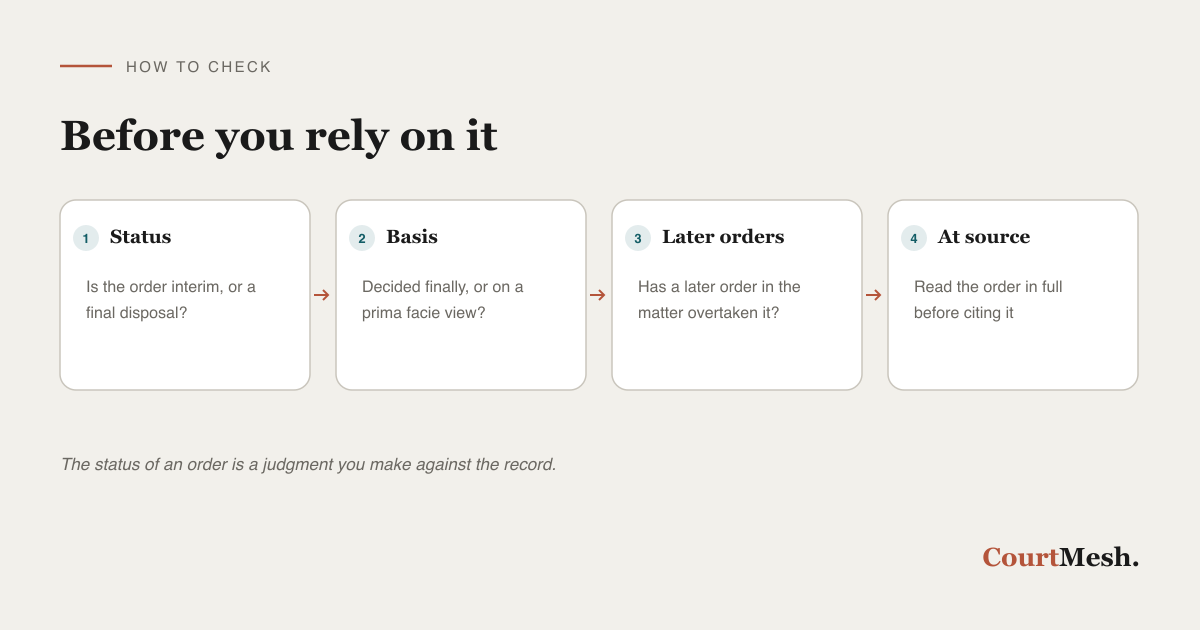
How to Confirm an Order's Status Before You Rely on It
Two questions you have to answer separately
There are two questions here, and running them together is where people come unstuck. The first is whether the order is interim or final. The second is whether it still holds. An order can be plainly final and still have been reversed on appeal; an order can be plainly interim and still be the operative position in the matter today. Answer both, against the record rather than from the way the document reads, before anything goes into a draft. None of it requires special tooling. It requires a habit, applied in a fixed sequence.
Start with the operative part
Skip past the narration and read the paragraphs that actually grant or refuse relief. Words such as stay, injunction, status quo, 'till further orders' or 'pending disposal', and a direction to list the matter on a future date, all tell you that the case is still alive and the order is holding a position rather than concluding it.
Ask whether the matter is disposed or pending
A final judgment disposes of the matter. A matter that still carries future hearing dates is, by definition, not finished, so whatever you are reading inside it is almost certainly interim. The disposal status is the single most useful signal available to you, and it is usually quick to establish.
Walk the trail forward
Do not stop at the order you happened to open. Find the most recent order in the same matter, and the final judgment if one has been delivered, and rely on the latest position rather than the earliest one you found.
Read the reasoning for provisional language
Phrases such as prima facie and balance of convenience, and any statement that the court is expressing no opinion on the merits, are direct signals that no concluded finding was made. Where the reasoning is hedged in this way, the proposition is not settled law and should not be cited as if it were.
Confirm at source and note the standing
Open the actual order or judgment rather than a headnote or a summary, satisfy yourself about what it decides, and record whether it still holds and as on what date. Only then is it safe to rely on, and only for the narrow thing it actually decided.
The sequence takes a few minutes on most matters. Skipping it is what produces the red flags below, any one of which should stop you before the citation goes in.
The status of an order is a judgment you have to make
No tool can make this call for you. Whether an order is interim or final, and whether it still holds, is a legal judgment you must make against the record. Do not treat any platform's label, tag, or status field as conclusive. An interim order can read exactly like a final judgment, and even a correctly identified interim order may have been overtaken by a later order in the same matter that you have not yet seen. Read the operative part at source, trace the matter forward to its latest position, and satisfy yourself before you rely on anything.
Where CourtMesh Helps, and Where It Does Not
Most of the work above is retrieval. You need the actual order, you need to know whether the matter is disposed or still pending, and you need to be able to walk the trail forward to the latest order and to any final judgment. That is where a research platform earns its place: by putting the document and its status in front of you quickly, so that the time you save goes into making the call rather than into hunting for the papers.
CourtMesh indexes roughly 310 million cases drawn only from official government portals, and every result links to the actual order or judgment rather than to a paraphrase, so you can read the operative part at source. Filters for disposition and case status help you separate disposed matters from pending ones and see the recorded outcome, with case status, including next-hearing dates and disposal, drawn from eCourts and the National Judicial Data Grid as those systems publish it. What it will not do is decide for you whether an order is interim or final, or guarantee that a status is current to the hour. Court records update on their own schedule, and the legal judgment about what an order is and whether it still binds stays with the advocate. The platform helps you find the order and its standing. Reading it, and weighing it, is the part that does not transfer.
Find the order, then judge it
Good research does not end at a persuasive snippet. It ends at the order itself, read in full and checked for whether it still holds and for what it actually decided. CourtMesh helps you get there faster: search across roughly 310 million cases, narrow by court, case type, year, judge or date range, and follow every result through to the actual order or judgment at source, where the disposal and the current status are recorded. The last word on whether an order is interim or final stays with you. We simply make sure you are reading the right document, in its current standing, before you decide.
Explore CourtMesh