Finding a judgment on point is the easy part. Knowing whether it still stands is the hard part, and it is the step most commonly skipped when a filing is due the next morning. A judgment can be perfect on the facts and dead on authority: overruled by a larger bench, reversed on appeal, distinguished into irrelevance, stayed, referred and pending, or quietly superseded by an amendment nobody mentioned in court. The PDF looks identical either way.
The difficulty is not carelessness. It is the format. A judgment is published as a finished document, frozen at the moment it was delivered. Everything it tells you, it tells you about the past. What it cannot tell you is what has happened to it since. So the check has to be done elsewhere, by someone who remembers to do it, and when a matter is listed that is precisely the step that falls off the list.
The Document Only Answers Backwards
A judgment is a backward-facing document. It cites the authorities it followed and the ones it distinguished. Every link points into the past, and each was accurate the day it was written and has been decaying since.
A judgment can tell you every authority it relied on. It cannot tell you a single thing about what happened to it afterwards. That asymmetry is the entire problem.
The question 'is this still good law' is a forward question. It asks what came after, and that answer is never inside the document you are holding. It is scattered across every judgment delivered since, in courts you may not have searched, sometimes without your judgment being named at all.
So the failure is silent. There is no error message, and you cannot proofread your way to it. The document has no way of knowing it is dead. Most of the time nothing has happened to it, which is exactly what makes the habit of checking so hard to sustain. When something has, you find out in front of a bench.
None of these is a research failure in the ordinary sense. The advocate found the right case. The case had simply stopped being the right case, and the document did not mention it.
Not Synonyms: The Ways a Judgment Loses Its Authority
In conversation the words get used loosely: a judgment has been 'shot down', or it is 'no longer good'. These are not the same event and they do not carry the same consequences. Some destroy a judgment's authority outright, some leave it intact and merely narrow its reach, and some leave it binding but unwise to lean on.
| Treatment | What has actually happened | What it does to the authority |
|---|---|---|
| Overruled | A later bench competent to do so, in practice a larger bench of the same court or a superior court, holds the rule laid down earlier is wrong in law. | The ratio ceases to be good law. The decree between the original parties is untouched. Unless the overruling is expressed to operate prospectively, the law is treated as having always been what the later court says it is. |
| Reversed or set aside | The same matter, between the same parties, is carried up and the decision set aside by the court above. | Gone as a decree and as authority. Where leave is granted and the appeal decided, the doctrine of merger operates and the order above takes its place. |
| Followed | A later court applies the ratio to the matter before it. | No change in formal status, but evidence it is being treated as live. Weight depends on the court and bench doing the following. |
| Distinguished | A later court accepts the decision as correctly decided but holds it inapplicable to the facts or question before it. | Authority formally intact. Repeated distinguishing narrows the field of application until the judgment is authority for little beyond its own facts. |
| Doubted or disapproved | A later bench questions the correctness of the reasoning without overruling, often because it lacks the strength to overrule. | Still binding on the courts bound by it. Practically a warning: persuasive weight drops and the question is likely headed to a larger bench. |
| Referred to a larger bench | A bench doubting the correctness of a decision refers the question for authoritative determination. | Unresolved and unstable. The decision generally holds the field until the reference is answered, but citing it without disclosing the reference is a poor idea. |
| Per incuriam | A later court finds the decision was rendered in ignorance of a binding statutory provision or binding precedent that would have controlled it. | Not binding, to the extent of the oversight. A narrow doctrine, and whether it applies is itself a contested question decided by a later court. |
| Sub silentio | The point you want to cite was never raised, argued or consciously decided. It was assumed on the way to something else. | Not an authority on that point at all, even though the sentence you want is sitting there in the text. |
| Superseded by statute | The provision construed has been amended, renumbered, repealed, replaced, or had its basis removed retrospectively by legislation. | The interpretation may be correct about the old text and irrelevant to the current one. No court has said anything, so nothing appears in the case law. |
| Stayed | The operation of the decision has been stayed, typically pending appeal or an SLP. | Cannot be acted upon between the parties, on the terms of the order. Its value as precedent for other benches is contested and turns on what the stay order says. |
Overruled is not reversed
Structurally these are close to opposites. Reversal is vertical and personal: same matter, same parties, carried up, decision set aside, decree gone. Overruling is horizontal and impersonal: a later court, in a different case between different parties, holds the earlier rule was wrong. The earlier decree stands and those parties keep what they won. What is lost is the proposition, not the outcome.
Appeals carry their own trap. Where an SLP is dismissed without reasons, that dismissal does not affirm the reasoning below and does not convert a High Court's view into law declared by the Supreme Court. Where leave is granted and the appeal is decided, the order above takes its place. Between those poles sit dismissals by speaking order, where the position turns on what the Court actually said.
Distinguishing is not a defect, until it is
On its face this is not criticism at all: the bench accepts the judgment as correctly decided and says only that it addressed a different situation. The authority is untouched. The trouble is cumulative. A judgment distinguished by a dozen benches, each finding another reason why the facts before them were not quite those facts, is confined until it is authority for little beyond itself. Nobody overruled it, no flag will ever be raised, and it is technically good law and practically inert. The shape of the treatment matters more than the count.
Doubted and referred: the unstable middle
The most awkward category is where nothing has formally happened and everything has changed. A bench concludes an earlier decision is wrong and cannot act on it, because a bench of coordinate strength cannot overrule its own court's earlier view. It can only say so and refer the question upwards: disagreement travels up, it does not get acted on sideways. So the decision sits there, formally binding, with a bench of the same court on record calling it wrong and a reference pending, sometimes for years. That is not a gap in the law but a period of known risk.
Per incuriam and sub silentio: narrow doors, widely knocked on
The point of per incuriam is not that the decision was wrong, because wrong decisions bind. It is that the decision never engaged with the law it was supposed to apply. A narrow door, and knocked on far more often than it opens.
Sub silentio is stranger still. The judgment may carry a clean, quotable sentence on precisely your question, and if the point behind it was never argued, that sentence is not an authority on it. Both doctrines are conclusions a later court reaches, not properties the original judgment carries, which is why neither is ever visible on the face of the decision you are holding.
Superseded by statute: the failure that leaves no trace in the case law
A judgment construes a provision; later the legislature amends it, renumbers it, or takes away the basis on which it rested. Every citator will still show that judgment as clean, because it is clean: nothing has happened to it in the case law, and the case law is all a citator reads. The text it construed is simply no longer in force, and an impeccable interpretation of a section that no longer exists is not an argument.
The constitutional position is worth stating precisely. A legislature cannot set aside a judicial decision by declaring it wrong: that would be an exercise of judicial power. What it can do is alter the law on which the decision rested, including retrospectively, so the foundation is removed. Exposure depends on the statute: the general principles of contract in the Indian Contract Act 1872 have been stable for a very long time, while the IBC 2016 has been amended repeatedly since it came into force. Before checking what the courts have done to a judgment, check what the legislature has done to the section underneath it.
Stayed: a live question, not a settled one
Here it is worth resisting a crisp rule where there is not one. What a stay does to the judgment's value as precedent for other benches is argued both ways, and it matters what was stayed: staying execution is a different animal from staying operation. The safe position is not to resolve the theory but to know the fact, and to be the person who discloses the stay rather than the one who is told.
There is a failure mode that is not in the table
Every treatment above assumes the judgment says what you think it says. Often it does not. The line you want may be obiter: an observation made in passing, no part of the ratio, binding on nobody. Checking that a judgment is still good law and checking that it is good law for the thing you are citing it for are two different checks, and no citator performs the second. You have to read it.
Why This Is Structurally Hard in India
Every common law system has this problem. Not every system has made it this hard to solve. Where a jurisdiction has a comprehensive citator, the taxonomy above has been operationalised for decades: an editorial team types the treatment and pushes a flag back onto the earlier record, once, centrally, and everyone downstream inherits it. India has no equivalent covering the whole field, only excellent private reporters, each with its own coverage and conventions, none official and none universal.
Documents, not a graph
Judgments are published as self-contained texts. A judgment is a finished object. Its relationship to every other judgment is not stored anywhere: it exists only as prose, inside other documents.
No universal official citator
No single official citator covers every court and tribunal in India as part of the record. Private publishers maintain their own, with their own reach and conventions. None is the authority.
Time runs one way
A High Court judgment is not amended when the Supreme Court displaces its reasoning years later. The old document is frozen. The only trace sits inside the newer judgment, which you have to find first.
Overruling is often silent
A larger bench can lay down an inconsistent rule without naming the earlier decision. No citation was made, so there is none to extract. Someone has to spot the inconsistency.
Neither High Court binds the other
A proposition can be settled in one High Court and rejected in another with nothing overruled anywhere. The judgment is not wrong. It is not the law where you are appearing, and no flag will tell you that.
The statute moves on its own
An amendment can hollow out a judgment without any court saying a word. The case law looks immaculate, because the case law never touched it. It was the legislature, and legislatures do not cite.
Then there is the arithmetic. 25 High Courts, each with a body of authority persuasive but not binding on the other 24. Below them, hundreds of district courts. Alongside them, tribunals with their own jurisprudence. The same judgment travels under several citations, and a single lis can produce a sequence of judgments over years, more than one of which shares a name with the others. Meanwhile Article 141 provides that the law declared by the Supreme Court is binding on all courts within the territory of India, so a single judgment can dislodge a settled position in every High Court at once without naming any of them. Note what it does not do: it has not been read as binding the Supreme Court to itself. A larger bench can revisit a smaller one.
The Citation Network: What It Is and What It Does
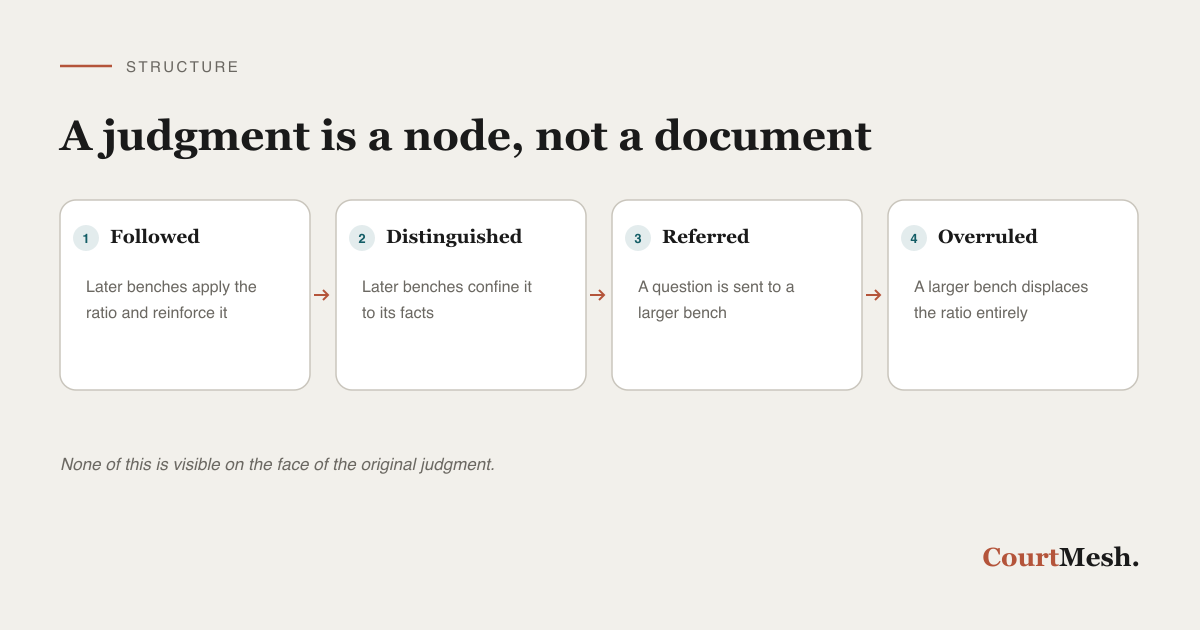
The fix for a pile of documents is to stop treating them as documents. A citation network models the corpus as a graph: each judgment a node, each citation an edge. The edge is not merely a link. It has a direction, a date, a court and bench, and a type, which is the taxonomy above expressed as data. Followed. Distinguished. Overruled. Referred.
Once the corpus is a graph the forward question becomes answerable, because forward citation is just traversal in the other direction. The document gives you the edges pointing out of it, into the past. The graph gives you the edges pointing into it, from the future. Those incoming edges are the answer. They always existed, scattered across ten thousand documents where you had no way to find them. That inversion changes what you can ask:
- Who cited this, when, and at what strength? A treatment by a larger bench of the Supreme Court and a passing reference by a Single Judge are not the same event.
- How did they treat it? Forty judgments following it and one overruling it from a larger bench is not 'forty-one citations'. It is one judgment that ended the question and forty that predate it.
- Is the line converging or splitting? Three High Courts following it and two declining is not a settled proposition. It is a conflict that has not reached the Supreme Court, and where you are appearing decides which half of it you are in.
- What is underneath it? Your authority relied on something. If that has been displaced, yours is standing on air and nobody may have got round to saying so.
- What have I not found? The graph surfaces authority that does not share your vocabulary. A judgment can be squarely on your question and use none of your keywords.
A citator is the inverse of a search engine
Search asks what exists. A citator asks what happened next. Different questions, answered from opposite ends of the same data. Which is why 'I found the case' and 'I checked the case' feel like the same activity and are not, and why better search has never made this problem smaller.
What Automated Citation Analysis Cannot Do
All of that is a real capability, and describing it accurately means describing what it does not do. A citation network narrows a search. It does not deliver a verdict, and any product implying otherwise is selling something it does not have.
Absence of a flag is not a clean bill of health
This is the single most important thing to understand about any citator, ours included. If a judgment carries no negative treatment, that can mean three very different things: nothing has happened to it; something has happened and the analysis has not reached that judgment yet; or something has happened in a form citation extraction cannot see at all, such as a silent overruling or a statutory amendment. On CourtMesh, retrieval spans the full corpus, but deep analysis including citation relationships covers only a subset of it, and that subset is expanding rather than complete. A clean screen means the tool found nothing. It does not mean there is nothing.
That is the headline caution. Beneath it sit several more, each failing in a different way:
- Coverage is partial and uneven. Retrieval and deep analysis are different layers with different reach. A judgment can be fully searchable while carrying no relationship data at all.
- Classification is an interpretive act. Whether a bench distinguished a judgment or effectively gutted it is argued in open court. A typed edge is a hypothesis, not a holding: a pointer to something you should read.
- Silent overruling is invisible. No citation means no edge means nothing to extract. The most consequential treatment of all is the one citation analysis cannot see.
- Statutory supersession sits outside the graph. The graph is judgments citing judgments. An amendment is not a citation, and no system will flag it from the case law.
- Procedural posture lives elsewhere. Stays, pending SLPs and pending references live in interim orders and cause lists, not necessarily in the judgment being cited.
- Depth of treatment gets flattened. A judgment buried in a string citation and one whose ratio is engaged with over five pages are both, to an extraction pipeline, a citation.
- Identity is genuinely ambiguous. The same judgment travels under several citations, party names repeat, and long litigation produces multiple rounds with near-identical names. Matching is mostly right, and 'mostly' is doing real work in that sentence.
The correct mental model is a very fast junior who has read an enormous number of judgments, flagged everything relevant, and has no authority to conclude anything. Genuinely valuable. Not the same as having checked.
The reason to insist on this is not modesty. Over-trusting a citator fails worse than not having one: an advocate without one knows the check is outstanding, while an advocate looking at a clean screen believes it is done, and the second one stops looking. No citator, and no software, is enrolled under the Advocates Act 1961. The duty to the court is personal, and it does not transfer to a tool.
A Checklist for Confirming a Judgment Still Stands
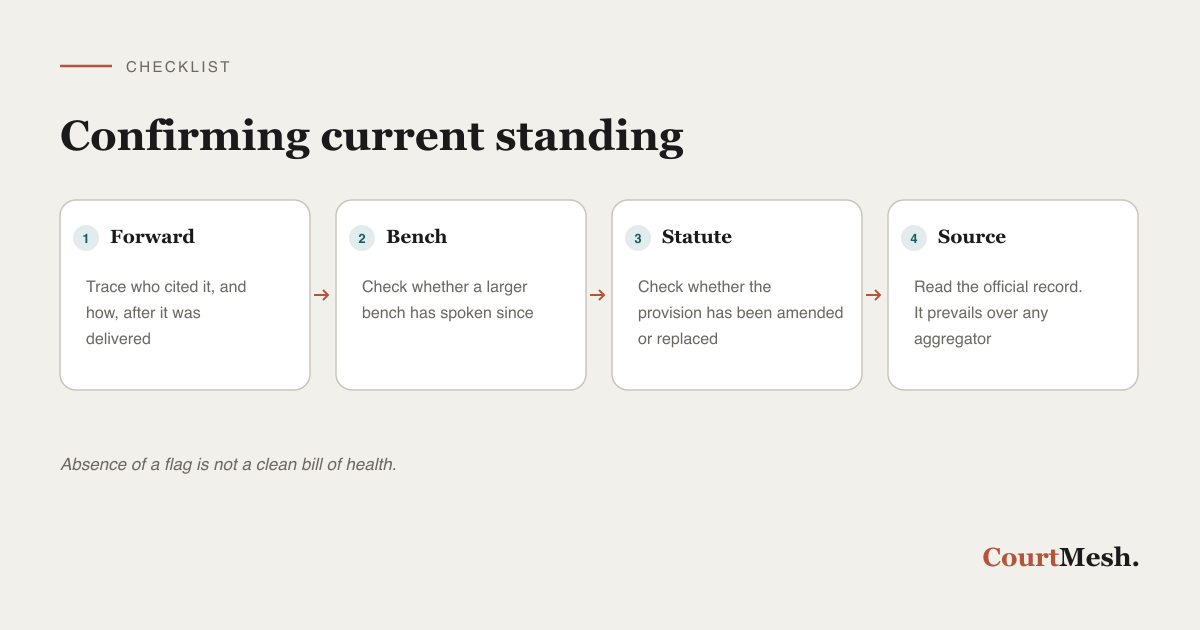
None of this needs to take long. What it needs is a defined shape, so that it survives contact with a deadline.
Fix the identity of the judgment
Case number, date, bench, and a neutral citation where one exists. Establish which round of the litigation you are holding: long matters go up and come back, and yours may already be superseded by a later order in the same lis.
Read it forward, not just backward
List every later decision that cites it, in date order. This is the step that answers the question. Everything else here is context around it.
Ask what bench, not just what court
Only a bench competent to do so can overrule. A coordinate bench that disagrees has not overruled anything: it has created a problem a larger bench will resolve. Bench strength is the first filter, not the last.
Trace the appellate history of the matter itself
Was it carried up in appeal or by SLP? Is something pending? If an SLP was dismissed, was it by a speaking order or without reasons? A dismissal without reasons neither affirms the reasoning below nor converts it into law declared by the Supreme Court.
Check whether the question is before a larger bench
A pending reference does not usually displace the decision, but it changes how you use it and what you say about it. It is also the kind of thing the bench may already know.
Read the statute as it stands, and as it stood
Amended, renumbered, repealed, replaced? Was there a validating enactment? Which text governed on the relevant date? A judgment can be perfectly good law about a section that no longer exists.
Isolate the proposition, not the case
Is the sentence you want the ratio, or an observation made in passing? Was the point argued, or assumed? A decision is an authority for what it decided, not for everything that can be read out of its text.
Check the ground underneath it
What authority did the judgment rest on, and is that still standing? A decision built on a displaced foundation is vulnerable even where nothing has been said about it directly.
Verify against the official record before it is filed
Whatever any research tool shows you, the record of the issuing court is the record. Confirm the citation, the date and the text against it before anything goes into a pleading.
Good law is a point-in-time answer
It is not a property the judgment has. It is a statement about what was true on the day you looked. Between the conference, the drafting and the hearing, a bench somewhere may have moved. Note the date of the check in the file: it costs nothing, and it tells the next person, who may well be you, exactly what was and was not verified.
Where CourtMesh Fits, and Where It Does Not
CourtMesh covers roughly 310 million cases: the Supreme Court, all 25 High Courts, the district judiciary and tribunals including the NCLT, NCLAT, ITAT, CESTAT, SAT, TDSAT and DRT. All of it is sourced directly from official government portals, with no third-party intermediary between the court's record and what you see.
That number describes retrieval. It does not describe analysis, and the difference is the most important thing on this page. Deep analysis, including the citation relationships this article is about, covers a subset of that corpus and not the whole of it. The subset is expanding. It is not complete, and it will not be. Inside it, relationships are typed as followed, distinguished, overruled and referred, and the graph can be traversed forward from any judgment within it. Outside it, you have good retrieval and no relationship data, which is a different and much weaker thing.
What it buys you is time, on the step that usually loses to time. Forward citation checking by hand is not a task, it is an afternoon, and afternoons are the first thing a deadline takes. Reduced to a first pass you run in minutes, it stops being the item that falls off the list. The judgment at the end is unchanged and undelegated: a division of labour, not a handover.
The official record prevails
Whatever CourtMesh displays, the record of the issuing court is the authoritative one. Where the two differ, the court's record governs. Anything going into a pleading should be confirmed against it: the citation, the date, the bench and the text.
Finding Is the Easy Half
Finding a judgment on point is close to free now. Knowing whether it still stands is where the professional work is, and it is the half no tool will do for you. What a tool can do is narrow the search: pull the later judgments that cite yours, type the relationship, and put the ones worth reading in front of you in minutes instead of an afternoon. CourtMesh does that across roughly 310 million cases drawn directly from official court portals, with citation relationships tracked as followed, distinguished, overruled and referred across the subset that carries deep analysis, and without pretending that subset is the whole. The rest is yours: the bench strength, the statute, the ratio, and the call. That is the part that should be.
Explore CourtMesh