In a great many motor accident claims, the harder question is not who was at fault. It is what the claim is worth. Liability is often admitted, or established without much difficulty from the police papers and the evidence of how the collision happened. Quantum is where the real contest lies: how a tribunal will value a life that was supporting a family on a certain income, or an injury that has taken away part of a person's capacity to earn. That figure is argued, not calculated, and the most persuasive way to argue it is to show what tribunals and courts have actually awarded on facts like yours.
Claims of this kind come before a Motor Accident Claims Tribunal under the Motor Vehicles Act 1988, and the two halves of such a matter call for entirely different work. Establishing how the accident occurred is largely a documentary exercise with a limited set of possible answers. Establishing what should be paid is open-textured. It draws on age, income, dependants, injuries and future, and on a structure the courts have built up over decades to turn those facts into a figure.
This piece is about that second half: what builds a compensation figure, why genuinely comparable awards are hard to find, why the year of an award matters, and how to assemble a quantum brief you can stand behind.
Why Quantum, Not Liability, Is Where These Matters Are Won
Liability is usually a bounded question. There is a first information report, often a charge sheet, a site plan, a mechanical inspection report, the evidence of the claimant or an eyewitness, and frequently an admission on the pleadings. The tribunal decides how the collision happened and whether the driver of the offending vehicle was negligent, sometimes apportioning part of the responsibility as contributory negligence. The insurer may add defences going to the policy, the licence or the permit. These are real contests, but they have a limited number of outcomes.
Quantum is different in kind. Once negligence is established, the answer sits somewhere on a range rather than at a fixed point. Two tribunals on broadly similar facts can reach meaningfully different figures, because so much depends on what income was accepted as proved, how a disability was read against the work the claimant actually does, and which heads of compensation were allowed or refused. The structure the case law has built brings real discipline to the exercise, but it does not remove the judgement inside it.
So the practical fight is over inputs, not principles. The claimant's side wants a higher income accepted, an addition for future prospects applied, a fuller set of heads allowed, and a disability read as a substantial loss of earning capacity. The insurer wants the opposite on each. Neither side wins that argument with adjectives. They win it by showing what has actually been awarded on facts close enough to be worth comparing.
Liability asks a question with a small number of answers. Quantum asks a question with a range of answers, and the whole argument is about where in that range your matter belongs.
What Actually Builds a Quantum Figure
Before you can look for comparable awards you have to know what makes an award comparable, which means being clear about the components a tribunal is assembling. What follows describes the shape of that exercise, not the figures inside it.
In a claim arising from death
The dominant head is loss of dependency, built in a sequence. The tribunal arrives at the income of the deceased on the evidence before it. To that it applies the addition for future prospects that the case law recognises, which reflects the reality that earnings tend to rise over a working life and which varies with age and the nature of the employment. From the result a deduction is made towards what the deceased would have spent on themselves, varying with the number of dependants. What remains is the annual dependency, multiplied by a multiplier fixed by reference to age under the structured approach the case law lays down. On top come the conventional heads, at figures the courts have fixed and periodically revised.
Income, as accepted by the tribunal
Not the income claimed, but the income the tribunal was persuaded to accept. A salary certificate, tax returns and an employer's testimony carry different weight, and for a self-employed person or daily wage earner the tribunal may assess income rather than adopt a document.
The addition for future prospects
A percentage addition the case law recognises to account for likely growth in earnings. Whether it applies, and at what level, turns on age and the nature of the employment, and the governing position has developed over time.
Deduction for personal expenses
A share of the income is treated as what the deceased spent on themselves rather than on the family, and that share varies with the number of dependants. The composition of the family is therefore a live issue, not a formality.
The multiplier
A multiplier fixed by reference to age, applied to the annual dependency under the structured approach the case law lays down. The structure exists to keep awards consistent, so the age band drives much of the final figure.
Conventional heads
Heads such as loss of consortium, loss of estate and funeral expenses, awarded at figures the courts have fixed rather than proved receipt by receipt. Which heads are available, to whom, and at what level are matters on which the case law has moved.
Interest, and the date it runs from
An award ordinarily carries interest, and both the rate and the date it runs from are decided by the tribunal. Two awards with the same principal sum can be worth quite different amounts by the time they are satisfied.
In a claim arising from injury
An injury matter is built differently and is harder to research, because the heads are more varied and more dependent on proof. The claimant recovers what was spent on treatment, what will have to be spent in future, what was lost in earnings while recovering, and, where the injury has left a lasting disability, compensation for the loss of earning capacity it causes. To that are added the non-pecuniary heads the courts recognise.
Medical expenses actually incurred
Hospital bills, surgery, implants, medicines and follow-up treatment, proved by documents. The most evidence-dependent head in the matter, and the one most often reduced for want of proof rather than on principle.
Future medical expenses
Where further surgery, replacement of an implant, prosthetics or continuing treatment are established by medical evidence, a sum for what is still to come. It must be supported by a doctor, not merely asserted in the petition.
Loss of income during treatment
Earnings lost while the claimant was hospitalised and recovering, turning on both the income accepted and the length of the period established by the medical record.
Loss of earning capacity
Where disability is permanent, the tribunal assesses how far it reduces the ability to earn. The percentage in a disability certificate is evidence, not the answer. What matters is the effect on the work this claimant actually does.
Pain, suffering and loss of amenities
Non-pecuniary heads compensating what the claimant went through and what the injury has permanently taken from ordinary life. These are assessed rather than proved arithmetically, which is why comparable awards carry weight here.
Attendant, conveyance and incidental heads
The cost of an attendant, transport to hospital, special diet and similar heads. Individually modest, collectively significant, and routinely allowed or refused depending on the evidence led.
Verify the current position before you argue it
This article states no multiplier figures, no percentage additions for future prospects and no amounts for conventional heads, and that is deliberate. Every one of those is fixed by case law and has been revised over time. A figure that was correct a few years ago may not be the position today. Check the governing decisions as they stand now before any of it goes into a submission.
Why Comparable Awards Carry the Argument
That structure tells you how a figure is assembled. It does not tell you what number to put before the tribunal, because almost every input is contested. Was the income proved, or should a notional income be assessed? Does the addition for future prospects apply here, and at what level? Is a permanent partial disability of a limb a proportionate loss of earning capacity for someone who works with their hands, and a smaller loss for someone who works at a desk? The tribunal answers those questions the way courts answer most open questions, by reference to how similar situations have been treated before.
That is what a comparable award does. It converts a submission about what is fair into a submission about what has been done. An advocate who can place before a tribunal a set of awards involving claimants of similar age, income and family circumstances, or injuries of similar nature and effect, is giving it a reasoned basis, anchored in the record, for landing in a particular part of the range.
The use runs in every direction. For the claimant, comparables push the figure up and justify the heads claimed. For the insurer, they hold it down. In appeal, whether seeking enhancement or reduction, they are effectively the whole argument, because the court is being asked to say the award below sits outside the range similar matters occupy. And well before any of that, comparables are how you advise a client honestly about what the claim is realistically worth.
Why Finding Genuinely Comparable Awards Is Hard
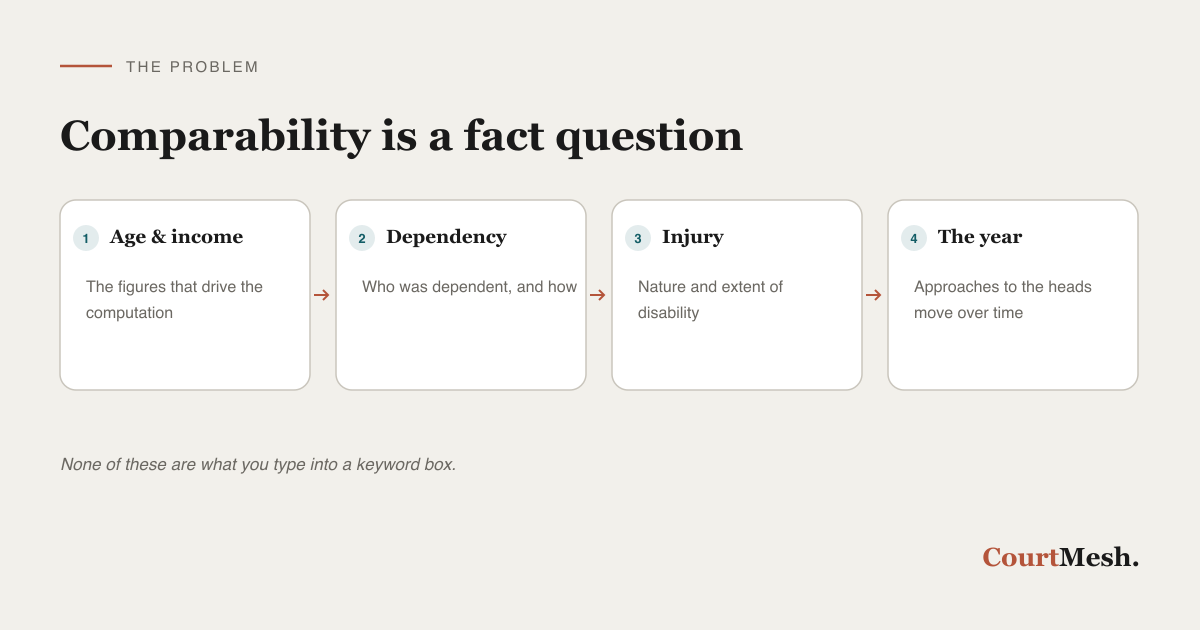
If comparable awards are so useful, why does nobody simply pull up a set for every matter? Because this material resists the way legal research is normally done. Motor accident matters are decided by tribunals across the country in very large numbers and appealed to the High Courts in very large numbers too, and most of that material stands for no proposition of law at all. An award records a fact situation and a figure. That is exactly what makes it valuable for quantum research, and exactly what makes it hard to find.
Consider how legal material is ordinarily indexed: by party name, citation, court, statute and section, judge, and the phrases in the text. None of that is what makes an award comparable. Nobody looks for a motor accident award by the name of the insurer. What you want is every award concerning a person of roughly a certain age, earning roughly a certain income in roughly that kind of work, supporting a family of roughly that composition, or carrying an injury of roughly that nature and effect. No index holds that description, because it is not a label. It is a fact pattern.
Comparability is a fact question, not a phrase
In ordinary precedent research you are looking for a proposition, and propositions travel in reasonably stable vocabulary, so typing the words that name the rule tends to find the judgments that decide it. Quantum research is not like that. You are matching on a situation, and situations are described in whatever words the tribunal happened to use that day. One award speaks of a mason, another of a labourer engaged in construction work, a third of a person doing manual work at a site. To a tribunal weighing loss of earning capacity these may be materially the same person. To a keyword search they are three unrelated strings.
The table below sets out the factors that make an award comparable, what each does to the figure, and why a literal search on words struggles to reach them.
| What makes an award comparable | Why it moves the figure | Why a keyword search does not reach it |
|---|---|---|
| Age of the deceased or injured person | Age drives the multiplier under the structured approach and affects how the addition for future prospects applies. | Age sits inside a line of narration, or in a date of birth, and is never a field you can search on. |
| Income, and how it was proved | The income the tribunal accepts is the base on which everything else is built, and a salary certificate, tax returns and an assessed notional income are treated differently. | Income appears as monthly salary, agricultural income, daily wage or an assessed figure, so no single phrase retrieves the awards that matter. |
| Number and relationship of dependants | The deduction towards personal expenses varies with the size of the dependent family, and its composition affects which conventional heads are available and to whom. | The family is described in prose, as a widow and two minor children or as the mother and unmarried sisters, which no keyword generalises. |
| Nature of injury and extent of disability | Whether disability is temporary or permanent, and how far it reduces this claimant's capacity to do this claimant's work, decides the largest head in most injury matters. | An amputation below the knee, a permanent partial disability of the lower limb and a loss of function in one leg can describe comparable situations in different words. |
| Occupation and nature of employment | The same disability affects a driver, a mason and a clerk very differently, and the employment also bears on the addition for future prospects. | Occupations appear as job titles, as descriptions of work done, or as a single passing word, so the closest matches are the ones most often missed. |
| Year in which the award was made | The approach to heads of compensation has developed, the figures fixed for conventional heads have been revised, and the value of money itself has moved. | A year filter narrows a result set but cannot tell you that an older award applied an approach since superseded. The award never says so. |
| Forum, and the stage the figure comes from | A tribunal award, the same matter enhanced or reduced in a High Court, and any further order can produce three different figures on identical facts. | The figure you find may be the one later disturbed. Nothing in the document tells you what happened to it afterwards. |
The facts, not the words that describe them
Read down the middle column and every entry is a fact about a person. Read down the right column and every entry says the same thing differently: the facts that make an award comparable are not the words the award uses. That is what makes quantum research a matching problem rather than a lookup problem. You are trying to find situations that resemble yours, described by people who had no reason to describe them the way you would.
Why the Year of an Award Matters More Than It Looks
Of all the comparability factors, the year is the most often overlooked and the one an opponent will seize on fastest. Compensation in this field is not static. The approach to heads has been developed and restated over the years, conventional heads have been recognised, clarified and revised, and the treatment of future prospects has been worked out in stages, so the position applying to a class of claimant today is not necessarily the one that applied when an older award was made. The value of money has moved as well.
The consequences are immediate. An old award on facts identical to yours may show a figure that no longer reflects how the exercise is done, and it may have applied a structure since superseded, so the figure was reached by a route no longer followed. A recent award on comparable facts, from a court whose view carries weight where you appear, is close to the most persuasive single document you can hand up on quantum. None of which makes older awards useless. They are often the only material on an uncommon fact pattern. The rule is that an award must be read in its period, and if you rely on an older one, be ready to say why it still holds.
An award is a snapshot of what a tribunal thought a claim was worth, on those facts, in that year. Read out of its year, it can mislead you as easily as it can help you.
A Practical Method for Building a Quantum Brief
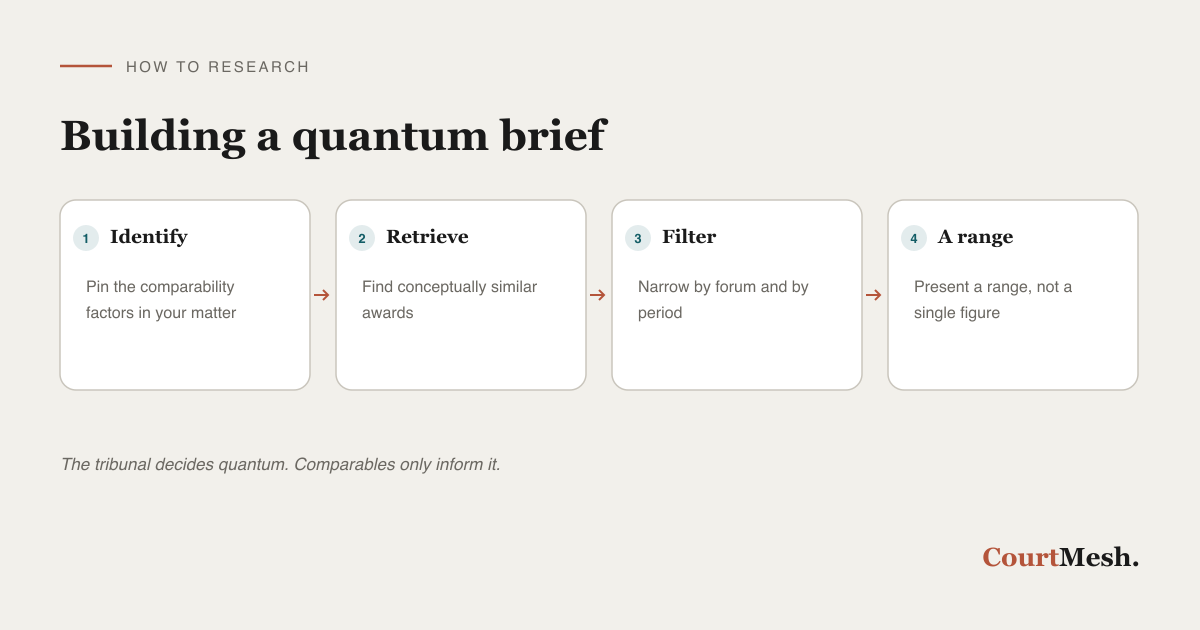
The way through is to stop treating quantum research as a hunt for a case and start treating it as the construction of a comparison set. Meaning-based search, sometimes called semantic search, helps at the retrieval step, because it lets you describe a situation in plain language and retrieve conceptually similar matters instead of guessing the words an unknown award used. The judgement at every step stays with you.
Write out the comparability profile of your matter
Set down in plain language what you are matching on: the age of the deceased or injured person, the occupation and the kind of work it involves, the income you can prove and the documents that prove it, the dependants and their relationship, and, in an injury matter, the injury, the treatment, the disability assessed and its effect on the work this claimant does. That profile is your query. A keyword string is not.
Retrieve on the situation, not on vocabulary
Describe the fact pattern the way you would explain it to a colleague, rather than anticipating whether the award you want said permanent partial disability or loss of function. You are looking for resemblance, so let resemblance do the work that guessing phrasings never could.
Filter to the forum and the period that matter
Narrow to the High Court whose view governs the tribunal you are appearing before, and to the tribunals within that jurisdiction, then work backwards from recent years. An award from the court that hears appeals from your tribunal carries more weight than a better fact match from elsewhere.
Read every candidate award in full
A search result is a lead, not a finding. Note the income actually accepted rather than claimed, the age and the multiplier applied, which heads were allowed and which refused and why, any deduction for contributory negligence, and the interest ordered. A headline figure without those details tells you nothing you can rely on.
Check what happened to the award afterwards
Awards in this field are appealed frequently, and appeals routinely enhance or reduce them. An award substantially altered on appeal is worse than none at all, because relying on it hands your opponent an easy point.
Assemble the set into a range and place your matter in it
Order the surviving awards by their key variables and look at the band they describe: those at the lower end, those at the upper end, and what distinguishes them. Then state where your matter sits within that band and why. That reasoning is the actual submission.
Anticipate the comparables the other side will bring
A quantum brief built only from awards that help you is half a brief. The insurer will arrive with its own set: awards where the income was treated as unproved, the disability read as having limited effect on earning capacity, or heads refused for want of evidence. Search for those deliberately, read them, and work out in advance what distinguishes them from your matter. The distinction you have already thought about is worth far more than the one you improvise at the hearing.
Reading the Award: Separating Surface Similarity From Real Comparability
Pulling awards out of a corpus is the mechanical part. Deciding whether an award that looks similar actually is similar is the part that requires an advocate, and no tool makes that decision for you. Two awards can share an age, an occupation and an injury label and still be entirely different matters, because the evidence led in each was different. Read every candidate against the dimensions the tribunal will apply.
- Is the income the tribunal actually accepted comparable to what you can prove, and was it proved in the same way?
- Was the deceased or claimant in the same age band, so the multiplier and the treatment of future prospects would be broadly the same?
- Is the dependency structure comparable in substance, in the number of dependants and their relationship?
- In an injury matter, is the disability comparable not merely as a percentage on a certificate but in its effect on the work this claimant does?
- Were the same heads allowed, and where one was refused, was it refused on principle or only for want of evidence?
- Was any deduction made for contributory negligence, which can make a headline figure look lower than the assessment behind it?
- Does the award reflect the approach that applies today, or one since developed or superseded?
An award that survives all of that is worth placing before the tribunal. One that fails on a material dimension is not a comparable at all, and offering it as one hands the other side a distinction ready made. A weak comparable does more damage than none, because it makes the rest of your set look as though it was assembled without reading.
Present a Range, Not a Single Figure
Having done the work, there is a temptation to reduce it to one number and argue for that. It is usually a mistake. A single figure invites a single counter-figure, and the hearing becomes two assertions facing each other with nothing between them. A range does better. It shows the tribunal the band that comparable matters occupy, demonstrates that you have looked at both ends of it, and asks the tribunal to place your matter within a band you have already established as real.
In practice that means presenting the comparison set itself, ordered so the pattern is visible, with the distinguishing features at each end drawn out, followed by the reasoning that places your claimant inside the band. The tribunal is not being asked to accept your figure. It is being asked to be consistent with figures it can see. That is far more durable in appeal, because a figure reached by reference to comparable awards has reasons attached.
The Honest Limits of Quantum Research
Better research produces better candidates and a better argument. It does not produce an answer, and it is worth being exact about where the limits sit.
This article is not a valuation, and neither is a search result
Nothing here is legal advice, and nothing here is a statement of what any claim is worth. This article describes how to find and read awards. It does not value one. The figures that go into the exercise are fixed by case law that changes, so confirm the current position from the governing decisions, and remember that the tribunal will decide on the evidence you actually lead, not on the comparison set you hand up.
Where CourtMesh Fits
Retrieval is the step that has traditionally been the hardest to do properly, and it is the one CourtMesh is built for. Its AI semantic search lets you describe a fact pattern in plain language and retrieve conceptually similar matters without having to guess the exact wording those matters used. Instead of working out whether the award you need described a claimant as self-employed or as running a small business, you describe the situation and let the tool surface matters that resemble it. Every result links to the actual judgment or award, so reading each one at source is a click rather than a separate hunt.
Breadth is what makes that worth doing at all, since a comparison set drawn from one district tells you very little. CourtMesh draws on roughly 310 million cases from the Supreme Court, all 25 High Courts, the District Courts and Tribunals, sourced only from official government portals. Filters for court, case type, year, judge, acts and sections, disposition and case status cut a broad candidate set down to the forum whose view governs your tribunal and the period you care about.
Retrieval, not valuation
It is worth being blunt about what CourtMesh does not do. It does not calculate compensation, predict what a tribunal will award, or put a value on a claim. It retrieves. Whether an award is genuinely comparable to your matter is a judgement for the advocate, made by reading it. What the claim is finally worth is a decision for the tribunal, made on the evidence.
Used that way, quantum research stops being a matter of whatever awards happen to be in the office file and becomes something you can build: define the comparability profile, retrieve matters that resemble it, filter to the forum and period that carry weight, read each one, confirm it still stands, and assemble a range you can defend.
Find the awards that match your facts
In a motor accident claim, the argument about quantum is won by whoever can show the tribunal what has actually been awarded on facts like these. CourtMesh lets you describe the fact pattern rather than guess the wording, across the Supreme Court, all 25 High Courts, District Courts and Tribunals, with every result linked to the judgment or award at source. Build the comparison set, read each award in full, confirm that each still stands, and make the assessment that only an advocate can make.
Explore CourtMesh