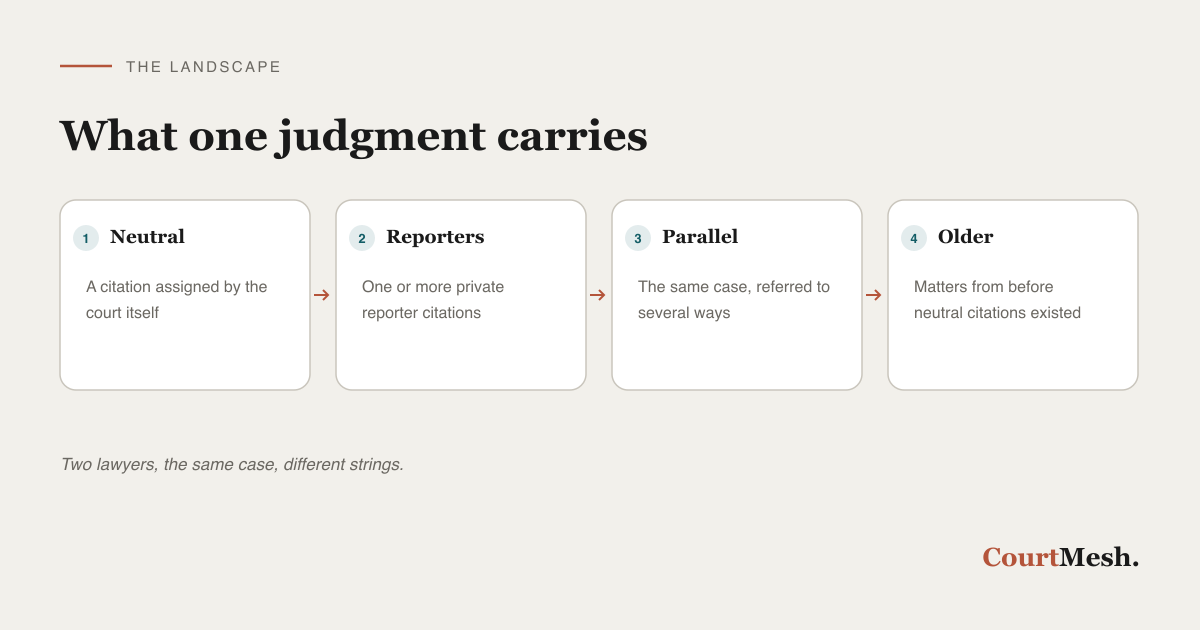
One judgment. One bench. One set of paragraphs. And, often enough, several different ways of writing down where to find it. A single Indian judgment routinely carries a court-assigned neutral citation alongside one or more private reporter citations, which is how two advocates can cite what they both insist is the same case using strings that look nothing alike.
This is not a mistake anyone made. It is the natural result of how judgments are published in India, and of a transition that is still underway. For a long stretch, the address of a case was whatever a private law reporter printed on its spine. More recently, courts have begun assigning their own citations at the source. Both approaches now run side by side, which is useful in the long run and confusing in the meantime.
If you have ever received a citation you could not match to a document, or argued past someone who was leaning on the very judgment you had open, this piece is for you. We will cover how the two kinds of citation differ, why the transition is messy, how to match an unfamiliar string back to a judgment, how to pinpoint a passage so every reader lands in the same place, and how to cite so that anyone reading your work reaches exactly the judgment you meant.
What a Citation Actually Identifies
Strip away the formatting and a citation is just an address. It is a compact instruction that tells a reader where to find one specific judgment among the millions that courts have delivered. A good citation does three things at once: it names the case, it points to the exact document, and, ideally, it lets you jump to the precise passage a party is relying on.
The trouble is that an address depends on the map you are using. If you and I describe the same building using two different systems, one by street and number, the other by plot and survey, both are correct, both point to the same place, and neither is obviously translatable into the other without a little work. Citations behave the same way. The judgment does not change. The system used to point at it does.
The anatomy of a citation
Most citations, whatever their flavour, are built from a small set of ingredients: a year, an identifier for the court or the reporter, and a number that isolates the individual judgment. Some forms add a way to pinpoint a passage, either a page or, increasingly, a paragraph. Read in that light, a citation string stops being a jumble of letters and numbers and becomes a set of coordinates.
Those ingredients are what let you tell one type of citation from another at a glance, and what let you match an unfamiliar string back to the judgment it names.
Why one judgment accretes many citations
A reported judgment passes through several hands, and each pair of hands can leave a citation behind. If more than one reporter carries the same judgment, each stamps it with a different string. Layer a court-assigned neutral citation on top, and a single judgment can legitimately answer to several citations at once.
- The court delivers the judgment and, in courts that have adopted the practice, assigns a neutral citation at the source.
- The judgment is published on the court's official portal, where the authentic text lives.
- One or more private reporters select the judgment, add editorial material, and assign their own citation.
- Advocates, textbooks, and later judgments then cite whichever form they happened to be working from.
None of these is wrong. They are parallel citations: different labels for one judgment. The problems begin only when a reader is handed one label and needs to reach the judgment through another.
Neutral Citation Versus Reporter Citation
The single most useful distinction to hold in your head is the one between a court-assigned neutral citation and a private reporter citation. They come from different places, they are tied to different things, and they behave differently over time.
The court-assigned neutral citation
A neutral citation is assigned by the court itself, independently of any commercial publisher. It is called neutral because it is vendor-neutral and media-neutral: it does not depend on which reporter published the judgment, and it does not depend on a printed page, so it works just as well on screen as on paper. Schematically, it is built from a year, a short identifier for the court, and a running number for the judgment, along the lines of YYYY COURT NNNN. That layout is an illustrative pattern, not a real citation, but it captures the shape you will see.
This is not a proposal waiting to be tried. The Supreme Court of India has adopted a neutral citation system, so at the country's highest court the court-assigned form is working practice rather than suggestion. The live question is no longer whether courts assign their own citations, but how to work while both systems are in use.
Two features make neutral citations powerful. First, the number is allotted at the source, so the citation exists the moment the judgment is delivered, without waiting for any publisher's editorial cycle. Second, neutral-citation systems typically pinpoint by paragraph rather than by page, which is a larger practical difference than it sounds and one we come back to below.
The private reporter citation
A reporter citation comes from a private law report, a commercial series that selects judgments, adds headnotes and editorial commentary, and publishes them in numbered volumes. Its ingredients are different: typically a volume, an abbreviation for the reporter, and the page at which the judgment begins, in the general shape of VOL ABBREV PAGE. That too is a pattern rather than a citation you could look up. Reporter citations carry real value. Editors curate what is worth reporting, write the headnotes practitioners rely on, and provide the analysis that turns a raw judgment into a usable authority.
But a reporter citation is tied to that publisher's series, and reaching it can mean reaching for a subscription product. If two reporters carry the same judgment, you get two reporter citations, neither of which the other publisher will use.
| Feature | Neutral citation | Reporter citation |
|---|---|---|
| Who assigns it | The court, at the source | A private publisher, after selection |
| What it is tied to | The judgment itself, independent of any publisher | A specific volume and page in one reporter's series |
| When it exists | From the moment the judgment is delivered | Only once the judgment is selected and printed |
| How you pinpoint | By court-numbered paragraph | By printed page |
| Stability | Singular for that judgment within the court's own scheme | One of possibly several, differing by publisher |
| Accessibility | Public and free to verify at the official source | Often behind a subscription or in print |
| Editorial value | None added; the bare judgment | Headnotes and commentary added by editors |
Why Neutral Citations Were Introduced
If reporter citations have served the profession for so long, why introduce a new system at all? The answer is partly about access and partly about the shift to digital-first legal work.
Access should not depend on a subscription
A reporter citation can send a reader to a product they must pay for. A court-assigned citation points to the authentic judgment on the court's own record, which anyone can reach.
A stable identifier at the source
Because the court allots the citation when the judgment is delivered, it exists immediately and does not depend on whether, or when, a publisher chooses to report the matter.
One canonical reference
Instead of a judgment answering to several publisher-specific strings, a neutral citation gives the profession a single agreed way to name it.
Built for reading on screen
Pinpointing by paragraph rather than page means a citation resolves to the same passage whether you are on a phone, a laptop, or paper.
None of this makes private reporters obsolete. Their editorial work, the headnotes and analysis, remains genuinely useful. What neutral citations change is the base layer: the plain question of how to name a judgment so that anyone, subscriber or not, can find it.
The core idea
A neutral citation separates the address of a judgment from the business of publishing it. The court says where the judgment is; publishers compete on what they add around it. Keeping those two jobs apart is what makes the address stable, free to verify, and the same for everyone.
Why a Court-Assigned Address Matters for Access
Access appeared above as one reason among four, and it is worth a moment on its own. When the address of a judgment belongs to the court rather than to a publisher, it can be handed to anyone: a litigant appearing in person, a student, a researcher in a district town. Each can reach the court's own record with it, without buying anything first.
That takes nothing away from private reporters, whose curation and analysis the profession pays for because they save time. The point is narrower. A citation anyone can open is also a citation anyone can be held to: quote a paragraph, and a reader can open the same paragraph and judge whether the quotation is fair.
The Transition, and Why the Mess Persists
A cleaner future does not arrive all at once. India has moved towards court-assigned neutral citations, but the move is a transition, and transitions are untidy by nature. Old and new forms coexist, and will keep coexisting for a long time.
Several things make the in-between period genuinely confusing:
These are not reasons to distrust neutral citations. They are the ordinary cost of moving a whole profession from one convention to another while decades of existing precedent stay exactly where they are. The judgments handed down before the change do not retroactively grow neutral citations just because a system now exists.
A citation is a promise that a reader can find what you found. During a transition, the promise holds only if you make it in a form the reader can actually follow.
Matching an Unfamiliar Citation to a Judgment
Half the friction in practice is not citing, it is receiving. Someone hands you a string and you have to reach the judgment through it. Often it opens at once. Sometimes it is a form you have never used, from a court you do not appear in. The method for that case works outwards from the shape of the string.
Work out what kind of citation you are holding
Read the components before opening anything. A year, a court code and a running number follow the illustrative pattern YYYY COURT NNNN and suggest a court-assigned neutral citation. A volume, an abbreviation and a page follow the illustrative pattern VOL ABBREV PAGE and suggest a private reporter. Which kind of address you hold decides where you look.
Pull the court and the year out of the components
The string almost always carries a year and one component standing for an institution: a court in the first case, a publisher's series in the second. A number you cannot interpret matters far less once you know which court and roughly when.
When the string will not resolve, search the parties instead
A citation is only one route to a judgment, and it is the brittle one. Party names, subject matter and an approximate year will reach a judgment that a mistyped or unfamiliar string will not. Allow a year either side, because the year of delivery and the year of reporting need not match.
Confirm by opening the judgment, on more than one detail
Read the court-assigned citation off the document at the official source, where the court prints one. Then check that the bench, the date, the parties and the subject matter fit what you were told. Any one can coincide by accident; all four rarely do.
A string that will not open is not proof of anything
A citation you cannot resolve tells you about your access, or about a transcription. It tells you nothing about the judgment: a string can fail simply because the matter was never reported, or because it predates any court-assigned form and has none to find. Settle it by locating the judgment, not by inference from the failure.
Pinpointing: Paragraphs Travel, Pages Do Not
Naming a judgment is only half of what a citation does. The other half is pointing at the part you are relying on, and that is where the two systems part company most sharply.
The rule is easy to state. A paragraph number belongs to the judgment. A page number belongs to an edition of it. The court numbers its own paragraphs when the judgment is delivered, and those numbers travel with the text wherever it goes: the portal, a printed volume, a PDF read on a phone. A page number is made by whoever set the type and exists nowhere outside that edition. So a page pinpoint asks a favour of the reader, that they happen to be holding what you were holding. A paragraph pinpoint asks for nothing.
What that means when you are drafting
Assume the bench will read the judgment from a source other than yours. That is the ordinary case, not the awkward one: you from a reporter's volume, the other side from a portal, the bench from a screen. A pinpoint that survives all three beats one that is exact in a single edition.
- Pinpoint by the court-numbered paragraph wherever the judgment carries them. It is the one reference every reader in the room can follow.
- Quote a few words alongside the number, so a reader can confirm they have landed in the right place even if the numbering in front of them runs differently.
- Give a page pinpoint as a supplement, not a substitute, where a house style expects one. Carrying both removes the dependency on any single edition.
How to Cite Cleanly During the Transition
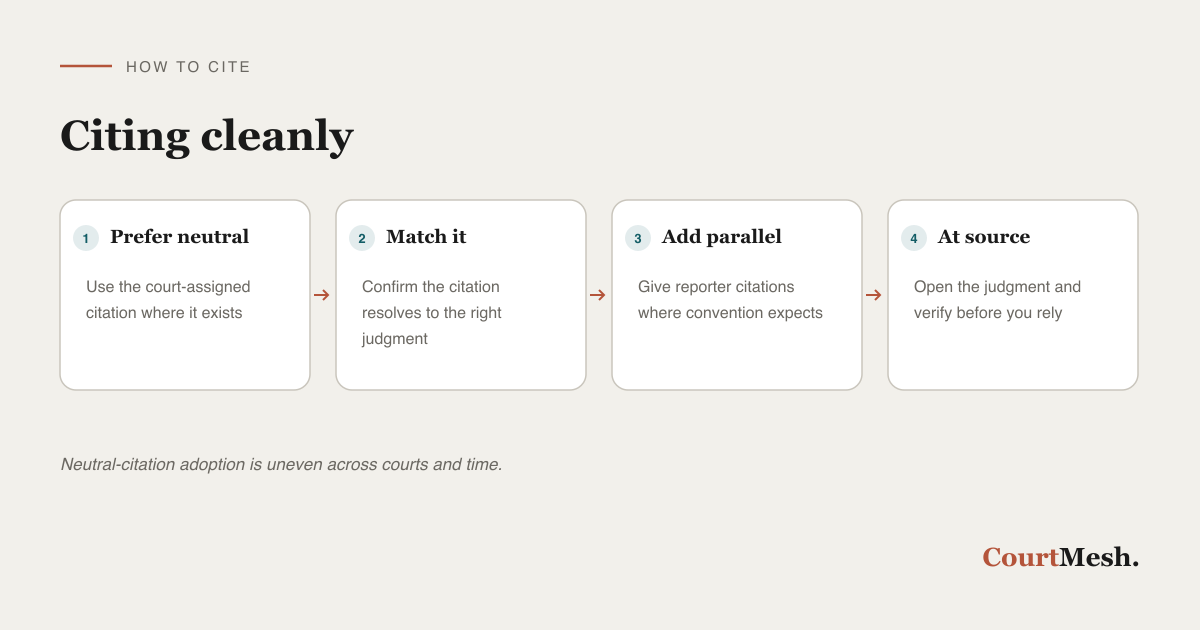
The goal is simple: a reader should reach the exact judgment you relied on with as little friction as possible. Here is a practical way to get there while old and new forms coexist.
Lead with the neutral citation where one exists
It is court-assigned, singular for the judgment, and free for anyone to verify at the official source. If the matter has a neutral citation, make it the primary reference.
Add parallel reporter citations if your forum expects them
Many benches and house styles still expect reporter citations. Provide them alongside the neutral citation rather than instead of it, so a reader can use whichever they can access.
Pinpoint by paragraph, and carry the identifying details
Point to the court-numbered paragraph rather than a page, and carry the case name, the parties, the date and the bench across whichever citation forms you use, so a reader can cross-check that every string names one and the same matter.
Confirm before you rely
Open the actual judgment at the official source and read the citation off the judgment itself before it goes into a filing. Never cite a string you have not resolved to a real document.
Make the citation self-rescuing
Every citation should carry enough around it to survive its own failure. Strings get mistyped, a series may be one the reader does not hold, a form may be unfamiliar. If the string is all you have given the reader, one wrong character ends the exercise.
So present a judgment as a small package rather than as a code: the parties, the court, the date, the court-assigned citation where one exists, and a parallel reporter citation where convention expects it, with a paragraph pinpoint on the passage you rely on. That leaves the reader several independent routes to one document instead of a single point of failure.
An honest caveat
Not every matter has a neutral citation, and a neutral citation is not, by itself, a guarantee that a document is authentic. Nor does the absence of one mean a judgment is not good law. Whatever citation you are handed, confirm that it resolves to the actual judgment at the official source, the Supreme Court's portal, the relevant High Court website, or eCourts, before you rely on it.
What Goes Wrong, Concretely
None of this is theoretical. The transition produces a small set of failures that recur, and each is cheap to prevent and expensive to discover late.
A digit is off, and the string still resolves
The worst transcription error is not the one that fails. It is the one that succeeds. A citation is a set of coordinates, and one wrong character can land on a different judgment that exists, opens, and reads like an authority. What catches it is the parties and the date, not the string.
Two advocates, one judgment, two forms
One side cites the court-assigned form, the other a reporter's, and neither recognises the other's authority as the decision already on the record. The argument runs as though there are two judgments, and is settled by naming the parties and the date.
A citation to a series the bench does not have
A reporter citation is only as good as the reader's access to that reporter. Cite a judgment solely by a series the bench is not reading from, and you have asked the court to take your word for the passage.
A pinpoint from a different numbering
Take a paragraph number from a reproduction that numbers differently from the court's text, and the reference lands on the wrong passage for every other reader. The citation resolves, the judgment is right, only the passage is wrong.
The failures that do not announce themselves
Two of those are caught in the hearing itself, awkwardly but survivably. The costly ones are the two that resolve cleanly: a mistyped string that opens a different judgment, and a pinpoint from a different numbering. Both are caught by one habit: open the judgment, check the parties and the date, and read the passage before you rely on it.
Where CourtMesh Fits
Most citation friction disappears the moment you can put the actual judgment in front of you. That is the narrow, honest job a good research tool does: not to assign citations, and not to promise it has resolved every parallel citation in existence, but to help you find the judgment behind a string and open the official document so you can read and confirm the citation yourself.
CourtMesh indexes roughly 310 million cases across the Supreme Court, all 25 High Courts, District Courts, and Tribunals, sourced only from official government portals, and every result links to the actual judgment. When you are holding a citation you cannot place, that matters, because the endpoint is always the authentic document rather than a summary of it.
To get from a citation to the judgment, you can:
- Search by case name, party, or the language of the matter using keyword or AI semantic search, then open the official judgment to read the court-assigned citation off the document itself.
- Narrow with filters for court, year, judge, case type or date range when a string gives you only partial information.
- Open the actual judgment from an official portal so you can confirm, with your own eyes, that the citation you were handed names the matter you meant.
Used that way, the citation stops being the obstacle. It becomes what it was always meant to be: a fast route to a document you can read, verify, and rely on. CourtMesh is a research tool for finding and confirming judgments, and it is not a substitute for legal advice.
Stop chasing citation strings
The next time a judgment reaches you under a citation you cannot place, whether a court-assigned neutral citation or a private reporter citation, the sensible next step is to open the actual judgment and read the citation off it yourself. CourtMesh puts that document one search away, across the Supreme Court, all 25 High Courts, District Courts, and Tribunals, drawn only from official government portals. Make matching a citation to a judgment the quick part of your day rather than the slow one.
Explore CourtMesh