Some of the hardest questions an advocate carries into court are the ones no court has yet answered. The point is live, the statute is silent or its language cuts both ways, and when you go looking for authority you find that your own High Court has never decided it and the Supreme Court has not settled it either. You are not standing on the firm ground of binding precedent. You are in the territory of persuasion, where a judgment of another High Court does not bind the bench in front of you, but it can still move it.
This is more common than the textbooks suggest. New statutes throw up questions faster than courts can answer them. A provision is litigated in one State before it is litigated in another. A tribunal takes a view that no High Court has yet tested. Insolvency, tax, arbitration, technology, and data law all generate points on which the reported position is thin, recent, or scattered across benches. Sooner or later every practising advocate meets a matter that turns on a question no authority compels the court to answer either way, where the outcome depends not on looking up the answer but on arguing the point better than the other side.
On such a question, strength comes from completeness. The advocate who can place the whole all-India picture before the bench, which High Courts have considered the point, what view each took, how the reasoning runs, and where the weight of opinion lies, argues from a position the opponent cannot easily match. The difficulty is not conceptual. It is practical. Assembling that picture means finding decisions on the same point across all 25 High Courts, many of which never reach the reporters your library carries, and doing it thoroughly enough that you can be candid with the court about the views that cut against you.
The heart of the matter
When your High Court has not decided a point and the Supreme Court has not settled it, no judgment binds the bench. A decision of another High Court is persuasive only. What such a bench responds to is the quality of the reasoning, not the rank of the court that produced it.
How Precedent Is Structured in India
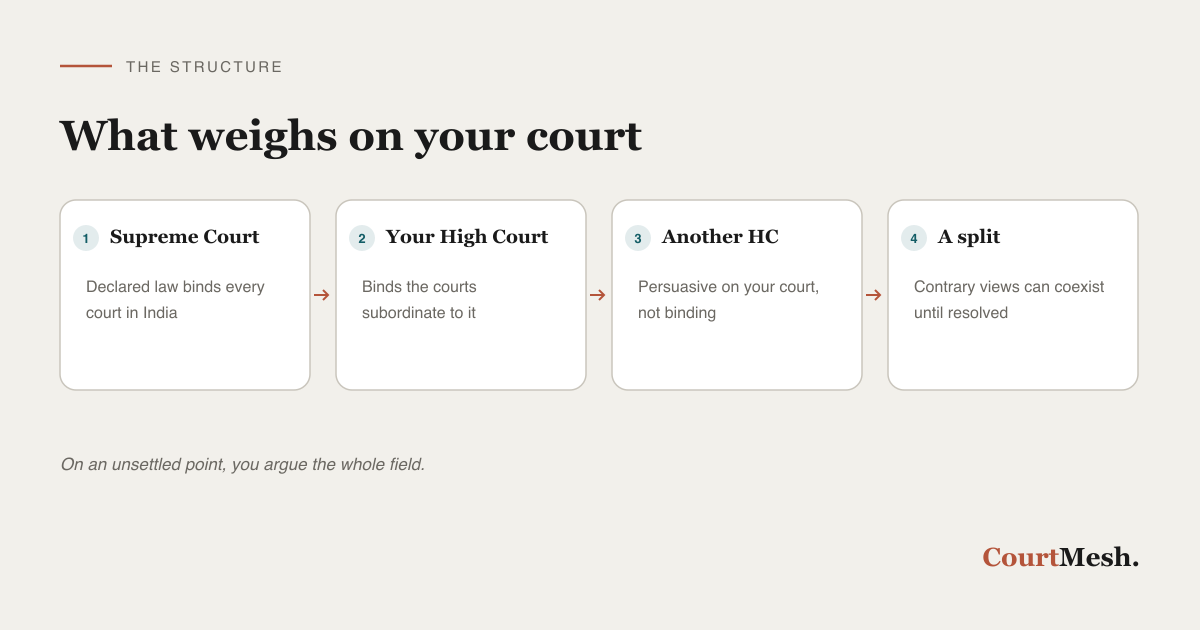
To use persuasive authority well, you have to be precise about what binds and what merely persuades. The Indian system of precedent is a hierarchy, and the weight of any judgment depends entirely on where it sits relative to the court you are addressing.
At the top sits Article 141 of the Constitution. The law declared by the Supreme Court is binding on all courts within the territory of India. When the Supreme Court has decided the ratio of your point, the enquiry is usually over: you are looking for the holding, not for persuasion. Difficulties arise only where the Court has spoken in general terms, or where what it said was obiter rather than the ratio of the decision, or where two of its benches appear to have taken different views.
Below that, a High Court binds the courts subordinate to it. A decision of the High Court governs the district judiciary and the tribunals within its territorial jurisdiction. Within the High Court itself, a coordinate bench ordinarily follows an earlier coordinate bench. A single judge follows an earlier single judge; a Division Bench follows an earlier Division Bench. This is a matter of judicial discipline rather than strict compulsion, but in practice it is nearly as strong. A bench that disagrees with a coordinate bench does not simply depart from it. It refers the question to a larger bench, so that the conflict is resolved within the same court.
Then comes the point this article is about. A decision of one High Court is persuasive, not binding, on another High Court. Each High Court is a constitutional court of coordinate standing, and none is subordinate to another. So a view taken by one High Court, however well established there, does not bind a bench in another that is looking at the point afresh. That view is something the second bench may follow, may distinguish, or may respectfully decline to follow. It carries weight through its reasoning, not through any power to command.
This is why conflicting High Court views can, and do, coexist. One High Court reads a provision one way; another reads it differently; both decisions stand as good law in their own territories until the Supreme Court resolves the conflict or the legislature amends the provision. For the advocate arguing in a third High Court that has not yet spoken, that unresolved split is not a nuisance. It is the field of play.
A Map of Who Binds Whom
It helps to set the hierarchy out plainly. The table below classifies the authorities you are likely to cite by their weight on the High Court you are addressing. The status in the middle column is what changes everything about how you use the judgment.
| Authority | Weight on your High Court | What you do with it |
|---|---|---|
| Supreme Court, law declared under Article 141 | Binding | Follow the ratio. It governs your point across India. |
| A larger bench of your own High Court | Binding | Follow it. Only a still larger bench can revisit it. |
| A coordinate bench of your own High Court | Ordinarily binding by convention | Follow it, or ask that the question be referred to a larger bench. You cannot simply depart from it. |
| Another High Court | Persuasive, not binding | Weigh the reasoning. You may adopt it, distinguish it, or respectfully differ. |
| A court subordinate to your High Court | Not binding | Of persuasive value at most, and only for the quality of its reasoning. |
What Persuasive Really Means
There is a temptation to treat persuasive as a polite word for weak. That is a mistake. A well-reasoned judgment of another High Court, particularly one that has stood for years and been followed elsewhere, can be very hard for a bench to brush aside. Persuasive authority is not authority the court is free to ignore. It is authority the court must engage with, and either adopt or give reasons for not adopting.
The weight of a persuasive judgment depends on things you have to read for, not filter for. The reasoning is what persuades. A judgment that works carefully through the statutory scheme and the competing constructions carries more weight than one that merely states a conclusion. It matters, too, whether the proposition you are relying on is the ratio decidendi of the case, the principle on which the decision actually turned, or merely obiter dicta, an observation made in passing. Obiter from another High Court is persuasive at its weakest. It also matters whether the judgment was rendered per incuriam, in ignorance of a binding statute or precedent, because a decision reached that way carries little force however confidently it is written.
So the number of High Courts that have taken a view is only the beginning. What you are really assessing is the quality and the direction of the reasoning across the field: how many courts have considered the point, which way each leaned, whether the later judgments engaged with the earlier ones or ignored them, and whether the trend is towards one construction or away from it. That is an argument you can build only if you have the whole field in front of you.
On an unsettled point you are not asking the court to obey. You are asking it to be persuaded. The advocate who has read the whole field, including the parts that hurt, is the one who persuades.
Why This Is a Comprehensiveness Problem
Binding-precedent research and persuasive-authority research are different exercises. When a point is settled, you are hunting for one thing: the decision that binds. Once you have it, you can stop. Persuasive-authority research is the opposite. There is no single decision that ends the enquiry, because no single decision binds. You need the whole field, and the value of your research is measured by how little of it you have missed.
That includes the views that go against you. This is not only an ethical requirement, though it is that. It is a matter of advocacy. If three High Courts support your construction and two oppose it, you need to know about the two, because your opponent will find them and because the bench will want to know how you deal with them. Walking into court having found only the helpful half of the field is worse than not having researched at all, because it leaves you exposed on the very ground you did not survey.
You need the whole field
Not the first good judgment, but every High Court that has considered the point, so you can show the bench the full state of opinion across India.
You need the contrary view
The decisions that cut against you are part of the field. Finding them first, and dealing with them, is what separates a candid argument from an ambush waiting to happen.
You need the reasoning, not the count
A split is not settled by a headcount of High Courts. What weighs is how each court reasoned, whether it engaged the other views, and where the trend now sits.
Why Traditional Research Misses the Cross-Court Picture
If the task is to survey all 25 High Courts on a single point, traditional research methods work against you at almost every step. The reasons are structural, not a matter of effort.
Reporting is regional. A judgment that is prominent in one state's reporters may never appear in the series your library carries. Older and unreported decisions of one High Court can be effectively invisible from another. If your reading is anchored to a particular set of reporters, you are seeing a particular slice of the country, and the slice you are missing is exactly the cross-court material persuasive research depends on.
Vocabulary drifts across benches. Two High Courts deciding the same point will often describe it in different words. One frames it as a question of limitation, another as one of condonation of delay; one speaks of maintainability, another of jurisdiction. Keyword search rewards you only when your words match the court's words. A decision squarely on your point, written in vocabulary you did not think to search, stays hidden. Persuasive research is precisely where this hurts most, because the differently-worded decision in a distant High Court is often the one you most need to find.
And the sheer spread defeats manual coverage. Reading every High Court, across the relevant years, on a single point, through a keyword-and-reporter workflow, is slow enough that in practice it does not get done. Advocates fall back on the two or three High Courts they know best, cite those, and hope the rest of the field agrees. On an unsettled point, that hope is the weakness in the argument.
Building the All-India View: A Method
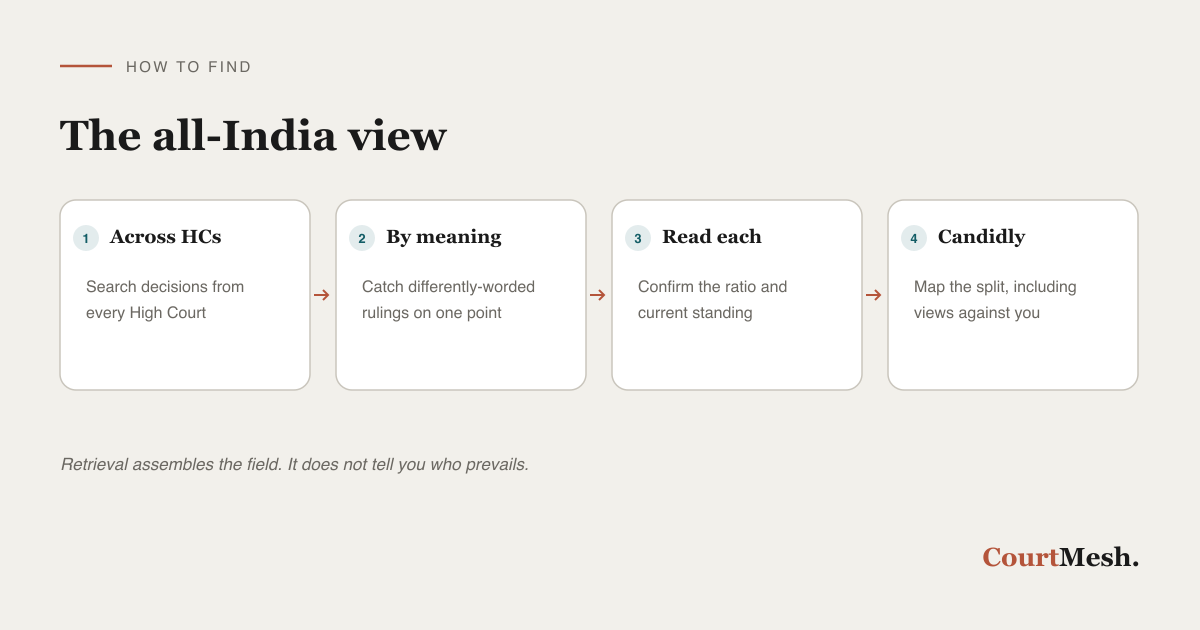
The remedy is a method, not more hours. The goal is to see the whole field first, in one place, and only then to read, weigh, and map it. The sequence below is how persuasive-authority research holds together when nothing binds the court.
Search across all High Courts at once
Begin with a single search that reaches every High Court, not one bench at a time. The point of the exercise is coverage, so the opening move has to be national. Anything narrower reintroduces the regional blind spot you are trying to escape.
Search by meaning, not only by words
Because the same point is described differently across benches, run the search on the concept, not on a fixed phrase. Meaning-based retrieval surfaces decisions that are on point but worded in vocabulary you would never have guessed, which is where the cross-court material usually hides.
Narrow with structured filters
Once you have the field, tighten it. Filter by court, by year, by case type, by date range, so that you are working with the decisions that actually bear on your point rather than the full sweep of results.
Read each authority at its source
A search result is a lead, not a holding. Open the actual judgment and read it. Confirm what the court decided, identify the ratio, separate it from obiter, and satisfy yourself that the case says what you want to cite it for.
Confirm each is still good law
Check whether the judgment has been followed, distinguished, doubted, or overruled since. A persuasive authority that has been overtaken is a liability. Citation relationships help you see how a decision has been treated, but they are a starting point for verification, not the end of it.
Map the split honestly
Set the decisions out as a field: which courts took which view, how each reasoned, and where the contrary authority sits. Build your argument on the strongest reading, and prepare to meet the decisions against you rather than hoping the bench overlooks them.
The Duty of Candour: Citing Against Yourself
There is a professional dimension to all of this that is easy to state and hard to live up to. An advocate owes a duty of candour to the court. On an unsettled point that duty has real bite. If you know of a judgment directly against the proposition you are advancing, the honourable course, and very often the effective one, is to bring it to the court's attention yourself and explain why it should not govern the matter.
This is not self-defeating. A bench that sees you deal openly with the authority against you trusts the rest of your argument more, not less. The advocate who cites the contrary High Court view and then distinguishes it, or shows why its reasoning is the weaker, is far more persuasive than the one who conceals it and is caught. Research and ethics run together here, and neither is done properly without the other.
You cannot be candid about a field you have not surveyed. Comprehensiveness is not just good advocacy. It is what makes candour possible.
Where CourtMesh Fits
This is the exact problem CourtMesh was built to make tractable. The platform indexes roughly 310 million cases from the Supreme Court, all 25 High Courts, the District Courts, and Tribunals, drawn only from official government portals. Because one search runs across every High Court at once, the first and hardest move of persuasive research, surveying the field in one place rather than assembling it reporter by reporter, becomes the default. Every result links straight to the actual judgment, so the field you survey is always one click from the text you have to read.
Two capabilities matter most for the cross-court problem. Semantic search retrieves conceptually related judgments without depending on the exact words used, which is how you catch the decision that is squarely on your point but written in another bench's vocabulary. And citation relationships, whether a case has been followed, distinguished, overruled, or referred to, help you see how a judgment has been treated over time, so you are less likely to cite an authority that has quietly been overtaken. Structured filters for court, year, judge, case type and date range let you narrow the field to the decisions that actually bear on your point once you have it in view.
What a tool can and cannot do
Retrieval helps you assemble the field faster and cast a wider net than a reporter-bound workflow ever could. It does not do the lawyering. You still have to read each authority at its source, confirm it is still good law, work out the ratio, and present the split candidly, including the parts that hurt. A tool does not tell you which view a court will prefer or which side of a split will prevail. And its citation analysis covers only a subset of the corpus, so the absence of a flagged relationship is never proof that none exists. Use it to see the field. Do the judgment yourself.
See the whole field before you argue
When no court has bound you, the advocate who has surveyed all of India argues from strength. CourtMesh gives you one search across the Supreme Court and every High Court, semantic retrieval that catches the differently-worded decision, and citation signals to check whether an authority still holds, each result linked to the judgment itself. Build the all-India picture, read it at source, and present the split with candour. See what a unified cross-court search puts in front of you.
Explore CourtMesh