Property due diligence in India has a settled shape. You trace the chain of conveyances backwards, you take out an encumbrance certificate for the period, you examine the mutation entries and the revenue records, you check the approvals, and if the documents line up you form a view that the vendor can convey what the vendor is offering to convey. That work is essential, it is skilled, and no safe transaction happens without it. It is also incomplete in one specific and expensive way. A title search tells you what has been recorded about a property. It does not reliably tell you what is being fought over, in a court, about the same property.
The distinction sounds academic until you watch it play out. A purchaser can complete a transaction on documents that are perfectly in order, pay the consideration, register the sale deed, get mutation effected, take possession, and only then discover that a suit over the same land has been pending in the district court for four years. The plaintiff may be a co-owner who says the vendor sold more than the vendor's share. It may be a person holding an earlier agreement who wants the court to enforce it against the vendor. It may be an heir who says the will relied on in the chain was never valid. None of them had any reason to appear in the register. Their claim was never an instrument to be registered. It was a plaint, filed in a court, indexed under names.
This article is for the person who has to sign off: in-house counsel at a company acquiring land, the advocate doing the title work, a family buying a flat, a lender taking security. It sets out what a title search establishes and what it structurally cannot, the categories of litigation that attach to land without touching the register, why they are so hard to find in India, a search method that improves the odds, and the limits that no method removes.
The core of it
A title search reads a register. Litigation lives in a court. The register is organised around the property; the court record is organised around people. That single mismatch is why a transaction can be clean on paper and contested in fact, and it is why a litigation search is a separate exercise rather than a step inside the title search.
What a Title Search Actually Establishes
A title investigation is a documentary exercise and a demanding one. Done properly it means reading the chain of conveyances over a long period, satisfying yourself that each transfer was made by someone competent to make it, taking out an encumbrance certificate from the relevant sub-registrar, examining the revenue records and mutation entries, verifying the identity and capacity of the vendor, checking sanctioned plans where there is construction, and looking at the property itself.
What that establishes is real. At the end of it you can say, with reasons, that the documents disclose an unbroken chain of transfers to the person now offering to sell, that no encumbrance was registered against the property in the office and period searched, and that the revenue records show the expected person holding the expected extent. Those are meaningful findings. They are also, every one of them, findings about documents.
What the register is built to hold
Registration under the Registration Act 1908 exists so that dealings in immovable property are recorded and can be found by someone who comes later. It is a record of instruments: sale deeds, gift deeds, mortgages, leases, releases, partitions, and the other documents through which rights in land are created and transferred. An encumbrance certificate is drawn from those records and answers a narrow question honestly, which is: what registered transactions affecting this property appear in this office over this period.
Even within its own domain the record has known gaps, and a good title opinion says so. A document never registered does not appear. A transaction registered in another office may not surface. The period searched is the period searched, and anything older sits outside it. Mutation entries, which buyers routinely treat as confirmation of ownership, are fiscal records maintained for the collection of revenue; they follow a transaction rather than creating or extinguishing rights in it. None of that is a criticism of the exercise. It is the exercise, done honestly.
What the register was never built to hold
Now the structural point. A claim is not an instrument. When a person files a suit saying that a deed in the chain is a forgery, that the vendor is one of five co-owners rather than the sole owner, or that they hold an earlier agreement to sell which the vendor has refused to honour, nothing comes into existence that can be registered. There is a plaint, a case number, a court file, and in time a set of orders. None of it has a natural route into the sub-registrar's index. The register carries on describing a property whose ownership is being actively contested somewhere else.
Some states do provide a mechanism by which a notice of pending litigation can be entered in the registration records. Where that mechanism exists, and where a party has actually taken the step, the register will carry a warning. Neither condition can be assumed. A brother fighting a partition suit has little incentive to go and register a notice, and frequently does not, particularly because the doctrine of lis pendens, to which the Transfer of Property Act 1882 gives statutory expression, generally binds a purchaser who buys while a suit is pending in any event. The absence of a notice in the register is not evidence that no suit is pending. It is evidence that no notice was registered. How lis pendens actually bites on a given transaction is a question for your advocate on the facts, but the practical lesson is blunt: buying in ignorance of a pending suit does not make the suit go away.
The Gap Between the Register and the Court
Three features of that gap are worth separating out, because each defeats a different assumption purchasers make without noticing they are making it.
The register is organised by property, the court by parties
You can go to a sub-registrar with a survey number and ask what is recorded against it. You cannot ask a court the same question. Court records are indexed by case number and party name, because a court is a forum for a dispute between people, not a repository of information about land. There is no index of litigation by survey number, plot number or municipal number. The one thing every purchaser wants to ask, what is pending about this land, is not a question the court system is built to answer.
A claim exists from the day it is filed
A suit affects a property from the moment it is instituted, long before any decree, and often the most consequential document in the file is an interim order made in the first fortnight. There is no waiting period during which the outside world gets told. The documents in the chain look exactly the same the day before the suit and the day after, because nothing in them has changed. What has changed sits in a court file in another building.
Records lag; courts do not wait
Revenue records and mutation entries are updated after the fact, at their own pace, and an order restraining the vendor from transferring the property may never be reflected in them at all. By the time the paper world catches up with a dispute, the transaction that the paper should have warned you about has usually been completed, registered and paid for.
Documents record what people agreed. Litigation records who disagrees, and disagreement is what unwinds a transaction.
The Litigation That Attaches to Land
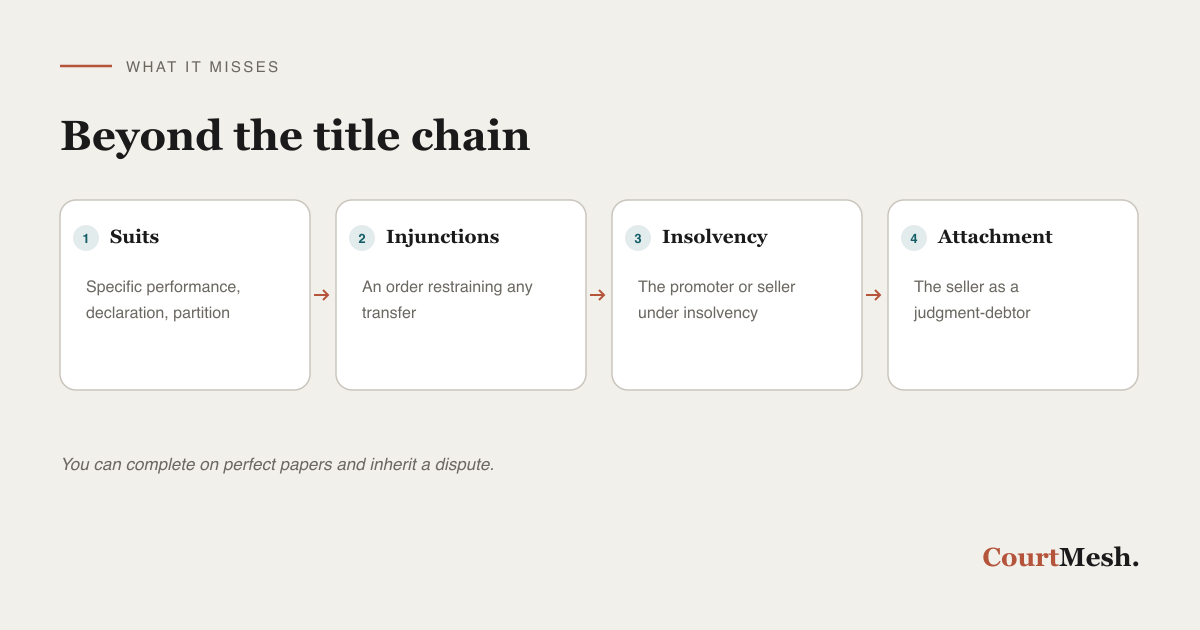
Not every matter involving a vendor is your problem. A vendor's service dispute or motor accident claim will rarely touch the land. Other categories sit very close to the transaction, and they fall into three families.
Claims to the property itself
The most direct threat is a person asserting that the property, or a share in it, is theirs. A suit for specific performance under the Specific Relief Act 1963 is brought by someone holding an earlier agreement to sell, asking the court to compel the vendor to convey to them; if that plaintiff succeeds, the purchaser who came later is left arguing about their own position rather than enjoying the land. A suit for declaration, usually coupled with a prayer to cancel a deed, attacks a link in the chain directly: a will said to be fabricated, a power of attorney said never to have been granted, a sale said to have been made by a person with no authority to make it. Partition and succession disputes are the quiet epidemic of the field, because so much land is held jointly, informally and across generations. A vendor who is genuinely one of several co-owners can convey only what is theirs, and a sibling or an heir who never consented has every reason to say so in court.
Orders that restrain the vendor
An injunction is different in kind, and easy to miss because it is short. A court may restrain a party from transferring the property, from creating rights in favour of anyone else, or from disturbing possession, usually by an interim order made early and revisited later. That order changes nothing in the register. It changes what the vendor may lawfully do. A transfer made in the teeth of it exposes the purchaser to having the transaction unwound and the vendor to the consequences of disobeying a court. The order may run to a page, it may have been passed years ago, and it will certainly not be sitting in the bundle of documents the vendor hands across the table.
Claims against the vendor rather than the property
The third family does not concern the property at all, until suddenly it does. If the vendor is a judgment-debtor, a decree-holder pursuing execution can seek attachment and sale of the vendor's assets, and property sold quietly while that is going on can be pulled back into the proceeding. If the vendor is a company, or the project is being built by a promoter that has gone before the National Company Law Tribunal under the IBC 2016, insolvency changes what may be transferred and by whom, and the timing of a transfer can itself become the subject of scrutiny. A purchaser who searched for suits about the land but never for proceedings against the seller has looked in one of the two places that matter.
The table below sets out the categories that recur, whether a conventional title search would surface them, and where you would actually go to look. Read the middle column as the general position rather than a rule for every state and every fact pattern.
| Type of matter | Would a title search show it | Where and how to look |
|---|---|---|
| Suit for specific performance of an earlier agreement to sell | Generally no. Unless the agreement itself was registered and falls inside the office and period searched, the register stays silent. | Civil courts of the district where the land lies, and the appellate courts above them. Search the vendor and every prior owner in the chain, and read for reliefs seeking conveyance. |
| Suit for declaration, or to cancel a deed in the chain | No. The impugned deed appears in the register looking perfectly regular. The challenge to it does not appear at all. | Search every party to the challenged deed: the executant, the attorney holder, the beneficiary, and the legal heirs of anyone deceased. |
| Partition suit among co-owners or family members | Rarely. A registered partition deed or a decree may surface. A pending partition suit will not. | District civil courts. Search the vendor, the other recorded co-owners, and the known legal heirs of the last recorded owner. |
| Succession, probate and challenges to a will | No, until something is granted, registered or produced. | Testamentary jurisdiction sits with the High Court in some places and the district court in others. Search the deceased and every known heir. |
| Injunction restraining transfer or creation of rights | No. An interim order is an order of a court, not an instrument for a register. | Read the orders inside every pending matter involving the vendor, not just the case titles. The restraint may sit in an interlocutory application. |
| Insolvency of the promoter or the vendor entity under the IBC 2016 | No. Nothing in the title chain changes when a petition is filed or admitted. | NCLT and NCLAT. Search the developer entity, its group companies and its directors, and check current status rather than mere existence. |
| Money decrees, execution and attachment against the vendor | Usually not, and where an attachment is reflected at all it depends on state practice and on whether it was communicated. | Search the vendor as a defendant and as a judgment-debtor, including execution proceedings. A decree obtained in one district can reach property in another. |
| Tenancy, eviction and possession disputes | No. Occupancy rights and protected tenancies rarely leave a mark on the deeds. | Rent control and small causes forums and the civil courts. Several of these publish little online, so combine the search with a physical inspection and enquiry of the occupants. |
| Complaints against a promoter under the Real Estate (Regulation and Development) Act 2016 | No. A project registration can look current while complaints accumulate against the promoter. | The state RERA authority and its appellate tribunal, plus the courts. Search the promoter entity and the project name. |
| Acquisition, planning and other regulatory challenges | Sometimes reflected in the revenue records, often not, and seldom with the current position. | Writ petitions in the High Court, typically naming the state and the landholders. Search the vendor and the prior owners in the chain. |
Why This Is Hard to Find in India
If the categories are clear, the search is not. Finding property litigation in India is genuinely difficult, and the difficulty is structural rather than a failure of effort.
Start with indexing, because everything else follows from it. The only way into a court record is through a name, which means the quality of the whole exercise is decided before any searching happens, at the moment you settle whose names go on the list. Miss a name and you will not see the matter, and nothing in the result will indicate that anything is missing.
Then the identity of the property is itself unstable across records. The same land is a survey number in the revenue record, a plot number in a layout plan, a khasra or hissa number in another state's system, a municipal number in the tax record, a tower and flat number in the builder's nomenclature, and in an old deed a description by boundaries where the boundaries are the names of neighbours who died decades ago. Extents are stated in different units. Villages get absorbed into municipal limits and renamed. Even when a court order does describe the property, matching that description to the one in your documents is an exercise of judgement, not a lookup.
Add the spread of forums. A dispute about a single piece of land can sit in the civil court of the district where it lies, in the High Court on appeal or in a writ petition about acquisition or planning, before the NCLT if the promoter is insolvent, before a RERA authority if it is a registered project, before a rent control or small causes forum if the fight is about possession, before a revenue court in matters that revenue law assigns there, and before a Debts Recovery Tribunal if a bank has moved against the owner. Each publishes on its own terms, and some barely publish at all.
Names multiply everything again. The vendor appears with initials in one filing and an expanded name in another, with a father's name attached in one register and not the next, with a spelling that shifted when it crossed from another script into English. Companies are renamed; families use more than one version of a surname. Then there is the limit no diligence removes: an heir who has not yet come forward is a name you cannot search. And publication is uneven, so interim orders trail behind final ones and district court entries can be far too thin to tell you whether a matter touches your land.
A Search Method That Holds Up
None of this makes the exercise futile. It makes it a discipline. A property litigation search is reliable to the extent that it is done deliberately, with its coverage written down and its limits understood. The sequence below carries most of the weight, whatever you use to run it.
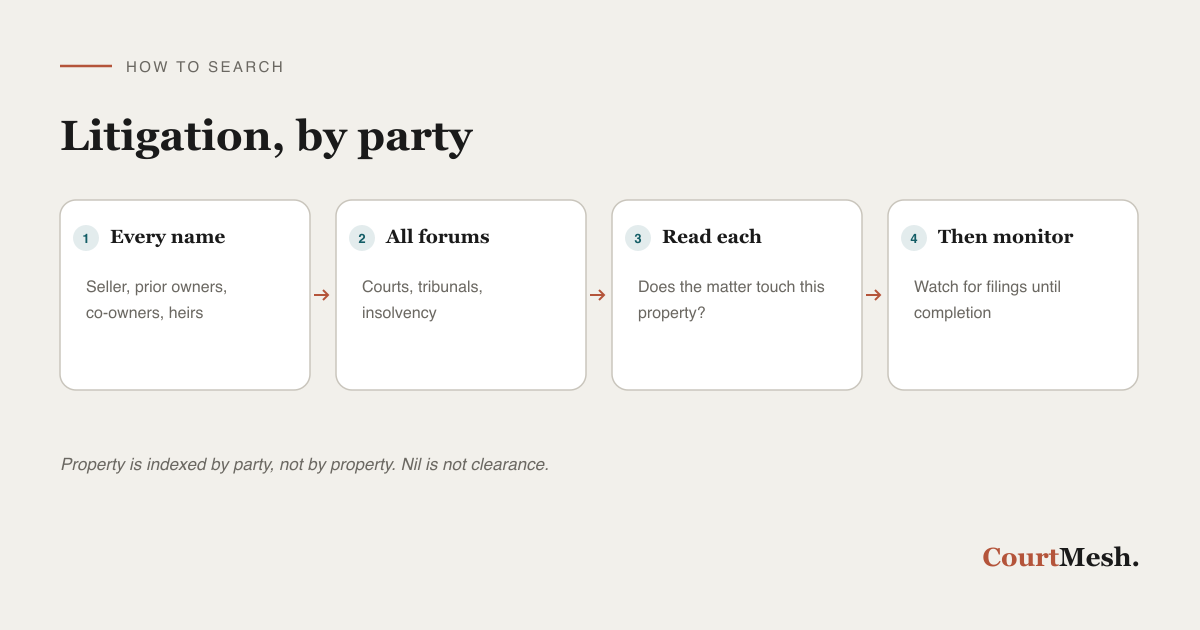
Take the names off the title documents, not out of your head
Open the chain of title and write down everyone in it: the vendor, every prior owner over the period examined, confirming parties, attorney holders, recorded co-owners, any mortgagee, and the known legal heirs of the last recorded owner. Where a project is involved, add the promoter entity, its group companies and its directors. This list is the search. Whatever is not on it will not be found, no matter how good the tool.
Write out the variants before you run anything
For each name, list the forms it plausibly takes in a court record: initials and expansions, with and without a father's name, alternative transliterations, married and maiden surnames, and for companies the abbreviated and full forms along with any former name. Search one form only and you retrieve one slice. The matters filed under the others sit there unretrieved, and the search box reports nothing wrong, because from its point of view nothing is.
Search every layer, not the one you assume matters
Property suits are overwhelmingly instituted below the High Court, so cover the district courts of the place where the land lies and, because proceedings against a person can be brought where that person is, the courts where the vendor and the promoter are based. Add the High Court and the Supreme Court for appeals and writs, and the tribunals, with the NCLT wherever an entity rather than an individual is selling. For the forums that publish little, such as rent control and revenue courts, plan to enquire rather than to search.
Read every hit; do not count them
A number is not an answer. Open each matter and look at the case type, the reliefs, the parties and their capacities, the year, the current status and the orders. Property litigation hides its significance in interim orders far more often than in final judgments, and a matter that looks dormant on a list may carry a live restraint on your vendor.
Test each plausible hit against the property description
The question is never whether the vendor is in litigation. It is whether the litigation is about this land. Where the record describes a property, hold that description against the one in your documents and see whether they can be reconciled. Where the online entry does not say enough, inspect the court record or apply for certified copies of the plaint and the orders. Guessing is not diligence.
Keep the traditional steps, and add the human ones
A search sits alongside the rest of the exercise, not on top of it. Take a written declaration and indemnity from the vendor about pending litigation, issue the customary public notice, inspect the property physically, and speak to the occupants and neighbours, who frequently know about a family dispute long before any record does. The most useful facts about contested land are often obtained by asking a person standing on it.
Search again immediately before completion, and keep watching after
A search is a snapshot with a short shelf life, and the gap between diligence and registration is exactly when an aggrieved co-owner tends to move. The period you searched and the period you are exposed to are not the same period: a suit can be filed in the interval, an injunction can be granted in it, and publication lag means a matter filed before your search may only surface after it. Re-run the names before you complete, and where exposure continues, for a lender holding security or a buyer awaiting mutation or possession, set up monitoring so that a new filing against the vendor or promoter reaches you when it appears rather than when it becomes a notice of motion.
Reading a Hit: Does It Touch This Property?
Most of the skill in this exercise is triage. A common name in a large district will return matters that have nothing to do with your transaction, and the discipline is to work out quickly which ones might. A few things decide it.
- The parties: does the cause title name your vendor, a prior owner, a co-owner or an heir, and in what capacity
- The case type and the reliefs: specific performance, declaration, cancellation, partition and injunction all point at land in a way a commercial recovery suit does not
- The schedule of property where the record discloses one: survey or plot number, extent, boundaries, village and district
- The forum: a matter before the court exercising jurisdiction over the place where the land lies deserves closer attention than one filed elsewhere
- The orders: an interim injunction, an attachment or a direction to maintain status quo can matter far more than the eventual outcome
- The status: pending or disposed, and if disposed, whether an appeal or an execution has followed
Ambiguity is normal. You will regularly find a matter that names the right person and says nothing at all about which property is involved. Treat that as a reason to go to the record: inspect the file, obtain certified copies, and put a direct question to the vendor in writing. What you must never do is resolve the ambiguity in the direction that suits the transaction. A hit you could not rule out is a hit you have not cleared.
The Caveat That Matters Most
Everything above is worth doing. None of it is worth trusting blindly, and the most dangerous mistake available in this exercise is to read silence as safety.
A nil result is not clearance
If you search every name you have and find nothing, you have established exactly one thing: nothing was found, for the names you searched, in the sources you searched, on the day you searched. You have not established that the property is free of litigation, and the reasons are structural rather than incidental. Property matters are indexed by party and not by property, so a matter can only be reached through a name you already knew to look for. Names vary in spelling, expansion and transliteration, and a variant you did not try returns nothing at all. Some forums publish little or nothing online, and every court publishes with a lag. A claimant who has not yet filed, or an heir nobody has heard of, is invisible by definition. A litigation search informs property due diligence. It does not replace it. A formal title investigation, a search of the registration and revenue records, and a written opinion from a qualified advocate remain necessary, and where anything turns on the answer, the official records of the relevant court, sub-registrar and revenue authority prevail over what any search tool displays. Read a clear result as a reason to proceed carefully. Never as clearance.
Where a Litigation Search Fits
The mechanical part of this work, the dozen portals with a dozen search grammars, is the part software can take off your desk. CourtMesh lets you search a party by name across roughly 310 million cases drawn only from official government portals, covering the Supreme Court, all 25 High Courts, the District Courts and the Tribunals, with the NCLT included for insolvency. Keyword search and AI semantic search both run over that corpus, and filters narrow the long list thrown up by a common name to the handful worth reading. Every result links through to the actual matter, which is the point of it: the value is never the count, it is being able to open the case and decide for yourself whether it touches your land. What the corpus holds is bounded by what those portals have published, so a search of it is a starting point and not a certificate.
Two habits make it useful for property work in particular. The first is running the whole name list, the vendor together with the prior owners, the co-owners, the known heirs and the promoter entity with its directors, rather than the single name printed on the agreement. The second is pointing keyword search at a distinctive identifier where one exists, a project name or a survey number, in case that text appears in the indexed record of a matter a party search would have missed. Treat that as a supplement, not as a property index. The record is still compiled around parties, and a search of this kind finds text, not land.
For the exposure that continues after diligence, the watchlist monitors a party by name and alerts you when a new filing surfaces in the source registries, which means it can only be as prompt as the registry that publishes it. It is private to your organisation, which matters more than it first appears when the name you are watching belongs to a live transaction counterparty whose attention you would rather not attract.
CourtMesh indexes court matters, not land records
This has to be said plainly, because the distinction is the entire argument of this article. CourtMesh does not hold title deeds, encumbrance certificates, registration indexes, mutation entries or any other land record, and it cannot perform a title search, establish ownership or clear a property. What it indexes is court matters. It is built for the question a title search structurally cannot reach, which is whether the people in your chain of title appear in court records, and where. It complements the title work. It does not do the title work, and it is not legal advice on your transaction.
Search the names before you sign the deed
A title search tells you what has been recorded about a property. It cannot tell you that a co-owner filed a partition suit last year, that an injunction restrains your vendor from transferring anything, or that the promoter behind the project is before the NCLT. CourtMesh brings that half of the picture into a single search across the Supreme Court, all 25 High Courts, the District Courts and the Tribunals, roughly 310 million cases drawn only from official government portals, with a private watchlist that keeps watching between agreement and registration. It will not clear a property, and it replaces neither the title investigation nor the legal opinion. It lets you ask, of every name in the chain, the one question the documents will never answer on their own.
Explore CourtMesh