Consider a sequence that will be familiar. An advocate goes looking for authority on a narrow point of tenancy law. The search returns nothing on point, so the question looks unsettled and the argument gets built the hard way, from first principles. Yet a High Court elsewhere in the country has decided that very question, squarely and in favour of the position being argued, and the advocate never finds it. The reason is not poor research. The reason is that the judgment was delivered in a regional language, and the search only ever asked its question in English.
This is not a rare misfire. It is a structural feature of legal research in India, and it is becoming more pronounced every year. Our courts do not operate in a single language, and increasingly they make no pretence of doing so. That is a real gain for access to justice. It is also a research problem that keyword search was never designed to solve.
Courts That Speak in Many Tongues
English remains the working language of the Supreme Court and much of the higher judiciary, and it is not going anywhere. But it has never been the whole picture. Across the country, an enormous volume of judicial work happens in the language of the region the court serves. Matters are argued, evidence is recorded, submissions are made, and orders and judgments are written in the language that the bench, the advocates, and above all the litigants actually use.
District and subordinate courts, where most people in India first encounter the justice system, very often work in the regional language of the state. A number of High Courts permit or use regional languages alongside English. The consequence is a body of legal reasoning that has always been partly vernacular, even though the reported, citable, and heavily searched slice of it has historically been dominated by English.
The translation push is real, and it is welcome
There is now a serious and sustained effort to go further, to place judgments in the hands of litigants in a language they can actually read, through translation. The logic is difficult to argue with. A litigant who cannot read the judgment that decides their land, their livelihood, or their liberty has not, in any meaningful sense, been fully heard. Making judgments available in regional languages is among the more significant access-to-justice reforms of the last several years, and its direction is unmistakable: more languages, more judgments, more of the time.
We will not attach figures to any of this, for two reasons. The numbers move quickly, and false precision here would be worse than honest generality. The qualitative picture is what matters, and it is clear enough. A growing share of Indian judicial output already exists, or soon will, in languages and scripts other than English. Often it exists in more than one language at the same time: the original as delivered by the court, and a translation intended to make it readable to the person whose case it decides.
Genuinely Good, and Genuinely a Problem
Two things are true at once here, and it helps to hold both without flinching. The first is that multilingual judgments are good. Justice delivered in a language the litigant cannot read is justice delivered at arm's length. Translation narrows that distance. It lets a farmer, a tenant, a small trader, or an accused person read for themselves what the court found and why. That is not a technicality. It sits close to the heart of what a fair hearing is supposed to mean.
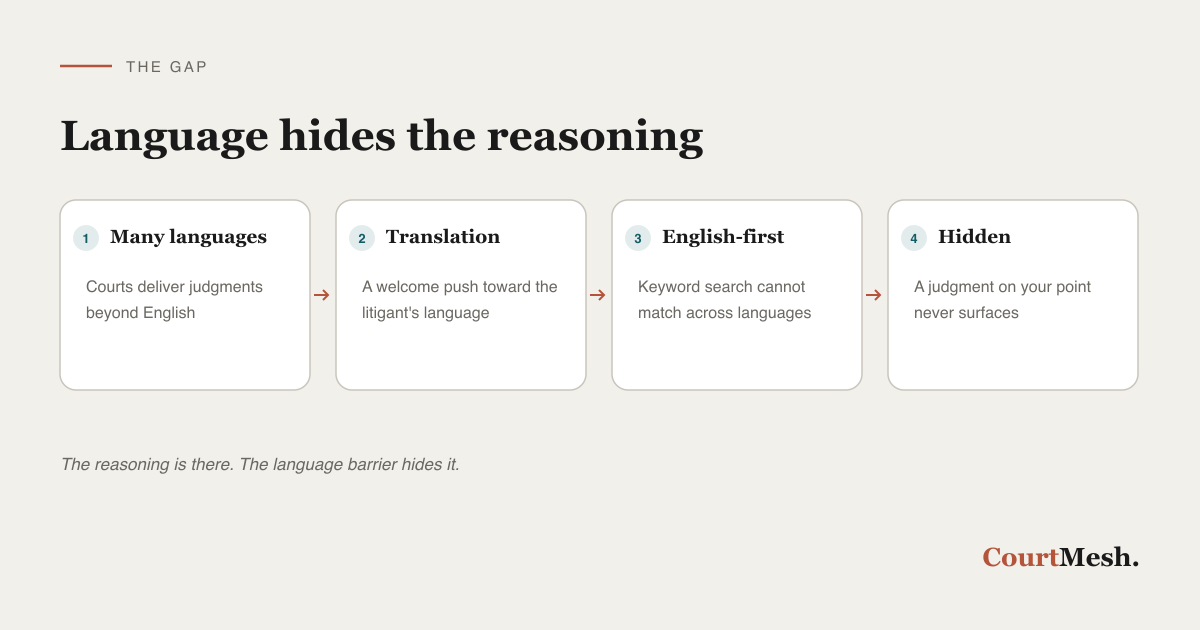
The second truth is that the same development fragments the raw material of legal research. The corpus of Indian reasoning is no longer a single English-language pile that one query can rake through. It is spread across many languages and several scripts, and it is growing in all of them at once. The reasoning an advocate needs is somewhere in that pile. Whether it can be found depends almost entirely on whether the search tool and the judgment happen to share a language. Frequently, they do not.
The law is there. The language is hiding it.
In most multilingual misses, the problem is not that no court has decided your point. A court may well have decided it, clearly and recently. The problem is that it decided your point in a language your search never asks about. The authority exists. The wording of your query, in the wrong language for that judgment, is what keeps it out of sight.
Where English-First Search Structurally Breaks
Traditional legal search matches strings of characters. You type words, the engine looks for documents that contain those same words or close variants, and it ranks what it finds. Within a single language, that is serviceable, if blunt. Across languages, it does not merely get worse. It breaks at the foundation, and it does so in at least three distinct ways.
A query in one language cannot match text in another
This is the simplest and most unforgiving barrier. A judgment written in one Indian language does not contain the English words you searched for, and an English judgment does not contain the words you would type in a regional language. There is no shared string to match on. The most relevant authority in the country can sit in the database, fully indexed, and remain permanently invisible to a query phrased in a language it was never written in. The engine is not failing. It is doing exactly what it was built to do, which happens to be the wrong thing for this problem.
Scripts and transliteration multiply the misses
India does not merely use many languages. It uses many scripts, and it moves words between them constantly. A single legal term or a party's name can be written in its native script, transliterated into the Roman alphabet in more than one accepted spelling, or rendered differently by two typists on two different days. Exact-match search treats each of these forms as a separate, unrelated token. Search one spelling and you miss the others. There is no single correct string to search for, which means there is no single search that catches everything.
Legal terminology does not translate word for word
Even setting scripts aside, legal language resists literal substitution. The word a statute uses in one language, the phrase an advocate would use in submissions, and the term a bench chooses in its judgment are frequently not identical, and the gap widens across languages. A concept that is one settled term of art in English may be expressed through a phrase, a borrowed word, or a locally established usage in a regional language. Keyword search has no notion of a concept. It knows only the characters you gave it, so it quietly drops every judgment that reached your idea by a different verbal route.
| Research scenario | English-first keyword search | Meaning-based retrieval |
|---|---|---|
| Query in English, judgment in a regional language | No shared string, so the judgment does not surface at all | More tolerant of wording, and where an English translation or summary exists it can help relate the concepts, though it cannot read a language it was never given |
| Same legal concept, different term of art across languages | Misses anything that did not use your exact word | Ranks by meaning, so closely related phrasing can still surface |
| Party name or term transliterated several ways | Each spelling is a separate token, so you catch only the ones you typed | Handles wording variation more gracefully, but is not a substitute for searching the native script where you can |
| Judgment exists only in its original language, no translation held | Invisible unless you happen to query in that language | Still cannot conjure a document it does not hold, because retrieval is not translation |
| You need the operative, binding text | Returns the string it matched, wherever it sits | Helps you locate candidates, but the authoritative version must still be read at source |
What Meaning-Based Retrieval Can and Cannot Do
Meaning-based search, often called semantic search, works differently from keyword matching. Instead of hunting for identical characters, it tries to represent what a passage is about and to retrieve text that is close in meaning to your query, even when the wording differs. For multilingual research this is a meaningful improvement over exact match. It is also, and this matters just as much, not magic. It is worth being precise about both halves.
What it genuinely helps with
Tolerance of wording
It does not demand your exact term. Phrase your question in ordinary language and it can still surface judgments that reached the same idea through different words. That alone rescues a large class of near-misses that strict matching throws away.
Connecting concepts
Where a judgment carries an English translation or summary alongside the original, meaning-based retrieval can help relate the concept in your query to the concept in the text, rather than insisting on a shared literal string.
Surfacing the almost-relevant
It is better at returning the authority that sits adjacent to your point, the case you did not know to look for because you did not know the precise words it used. That is often where the useful reasoning hides.
What it cannot do, and will not pretend to
Set against those strengths are hard limits, and an honest tool states them plainly rather than letting you assume they are not there.
- It is not a translator. Meaning-based retrieval can be more forgiving of wording, but it does not turn a judgment in one language into reliable text in another, and it should never be treated as if it does.
- It cannot conjure what it does not hold. If a judgment exists only in a language and form that a given database has not indexed, no amount of clever ranking will produce it. Retrieval can only reach into what is actually there.
- It does not decide the law for you. It brings candidates to your attention. Reading them, weighing them, and confirming what they actually hold remains legal work that only a person can do.
Better than exact match is not the same as complete
Meaning-based search is more tolerant of how you phrase a question than keyword search is, and across languages that tolerance is genuinely useful. It is not a claim that every judgment in every Indian language is within reach, or that wording no longer matters at all. Treat it as a stronger net, not a guarantee that nothing slips through.
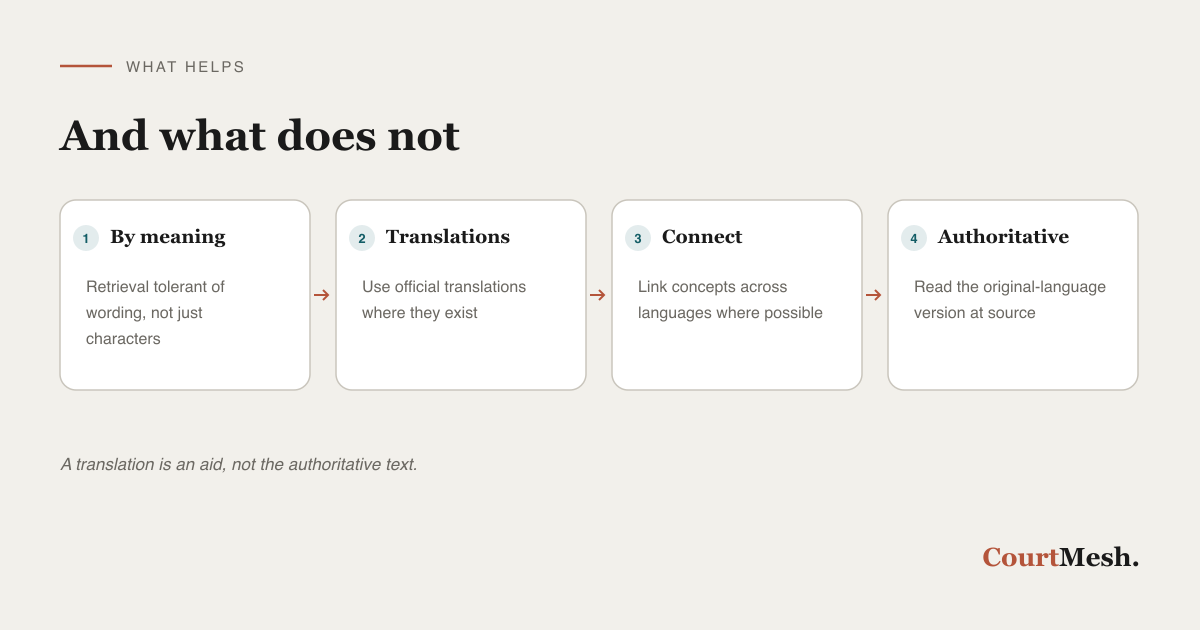
A translation opens the judgment to the person whose case it decides. It does not replace the judgment. What the court issued, in the language it issued it, is still the thing that governs.
A Practical, Honest Method
None of this counsels despair, and none of it counsels blind faith in any single tool. It counsels method. Here is a way of working that takes the multilingual reality seriously without pretending the problem is solved.
Search in the language of the matter where you can
If the point turns on a regional-language jurisdiction, and you can read or work in that language, search in it directly. The most direct way to find a judgment written in a language is to look for it in that language, in its own script.
Use meaning-based search to widen the net
Do not rely on exact wording alone. Let semantic search surface authorities that reached your point through different phrasing, and pay attention to the adjacent results you did not specifically ask for.
Lean on official translations where they exist
Where a court or an official source has published a translation, use it to understand the reasoning and to navigate. It is a genuine aid to comprehension and to finding your way around a judgment.
Always read the authoritative-language version at source
Before you rely on a holding, open the judgment as the court issued it, in its original language, from the official record. Confirm that the point you intend to argue is actually there, in the words that govern.
Cite and quote from the version that binds
When you put a proposition to a bench, anchor it to the authoritative text of the judgment, not to a convenient rendering of it. If you worked from a translation to get there, note that on the file, so the next person to pick it up knows which text was actually read and which one still needs to be checked.
That leaves the situation nobody likes to plan for: the judgment is squarely on your point, and you cannot read the language it is written in. The answer is not to guess at it, and not to quietly drop the authority either. Get it read by someone who works in that language, ideally an advocate rather than a general translator, because the difficulty is rarely the ordinary vocabulary. It is the terms of art, the qualifications, and the parts of a sentence a court chose carefully. Ask them for the operative passage in the court's own words rather than a summary, and record who read it and when. If the point is decisive and no reliable reading is available, treat the authority as unverified and say so, rather than putting weight on something nobody in the matter has actually read.
A translation is an aid, not the authoritative text
This is the line that must not be crossed. A translation, whether produced officially or by a machine, is a reading aid. It is not the judgment. The judgment in its original language, as issued by the court, is what governs. Always confirm the meaning against that authoritative version, and never rest a legal proposition on a machine rendering. If a translation and the original appear to diverge on anything that matters, the original wins, every time.
What Is at Stake If You Get This Wrong
The vernacular gap is not an abstract inconvenience. When research quietly stops at the edge of the English-language corpus, the consequences land on real matters and real clients.
Where CourtMesh Fits, Honestly Stated
CourtMesh is built for this reality, and it is worth being exact about what it does and does not claim. It indexes roughly 310 million cases from across the Supreme Court, all 25 High Courts, District Courts, and Tribunals, drawn only from official government portals. Every result links straight to the actual judgment on the record, so you are always one click from the source rather than from someone's summary of it.
On top of that corpus, CourtMesh offers keyword search over the whole record and AI-driven semantic search, the meaning-based retrieval described above, over the roughly 2 million judgment subset that carries semantic indexing, so within that subset you are not confined to exact wording. You can narrow by court, year, judge, case type and date range. The semantic layer is more tolerant of how you phrase a question than strict keyword matching, which is precisely the property that helps when the same idea appears in different words.
What CourtMesh does not do is equally important to say. It does not translate judgments for you, it does not claim to bridge every language and script perfectly, and it does not claim that its coverage of regional-language judgments is complete. It follows that a search returning nothing tells you only that nothing surfaced. It is not evidence that no court has decided your point, and it is certainly not evidence that the question is open. What CourtMesh gives you is a stronger, more tolerant way to find candidate authorities across a vast official corpus, with a direct link to each judgment, so that you can do the one thing no tool should do for you: read the authoritative version, in the language the court issued it, and confirm the law for yourself.
Find the reasoning, then read it at the source
India's move towards judgments in many languages is a gain for access to justice, and a real test for legal research. The reasoning you need may already exist in a language your old search never queried. CourtMesh gives you keyword search across roughly 310 million cases from official portals, with meaning-based retrieval over the roughly 2 million judgment subset that carries semantic indexing, all 25 High Courts included, with a direct link to every judgment. Use it to widen the net and surface what exact-match search would miss, then open the authoritative version at source and confirm the law in the words that actually govern.
Explore CourtMesh