
An allottee books a flat in a registered project. A date for handing over possession is undertaken. That date passes, and then another one does. The allottee wants the possession that was promised, or the money back, and wants it decided by a forum that understands what a promoter committed to and what a project registration records. Since 2016 the law has provided for such a forum, and the states have built them out. In the years since, those forums have decided an enormous quantity of matters, and almost none of that decided material sits where a lawyer instinctively looks for law.
The Real Estate (Regulation and Development) Act 2016 did something unusual. It did not merely add a chapter to an existing code or create a new cause of action to be pursued in the ordinary courts. It built a regulator and an adjudicatory forum for a sector that was already generating a very large volume of disputes, and it did so state by state. Implementation runs at the level of the state: state rules, a state authority, an appellate tribunal above it, and orders published on the authority's own portal rather than in any common place. The result is a body of law that matters to an extremely large number of people, that is growing quickly, and that has no single place to search. This piece is about what that Act created, why it produces so much decided matter, why researching it is structurally difficult, and how to go about it anyway without overstating what you find.
What the 2016 Act Actually Created
It helps to be precise about the machinery, because the research difficulty follows directly from the design. The Act does three separate things at once, and each of them generates a different kind of paper.
A regulator and an adjudicatory forum in one statute
First, it sets up a registration regime. Projects of a certain description have to be registered with the authority before they are marketed, and real estate agents have to register too. Registration is not a formality. It requires the promoter to place particulars of the project on the record: what is being built, on what land, with what approvals, and by when. Those particulars become a reference point against which everything the promoter later does can be measured.
Second, it fixes obligations on the promoter. Disclosure, adherence to the sanctioned plan, periodic updates on the state of the project, restrictions on how money collected from allottees may be used, and an undertaking about when possession will be handed over. These are continuing obligations, not one-time conditions, which means a promoter can fall out of compliance at any point during a project that runs for years.
Third, and this is the part that generates case law, it creates a forum. An allottee with a grievance does not have to begin an ordinary suit. There is an authority that hears and decides complaints, the Act contemplates an adjudicating officer for certain questions, and above the authority sits an appellate tribunal. That structure has been built out across the states, and each of those bodies passes orders.
That last element is what turned a regulatory statute into a source of decided law. A regulator that only issues circulars produces guidance. A regulator that also decides individual disputes produces orders, and orders reason. They record findings, apply a provision to a set of facts, and arrive at a result. Do that thousands of times over and a jurisprudence starts to form, whether or not anyone has organised it.
Why RERA Produces So Much Decided Matter
The volume is not an accident of drafting. Several features of the sector and of the forum push in the same direction.
One project, many allottees
A single delay does not produce one dispute. Every allottee in the project has an independent grievance, and each one that is pursued is decided separately and produces its own order.
A forum built to be approached
The Act deliberately created a specialised route to a decision rather than leaving allottees to ordinary litigation. A forum that is easier to approach is a forum that is approached more often.
Disputes that repeat
The same grievances recur across projects and across states: possession not handed over, a refund sought, a plan altered, a disclosure not made. The fact patterns rhyme even when the projects do not.
Long project cycles
Construction runs for years, and obligations run alongside it. A promoter can come into and out of compliance repeatedly during a single project, and each lapse can be complained of.
Put those together and you get exactly what has happened: a young forum sitting on a sector with enormous dispute volume, deciding matters in quantity. The output is real law in the practical sense. It tells you how a given authority reads a promoter's undertaking, what it treats as a genuine impediment to completion, what it expects a promoter to have placed on record, and what it does when an allottee wants out rather than in. A practitioner advising either side needs to know all of that. The difficulty is getting to it.
Why This Body of Law Is Hard to Research
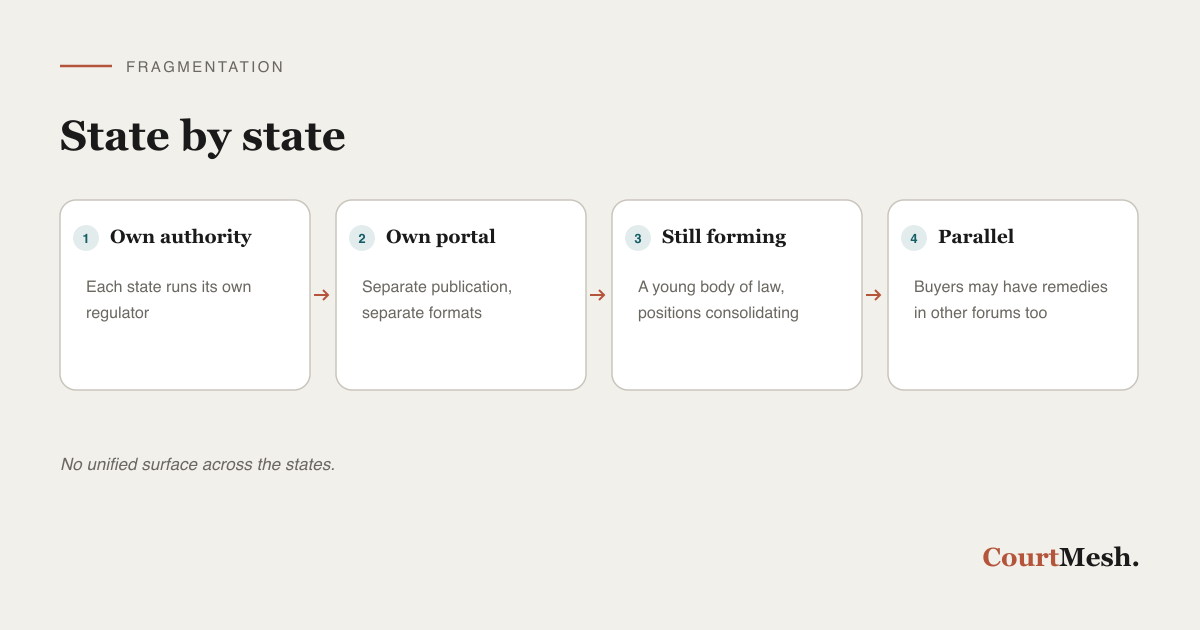
Every research problem here traces back to a single design choice. Real estate is regulated at the state level, and the Act was built to work that way. That was a sensible constitutional and administrative decision. It is also the reason the resulting body of orders is one of the more difficult things in Indian legal research to survey properly.
Implementation is state by state
There is one central Act, but there is no single national authority deciding complaints. States have framed their own rules under the Act and constituted their own authorities and appellate tribunals. Those bodies are staffed differently, they have developed their own practice on procedure and on the form an order takes, and they are not bound by each other. Two authorities reading the same provision, faced with comparable facts, can reach different conclusions and both can be perfectly defensible. Neither is deciding wrongly. They are simply separate forums that have not been given a common apex on the question.
One portal per state, each built differently
Because each authority is its own institution, each publishes on its own portal. The consequence is a practical one that anybody who has tried this will recognise. There is no single search box. To survey how a question has been treated across the country you have to visit many separate systems in turn, learn how each one is organised, and work out what each of them will and will not let you do. Some let you search by the promoter or the project. Some organise by date or by the officer who passed the order. Some expect you to know a complaint number before they will show you anything useful. A method that works on one portal frequently does not transfer to the next one, so the research effort scales with the number of states you care about rather than with the difficulty of your question.
Publication is inconsistent, and so is the format
Beyond the interface problem sits a deeper one: what gets published at all, and in what shape. Some authorities publish orders promptly and in full. Others publish selectively, or in summary, or with a delay. Formats vary from clean text to scanned images of signed orders, and a scanned order is effectively invisible to text search unless somebody has run it through recognition. Archives vary in how far back they run. Short orders and procedural directions, which are often exactly what you need when you are trying to understand how a forum handles a recurring point, are the least likely to be published in full. None of this is bad faith on the part of any authority. It is what happens when many institutions build their own publication practice independently and at speed. But it means that absence from a portal is not evidence that nothing was decided, and it means no aggregator anywhere can honestly claim to hold everything.
The law is young, and positions are still consolidating
The Act is less than a decade into its working life. That is a short time for a body of law to settle. In an established field you can usually identify a leading position and then map the departures from it. Here you are often watching a position form in real time. An authority may take one view early on, refine it as more matters of the same kind come before it, and arrive somewhere different once the appellate tribunal has spoken. An order from the first years of the regime may accurately record what was decided then and still not reflect how the same authority approaches the question today. Reading a single order and treating it as the settled position of that state is the most common error in this area.
The reasoning is heavily fact bound
Finally, much of what these forums decide turns closely on the documents and the project. What the agreement said, what the registration recorded, what the approvals permitted, what stage construction had reached, how each side behaved once the date passed. That is as it should be for a forum deciding real disputes about real buildings. But it means the transferable part of an order is usually the reasoning, not the result. Two matters that look identical in summary can end differently on facts that only appear when you read the order in full, which is precisely why the summary view offered by most portals is not enough.
The Same Grievance, More Than One Forum
There is a further complication that pure portal searching will never reveal. The creation of a specialised forum did not empty the field around it. Depending on how a grievance is framed and what is being sought, an aggrieved allottee may have more than one route available, and the relationship between those routes has itself been the subject of litigation.
Two consequences follow for research. The first is that orders of the authority are not the only place the law on a RERA question is being made. Matters travel upward: an order can be carried to the appellate tribunal, and from there the dispute can reach the High Court, whose decisions shape how the authority within that jurisdiction proceeds.
The second is that where an allottee chooses to go affects what you will find and where. A grievance pursued elsewhere leaves no trace on the authority's portal at all. So a survey that only counts what the authority decided is not a survey of how that kind of grievance has been treated generally. It is a survey of one channel. Keep that in mind before drawing any conclusion about how a question tends to go.
In an old field you learn the settled position and then study the exceptions. Here you are watching the position form. That is not a reason to research less carefully. It is a reason to research more carefully, and to date everything you find.
Recurring Issues and the Research Problem Each One Presents
It is worth being concrete about the kinds of matters that come before these forums, because the research difficulty is not uniform. Some issues are hard because they are decided in enormous volume and nothing indexes them. Others are hard because the reasoning is highly project-specific. Others are hard because the position has moved.
| Recurring issue | What the matter usually turns on | Why it is hard to research |
|---|---|---|
| Delay in handing over possession | The date undertaken, what the promoter says prevented completion, and what the allottee is entitled to once the date has passed | Decided in very large volume with no topic index. The useful order is the one with a comparable project posture, and nothing in the portal will tell you which order that is |
| Refund and withdrawal from the project | Whether the allottee may exit rather than wait, and what follows for both sides if they do | Outcomes turn on the stage of the project and the conduct of each side, so a single order read in isolation is a poor guide to how the issue is generally treated |
| Compensation for the period of delay | The consequence of delay expressed in money rather than in possession | Approaches differ between states and have developed over time, so an early order may no longer reflect how the same authority now proceeds |
| Change to the sanctioned plan or the project | Alterations to layout, specifications, or common areas after allottees have booked | Depends almost entirely on project documents and approvals. The reasoning travels between matters far better than the result does |
| Registration and its consequences | Whether a project or an agent was registered, and what follows from a failure to register | Determined against state rules that differ, and often recorded in short orders that are the least likely to be published in full |
| Disclosure and periodic project updates | What the promoter was required to place on the record and whether it was placed there | Frequently disposed of in brief compliance orders. Individually unremarkable, collectively the clearest signal of what an authority expects |
| Execution of an order already passed | Recovering what an order has already granted when it has not been complied with | Often recorded in proceedings that never surface as a searchable order, so the enforcement practice of an authority is the hardest layer of all to see |
Read across that table and a pattern emerges. The issues that recur most often are the ones with the least research infrastructure built over them. There is no reporter selecting RERA orders, no editor writing headnotes for them, no digest gathering them under a topic. Everything a researcher normally leans on to move from a question to the relevant decisions is simply absent, and the volume that would justify building it is the same volume that makes doing it by hand impractical.
Why It Is Worth Researching Well Anyway
Given all that, a fair question is whether the effort is worth it. It is, and for reasons that are quite practical.
Authorities are consistent with themselves
A forum that decides the same kind of matter repeatedly develops a settled way of handling it. Knowing how this authority has treated this issue is often a better predictor of what will happen than any general proposition of law.
The appellate tribunal shapes the authority
Orders of the state appellate tribunal carry real weight with the authority beneath it. Reading only first instance orders gives you the practice without the correction that has been applied to it.
Other states persuade even though they do not bind
An order from another state's authority binds nothing in yours. On a question your own authority has not yet faced, a considered order from elsewhere can still be genuinely persuasive if you present it honestly as persuasive.
High Court decisions bind within the jurisdiction
Where a RERA matter has reached the High Court, that decision governs within its jurisdiction in a way no authority order does. It is the layer most often skipped and the one that matters most.
The right unit of research is the pattern, not the order
The instinct carried over from case law research is to hunt for the single best order and lead with it. In this field that instinct misfires. These forums decide in volume, on facts, and their positions are still forming, so one order tells you what happened once. What you actually want is how this authority has treated this recurring issue across a number of matters, and where the appellate tribunal has agreed or differed. A pattern of consistent treatment, properly dated and sourced, is far stronger than a single favourable order that may turn out to be an outlier or may already have been set aside.
A Practical Method for Researching RERA Orders
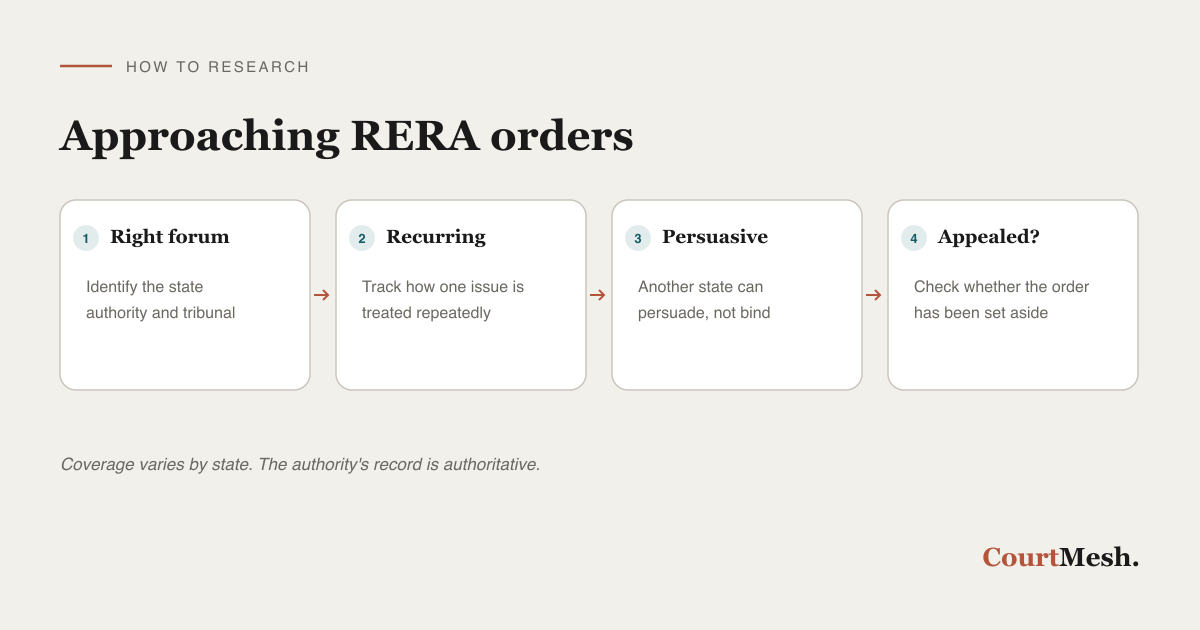
None of the difficulty above is a reason to research loosely. It is a reason to have a method and to follow it in order. This one works.
Fix the forum before you fix the argument
Identify the state authority that governs the project, which follows from where the project is located rather than from where the parties are. Then establish, within that state, how work is routed between the authority, the adjudicating officer that the Act contemplates, and the appellate tribunal, because states differ in the detail. Getting this wrong at the start means every order you subsequently read may be from the wrong body.
Search that state's own orders first
Start with the authority that will decide your matter. Learn how its portal is organised, what it lets you search by, and how far back its archive runs. Search by the recurring issue, by the project or promoter where relevant, and by the provisions engaged. Note what the portal will not let you do, because those are the gaps you will have to close another way.
Read the appellate tribunal, not only the authority
Orders of the state appellate tribunal tell you where the authority has been corrected and where it has been affirmed. A first instance position that has been consistently upheld is much safer to rely on than one nobody has tested. Treat the tribunal layer as part of the core search, not as an optional extra.
Look for how the issue has been treated, not for one order
Gather several orders on the same recurring point rather than stopping at the first helpful one. Look for the consistent thread: what the forum asks about first, what it treats as decisive, what it will not entertain. Date every order you collect, because on a young question the sequence tells you which way the practice is moving.
Read every order at source and in full
Portal listings, cause list style entries, and summaries compress away exactly the facts the reasoning turns on. Open the order itself on the authority's own record and read it. Record the complaint number, the authority or tribunal, the date, and the promoter and project as recorded, so anyone can retrieve the same document.
Check what happened to the order afterwards
An order at first instance is not the end of the story. Establish whether it was carried in appeal, whether it was stayed, whether it was modified or set aside, and whether the matter went further to the High Court. An order that has been disturbed is worse than useless in an argument, because relying on it damages everything else you say.
Use other states openly as persuasive material
Where your own authority has not decided the point, a well reasoned order from another state can help. Present it for exactly what it is, considered reasoning from a coordinate forum that does not bind, and be candid that the position may differ across states. Overstating the status of an out of state order is an easy way to lose credibility on a point you might otherwise have won.
What to record for every order you rely on
- The authority or appellate tribunal that passed it, and the state
- The complaint or appeal number as recorded on the portal
- The date of the order, which on a developing question is as important as the content
- The promoter, the project, and the registration as they appear in the order itself
- The precise issue decided, distinguished from anything the forum observed in passing
- Whether the order has been appealed, stayed, modified, or set aside, and when you last checked
- Where you obtained it, so that the document can be retrieved from the same source again
Before you rely on any RERA order
Coverage of state RERA portals varies considerably, and no aggregator anywhere is complete, so the absence of an order from any database, including CourtMesh, proves nothing about whether it exists. Positions differ between states and are still developing, which means an order that accurately stated an authority's approach some years ago may not state it today. Always read the order on the authority's own record rather than from a summary, and confirm before you rely on it whether it has been appealed, stayed, or set aside. Where an aggregated copy and the authority's own record differ, the authority's record prevails.
Where CourtMesh Fits In
We should be careful and accurate about this, because the temptation to overclaim in a fragmented field is exactly what makes research unreliable. CourtMesh aggregates from official government portals only, across the Supreme Court, all twenty-five High Courts, the district courts, and tribunals, amounting to roughly 310 million cases in one searchable place. You can search by keyword, or with AI semantic search that matches on the meaning of a point rather than on an exact phrase, and then narrow what comes back.
- Court
- Case type
- Year
- Acts and sections
- Disposition
- Case status
Every result links to the actual decision, so you move from a search hit to the document itself in one step rather than relying on anybody's summary of it. What that means for this subject specifically is worth stating plainly. Coverage of any forum is bounded by what that forum itself publishes. We do not claim comprehensive coverage of the state real estate regulatory authorities, and you should not assume that a search which returns nothing means an authority decided nothing. What CourtMesh does help with is the layer above and around the authority: High Court decisions arising out of RERA matters are part of the corpus, and those are the decisions that bind within a jurisdiction, that are most often skipped in portal-first research, and that tell you how the courts have received what an authority or a tribunal did.
So the honest division of labour looks like this. Use a broad search across courts and tribunals to find the binding and persuasive layer sitting above the authority, to see how comparable questions have been treated elsewhere in the system, and to trace a matter that has travelled upward. Then go to the relevant state authority's own portal for its orders, and treat that authority's record as authoritative for anything it has decided. CourtMesh is a research tool that helps you find and open decisions. It does not give legal advice, and it is not a substitute for the record of the authority whose order you intend to rely on.
Research the layer above the portal
RERA has produced a substantial body of orders in under a decade, and it sits scattered across state portals with no index over it. The part you can least afford to miss is the layer above: how the High Courts have dealt with matters arising out of RERA, and how comparable questions are treated across the wider system. CourtMesh lets you search roughly 310 million cases from official government portals across the Supreme Court, all twenty-five High Courts, the district courts, and tribunals, by keyword or by meaning, with every result linking to the actual decision. Start there, then verify at the authority's own record.
Explore CourtMesh