Most advocates walk into court having prepared the law to the last comma and the bench hardly at all. The reason is understandable. The law sits in the reports, waiting to be read, while a judge's reasoning does not announce itself. Yet the same submission, on the same facts, can land very differently from one bench to another, because judging is not the mechanical application of a rule to a set of facts. Preparing the argument without preparing for the reader of the argument leaves value on the table, and it is value that costs nothing to recover except time and attention.
Ask any advocate who appears regularly and they will tell you, quietly, that they argue the same point differently before different benches. Not because the law changes, but because they have a sense of how a particular judge tends to read a statute, which line of authority that judge finds congenial, and what kind of submission tends to earn a patient hearing. This is not a secret art. It is ordinary craft, learned slowly through appearance, corridor talk, and memory. The difficulty is that memory is uneven and appearance is limited, so most advocates carry a rich sense of two or three benches and almost nothing about the rest.
This piece is about closing that gap deliberately: what it means to research the bench, why it is worth the effort, why it is genuinely hard to do by hand, and, just as importantly, where the line sits between legitimate preparation and anything that would be improper. That line matters, so we will draw it early and keep returning to it.
Why the Bench Matters as Much as the Law
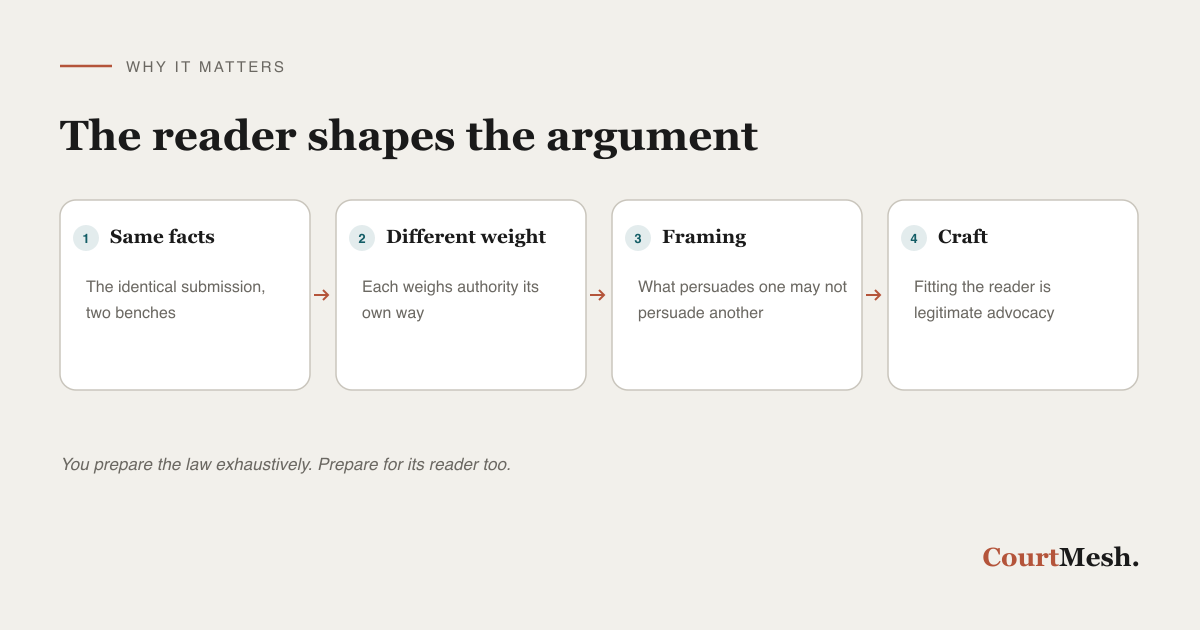
Start with a truth that every litigator knows but few build into their preparation. Two judges, faced with the same provision and the same facts, can reach the same result by different routes, or reach different results entirely, without either of them doing anything wrong. Judging involves choices: how much weight to give the plain text of a statute against its purpose, when to read a precedent narrowly and when to read it broadly, how to treat a fact pattern that sits at the edge of an existing rule. These choices are the substance of the common law method. They are also, from the advocate's chair, the difference between an argument that finds a receptive ear and one that has to fight the current the whole way.
Under Article 141 of the Constitution, the law declared by the Supreme Court is binding on all courts within the territory of India, and the discipline of stare decisis keeps the system coherent. But binding authority still has to be read, and reading is where the room lies. A precedent has a ratio, the principle for which it stands, and it has obiter, the observations made along the way. Where the ratio ends and the obiter begins is itself a matter of interpretation, and different benches draw that boundary differently. An advocate who knows how a particular judge has drawn it before, on a comparable question, is simply better prepared than one who does not.
Where benches genuinely differ
It helps to be precise about what varies, because the variation is not mood or personality, it is method. Broadly, benches differ along a few stable dimensions.
How authority is weighed
Some judgments lean hard on the text of the statute and treat purpose as a secondary aid. Others read the provision in light of its object and the mischief it was meant to cure. Knowing which instinct a bench tends to follow tells you whether to lead with the words or with the purpose.
How precedent is treated
A given line of authority may have been followed in one judgment, distinguished in another, and confined to its facts in a third. How a judge has previously handled the very cases you intend to cite is directly relevant to how you should present them.
How fact patterns are approached
Some reasoning stays close to the specific facts, drawing careful lines. Other reasoning reaches for the governing principle. Pitching your submission at the level the bench tends to work at makes it easier to follow and harder to resist.
Take a familiar situation, described in the abstract. You intend to rely on a well known authority for a broad proposition. Before one bench, that authority has been treated as stating a general principle of wide application. Before another, the same authority has been read narrowly, confined closely to the facts it arose from. The authority has not changed. What has changed is the reading, and the advocate who knows which reading the bench tends to prefer will open very differently: leading with the principle in the first instance, and meeting the narrowing head on in the second. Same authority, same advocate, two quite different opening moves, both of them sound.
You are not trying to change how the bench thinks. You are trying to be understood by the bench as it already thinks.
What Researching the Bench Actually Means
Because the phrase can be misread, it is worth stating plainly what the exercise is and what it is not. Researching the bench means reading a judge's own reasoning, in their own published judgments, on the kind of question you are about to argue. It means noticing which authorities they have followed and which they have distinguished, how they have read the relevant statutory scheme, and how they have approached fact patterns close to yours. The raw material is entirely public: reported and reportable judgments, delivered in open court and available from the official record. You are studying jurisprudence, not the person who authored it.
Where the line sits
This is preparation and framing, and it is legitimate advocacy. It is not, and must never become, an attempt to influence a judge improperly, to shop for a friendly forum, or to profile the bench in order to predict or game a result. You are reading public judgments to understand the reasoning you will be arguing into, exactly as you read the statute and the precedents. It goes nowhere near a judge's private life, and it leaves judicial independence exactly where it is, which is where it belongs. If the exercise ever starts to feel like an effort to work the judge rather than to serve the argument, it has crossed the line and should stop.
Jurisprudence, not personality
The distinction is worth holding onto because it does all the ethical work, and because it explains why the exercise is ordinary rather than exotic. What you are reading is a body of published legal reasoning: how questions of this kind have been analysed before, on the record, in open court. Held to that standard, researching the bench is no different in kind from the rest of hearing preparation. You already read the statute before you argue it. You already pull the leading authorities and the recent ones. Reading how the specific bench before you has reasoned on the same question is the natural third leg of the same table. The only reason it is done less is that it is harder to do, not that it is less legitimate.
Two Kinds of Preparation, Side by Side
It can help to see the two efforts laid out against each other. Preparing the law and preparing for the bench are not alternatives. They are complementary, and the second is worthless without the first. But they answer different questions, change different things about your submission, and fail in different ways when neglected.
| Dimension | Preparing the law | Preparing for the bench |
|---|---|---|
| What you study | Statutes, rules, and the governing line of authority on the issue | How this particular bench has reasoned on this kind of issue before |
| The question it answers | What is the correct legal position | How is this bench most likely to read and weigh that position |
| What it changes | The substance of your submission and the authorities you rely on | The framing, the order of emphasis, and how you present the authorities |
| What good looks like | Accurate, complete, and current on the law | Pitched in the terms the bench tends to find persuasive |
| The failure mode of ignoring it | You are simply wrong on the law and lose on the merits | You are right on the law but argue past the bench and lose value you had |
The last row is the one that stings. An advocate who is wrong on the law expects to lose. An advocate who is right on the law but has framed the argument for the wrong reader loses something more frustrating: a matter that was winnable, lost partly to a failure of preparation that never showed up on the file. That failure is invisible precisely because the law was sound. The gap was in the reading of the reader.
Why This Is So Hard to Do by Hand
If researching the bench is so obviously useful, why do so few advocates do it thoroughly? The honest answer is that it is genuinely difficult, and the difficulty is practical rather than conceptual. A judge sits for years, often across many kinds of matter, and the judgments relevant to your issue are scattered thinly through a long and busy docket. Finding them by hand means the kind of manual trawl that a hearing timeline rarely allows.
Consider what the manual version actually demands.
The keyword problem deserves a moment on its own, because it is the quiet reason most manual research falls short. Two judgments can turn on an identical principle while sharing almost none of the same words. One may speak of a duty of care, another of a standard of reasonable conduct, a third of foreseeability, and all three may be the reasoning you need. Search the exact words of your issue and you will miss the two that matter and drown in a hundred that do not. Meaning, not vocabulary, is what you are chasing, and meaning is exactly what a plain text search cannot see.
The real bottleneck
The barrier is not that a judge's reasoning is unknowable. It is public, in the judgments themselves. The barrier is retrieval: assembling the conceptually relevant judgments, by a specific bench, on a specific issue, fast enough to be useful before the hearing. Solve retrieval and the rest is ordinary reading.
A Practical Workflow for the Hearing
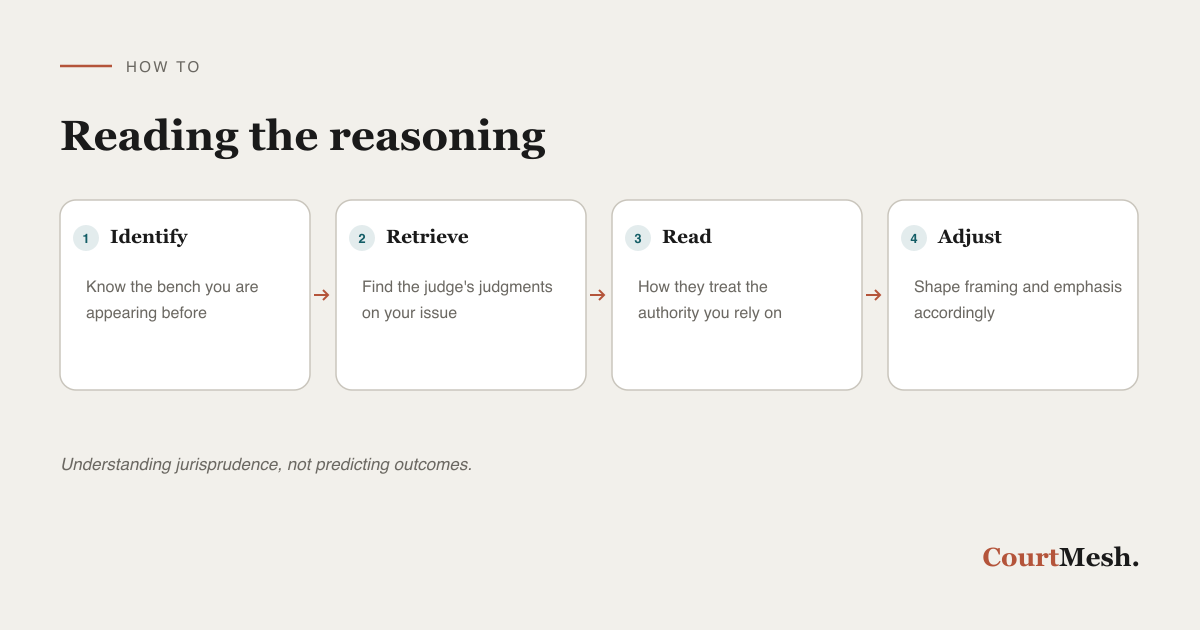
Here is a workflow that treats the bench as a serious object of preparation without ever straying from legitimate craft. It assumes you have already done the substantive legal research. This sits on top of that work, not in place of it.
Identify the bench
Confirm who is likely to hear the matter as early as the cause list and listing pattern allow. The earlier you know, the more time you have to read, and the less rushed the exercise.
Retrieve the judge's judgments on your issue
Assemble the judgments that bench has authored on the kind of question you are arguing. This is where a judge filter earns its keep: instead of reading everything, you narrow to the reasoning that is actually relevant to your matter.
Search by meaning, not just by keyword
Describe your issue or fact pattern and retrieve judgments that engage the same reasoning, regardless of the exact words used. This is how you catch the conceptually relevant judgment that a keyword search would have missed.
Read for reasoning, not result
For each judgment, read how the conclusion was reached, not merely what it was. Note the interpretive instinct, the authorities followed or distinguished, and the level at which the facts were engaged.
Trace the treatment of your authorities
Check how the bench has previously handled the specific cases you intend to rely on. An authority the bench has distinguished before needs to be presented differently from one it has followed.
Adjust framing and emphasis
Reorder your submissions to lead with what this bench tends to find most useful, and prepare to meet the reading of authority the bench is most likely to bring. The substance does not change. The presentation does.
Notice what the workflow does and does not produce. It produces a well-founded sense of how to present a sound argument to a particular reader. It does not produce a prediction, a score, or a probability of success, and it should not be asked to. The output is preparation, not prophecy.
Turning the Reading Into Better Advocacy
Research that never changes what you do at the podium is a hobby, not preparation. The value of reading the bench shows up in concrete choices about how you argue. A few of the most useful.
Lead with the register that fits
If a bench tends to begin with the text of the statute, open there and let purpose follow. If it reasons from object and scheme, frame the provision that way first. Same argument, sequenced for the reader.
Pre-empt the likely reading of authority
If the bench has distinguished a case you must rely on, address the distinction head on before it is put to you. Anticipation reads as command of the material, not defensiveness.
Pitch at the right altitude
A bench that reasons closely from facts will want the facts marshalled with care. One that reaches for principle will want the governing rule stated cleanly. Meet the bench where it works.
Choose your strongest ground first
If a bench has shown a settled approach to one kind of submission, and your case offers more than one route, lead with the route the bench is most comfortable travelling.
Each of these is a framing decision, not a change to the merits. The facts are the facts and the law is the law. What you are choosing is the order, the emphasis, and the register, so that a busy bench can follow your reasoning with the least friction. That is what good advocates have always done from instinct and long acquaintance. Researching the bench simply lets you do it deliberately, and for benches you have never appeared before.
The Honest Limits of the Exercise
Two limits deserve to be stated plainly, because overstating what this exercise can do is its own kind of failure.
The first is a limit of coverage. Retrieval across the corpus of judgments is broad, but the deeper layers of analysis are not co-extensive with it. Citation relationships between cases, whether an authority was followed, distinguished, overruled, or referred to, have been derived over a subset of the corpus rather than over every judgment ever delivered. So a judge's full body of relevant work may not be exhaustively captured, and the absence of a noted relationship is not evidence that none exists. What you assemble should inform your preparation, not stand in for a guarantee that you have seen everything. Treat it as a well-founded sample, read the underlying judgments yourself, and keep your own judgement in the loop.
The second limit is one of principle, and it is the more important of the two. This exercise tells you how a bench has reasoned before. It does not tell you how the bench will decide your matter, and nothing about it should be dressed up as if it could. Judges decide the case in front of them, on its own facts and submissions, and a settled interpretive approach is not a settled outcome. The moment research is used to predict a result rather than to prepare an argument, it has stopped being preparation and become something the profession rightly has no place for.
Keep it on the jurisprudence
The safe and useful version of this exercise never leaves the ground of published reasoning. You are reading judgments to understand the jurisprudence, framing your submissions to be understood, and respecting that the decision belongs entirely to the bench. Preparation, not prediction. Framing, not influence. Held there, researching the bench is simply good lawyering, and it honours the court rather than second guessing it.
Where a Research Platform Fits
Everything above can be done with nothing but the official reports and enough time. What a research platform changes is the retrieval bottleneck, which is the part that defeats most advocates in practice. CourtMesh lets you filter judgments by the authoring judge, so you can assemble a bench's reasoning on your issue instead of reading the whole docket. Its semantic search lets you describe an issue or fact pattern in your own words and retrieve conceptually relevant judgments even when the vocabulary differs, which goes directly at the keyword problem described above. And where citation relationships have been derived, whether an authority was followed, distinguished, overruled, or referred to, you can trace how the bench has treated the very cases you intend to cite.
The corpus spans roughly 310 million cases across the Supreme Court, all 25 High Courts, District Courts, and Tribunals, drawn only from official government portals, and every result links back to the actual judgment so you read the reasoning at source rather than taking a summary on trust. What it does not do is predict, profile, or score. It helps you find the relevant reasoning faster. The preparation, the framing, and the judgement remain yours, which is exactly as it should be.
Prepare for the bench, not just the law
The law is only half of what you can prepare. The other half is the reasoning you will be arguing into, and that is public, in the judgments themselves. CourtMesh helps you find a judge's relevant prior reasoning faster: filter by the authoring judge, search by meaning rather than keyword, and, across the judgments where citation relationships have been derived, trace how the authorities you rely on have been treated. Every result links back to the judgment at source. Preparation, not prediction. Research the bench with the same rigour you bring to the law.
Explore CourtMesh