You run the search, you read a clean and empty screen, and you draw the quiet conclusion that your counterparty has no litigation history. Sometimes that conclusion is correct. Very often it tells you something far narrower: that you spelled the name the way the database did not.
Searching a party by name feels like the simplest thing a legal researcher does. Type the name, read the matters, move on. In India it is one of the most deceptive tasks on the desk. A single person or company can sit in the public record under a scatter of surface forms at the same time: three valid spellings of one name, a set of initials in one court and the expanded version in another, a father's name attached here and dropped there, a company written as Private Limited on one cause list and (P) Ltd on the next. Exact match search finds only the string you typed. Everything else stays exactly where it is, filed and indexed and fully searchable, and completely invisible to you.
This matters most in the searches that most depend on completeness, which are exactly the searches where a miss is expensive: a conflict check, a due diligence report, a background review before a transaction is priced. In each of them the failure is silent. Nothing on the screen ever tells you that a real matter is sitting two spellings away.
A Miss Is a False Negative, and Silence Is Not Proof
It helps to name the two ways a name search can go wrong. A false positive is a hit that is not your party: you searched a company like Acme Traders and found a different Acme Traders in another state. False positives are irritating but self-correcting, because you open the matter, see that the particulars do not match, and set it aside. A false negative is the opposite, and far more dangerous: your party's matter genuinely exists in the record, but your search never surfaced it. You cannot open what you did not see, and nothing flags its absence. The entire risk of name search lives in this asymmetry. The mistakes you can see cost you minutes. The mistake you cannot see is the one that reaches your report.
India's court data is more open than it has ever been. District Court records move through the eCourts system, the National Judicial Data Grid aggregates case information from across the country, and the High Courts and the Supreme Court publish their own dockets. Openness, though, is not the same as findability. Every one of those records carries a party name exactly as it was entered at filing, by an advocate's clerk, a data entry operator, or the litigant in person, and none of them were coordinating with each other on how that name should be spelled. The data is public. Whether your search reaches the right entry is a separate question entirely.
A nil result answers one question and one only: nothing matched the spelling you searched. It does not tell you whether the party has ever been to court.
Why One Name Becomes Many
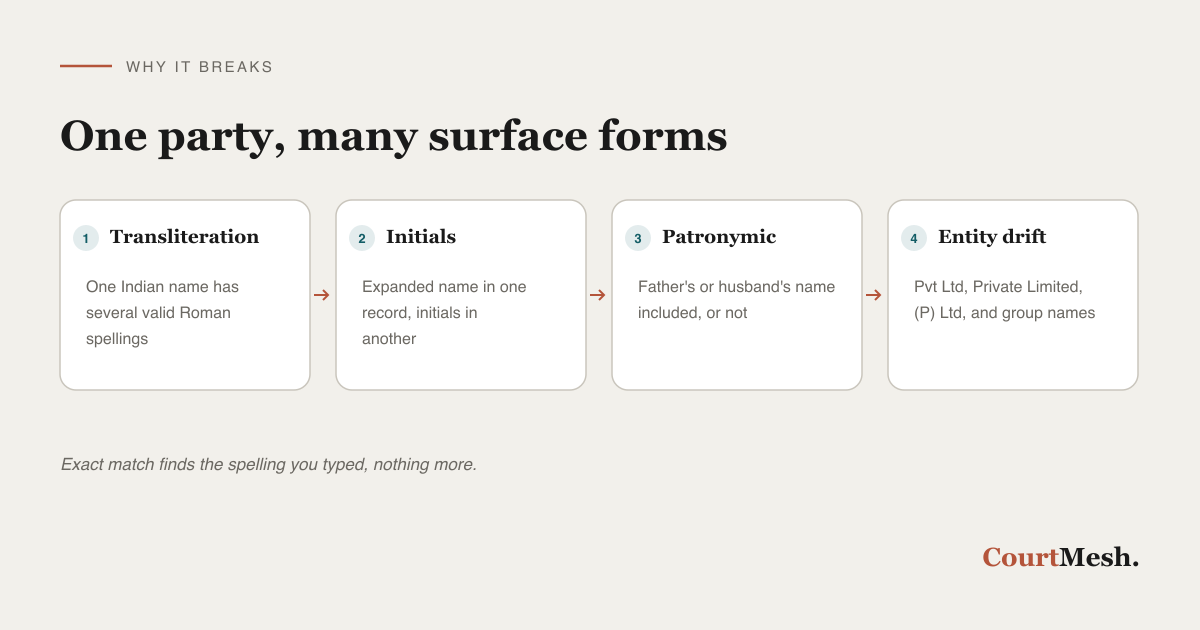
To search well you have to understand why the same identity fragments across the record in the first place. For people, three forces do most of the damage: transliteration, the structure of initials and name order, and the relational tags and honorifics that ride along in the party field. They compound. A single individual can be scattered across many surface forms before a company is even involved.
Transliteration: one name, many valid spellings
Names in the court record are for the most part entered in Roman script, while a very large share of Indian names originate in Devanagari, Tamil, Telugu, Bengali, Kannada, Malayalam, Gurmukhi, and other scripts. Carrying a name from one of those scripts into English is transliteration, and transliteration has no single correct answer. Sounds that are clearly distinct in an Indian language can collapse onto the same Roman letter, and sounds that have no clean English equivalent get approximated differently by different people. The result is that one name is spelled correctly in several different ways, in several different places, all at once.
- Long and short vowels blur: Laxmi and Lakshmi, Sita and Seetha, Rajiv and Rajeev
- Aspirated consonants split from their plain forms: Bhupinder and Bupinder, Dhruv and Druv
- The b, v, and w sounds overlap: Vasant and Basant, Viswanathan and Vishwanathan
- A trailing or internal h appears and disappears: Mukherjee and Mukerji, Ananth and Anant
- Name prefixes multiply: Md, Mohd, Mohammad, Mohammed, and Muhammad all stand for one name
The crucial point is that none of these is a misspelling. Each is a legitimate romanisation that some official document, some advocate's filing, or some clerk's keyboard treated as the correct one. When you search a single spelling, you are not searching a name. You are searching one of its several equally valid forms, and betting that the record happened to use the same one.
Initials, expansions, and the order of names
Beyond spelling, the very structure of a name shifts from record to record. Across much of India, and particularly in the south, names are conventionally recorded as an initial followed by a given name, where the initial stands in for a father's name, a house name, or a village. The same person can appear as K. Raman in one matter, Raman K in another, and Kesavan Raman in a third where a clerk expanded the initial in full. To exact search these are three unrelated strings that share, at most, a single token. Search one and you may find him. Search another and the screen is blank, and the blankness looks identical to innocence.
Name order is not fixed either. Given name first is common, but records built from different templates put the surname first, or fold in the surname of a father or a husband. An initial that expands one way in one document expands another way in the next. You are not looking for a fixed key. You are looking for a person who is recorded under a small family of arrangements, only some of which you will think to type.
Patronymics, honorifics, and relational tags
Indian party fields routinely carry more than a name. A litigant may be recorded with a father's or a husband's name folded directly into the field: Sunita W/o Rajesh Kumar, or Rajesh S/o Mahesh. The relational tag, w/o, s/o, or d/o, is sometimes part of the searchable string and sometimes stripped out. Honorifics ride along in the same way: Sri, Shri, Smt, Kum, Dr, M/s, and the prefix Late for a party who has died. A search for the bare name misses the record whose field begins with Smt, and a search that includes the honorific misses the record where it was never entered. The name you want is in there. It is simply wearing a prefix you did not account for.
When the Party Is a Company, the Name Drifts Too
For corporate parties the problem changes shape but does not shrink. A company has exactly one registered legal name under the Companies Act 2013, yet that is rarely the form in which it appears across cause titles and cause lists. Whoever typed the memo of parties abbreviated it, reordered it, or truncated it to fit, and the record kept whatever they typed. The single registered name becomes a spray of surface forms, and a group of related companies multiplies the problem all over again.
Suffix and punctuation drift
Private Limited becomes Pvt Ltd, then Pvt. Ltd., then (P) Ltd, and sometimes just Ltd. The word and becomes an ampersand. Company becomes Co. Full stops and brackets appear and vanish. A firm like Acme Traders Private Limited scatters across half a dozen forms of one registered name.
Descriptive tails
Trading names carry tails that come and go: & Sons, & Bros, Enterprises, Industries, Exports, Traders, Agencies. The cause title may keep the tail, drop it, or shorten it, so that Acme & Sons and Acme Enterprises might be one house, or two entirely different ones.
Group and sibling entities
A business group often litigates through many entities that share only a brand root: a group like Acme might file as Acme Industries, Acme Exports, Acme Logistics, a holding company, and the personal names of its promoters. A search for any one of them says nothing at all about the others.
Two more forces sit underneath these. Companies change their names, and matters filed under an old name stay under the old name in the record long after the rebrand is complete. And a dispute involving a group is usually filed against whichever entity actually signed the contract, not the name the market knows the group by. To see a group's full exposure you have to know its family of names before you search, which is precisely the knowledge a due diligence exercise is trying to build in the first place. The search quietly assumes the answer it was meant to find.
Why Keyword Search Cannot Bridge the Gap
Exact and keyword search share one quiet assumption: that the string sitting in the database matches the string sitting in your head. Keyword search is more forgiving than pure exact match. It can shrug off letter case, cope with some word order, and match on partial tokens. But at its core it is still comparing characters to characters. It has no model of the fact that Laxmi and Lakshmi are one name, that K. Raman and Kesavan Raman might be one person, or that (P) Ltd and Private Limited mean precisely the same thing. It matches shapes, not identities.
So the entire burden shifts onto you. To find every form, you have to think of every form before you type it. You have to generate the transliteration variants, guess the initials and their expansions, imagine the honorifics, and enumerate the corporate suffixes and the sibling entities. Miss one, and the matters filed under it never once enter your field of view. Note what has happened: the search did not fail loudly or throw an error. It succeeded, accurately, at the wrong question. It told you the truth that nothing matched what you typed, and let you mistake that for the answer you actually wanted.
The quiet failure mode
Keyword search never tells you when it has under-matched. That is why a nil result deserves more suspicion than a crowded one, not less.
A Map of the Variants
Before the method, a map. The table below gathers the main variant types in one place: what the drift looks like, why exact search walks straight past it, and the move that actually handles it. Read it as a checklist to run against any name before you decide you are finished.
| Variant type | What the drift looks like | Why exact search misses it | How to handle it |
|---|---|---|---|
| Transliteration | Laxmi and Lakshmi; Chaudhary, Choudhury, and Chowdhury | Every spelling is a different character string, though all are one name | Search each plausible romanisation, and run semantic search alongside exact match |
| Initials and expansion | K. Raman, Raman K, and Kesavan Raman | An initial and its expansion share no common searchable token | Search both the initialled and the expanded forms, in both name orders |
| Patronymic and honorific | Sunita, Smt Sunita, and Sunita W/o Rajesh | Relational tags and honorifics change the string the field begins with | Search the bare name, and vary or strip the tags rather than trusting the prefix |
| Entity-name drift | Acme Traders Private Limited, then Pvt Ltd, then (P) Ltd | Abbreviated suffixes and punctuation produce distinct strings | Search the core name without any suffix, then each suffix form in turn |
| Group and sibling entity | Acme Industries, Acme Exports, and the promoter's own name | A separate legal name shares only a brand root, not a searchable identity | Build the family of related names first, then search every one of them |
How to Search a Name Properly: A Multi-Pass Method
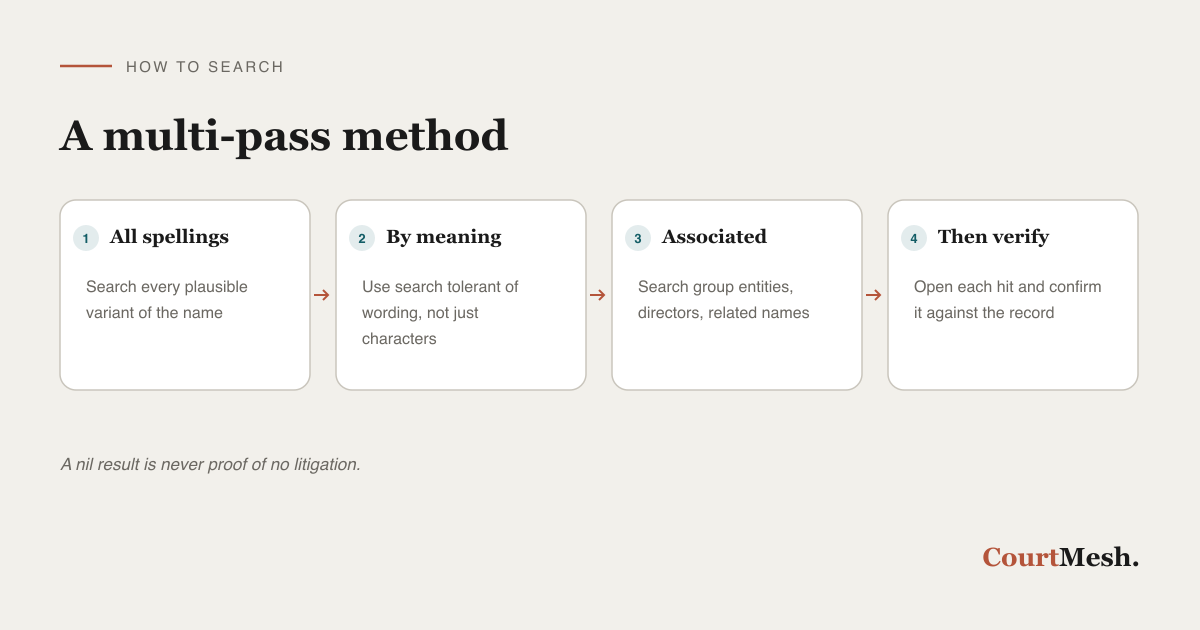
The fix is not one clever query. It is a disciplined method with two movements: widen deliberately, then verify ruthlessly. Treat your first search as the opening of the work, never the close of it.
Generate the plausible spellings before you search
Write the variants down first, on paper or in the search itself. For a person, list the transliteration spellings, the initialled and the expanded forms, and both name orders. For a company, list the core name with and without its suffix, each suffix form, and the descriptive tails. You are drawing a small map of one identity, not composing a single perfect query.
Use meaning-aware search, not only exact match
Where the tool offers semantic search that matches on meaning rather than on exact characters, run it alongside keyword search. It is more tolerant of paraphrase and word order, so it can surface a record you would never have thought to type. Treat it as a widener that complements your variant list, not as a guarantee that replaces it.
Search the associated names and the group entities
Reach past the single name. For an individual, search with and without the father's or husband's name and the honorifics. For a company, search the sibling entities, the holding company, and the promoters by their own names. Real exposure very often sits under a related identity rather than the one you began with.
Narrow with filters, then widen again
A broad search returns noise, including the other Acme Traders two states away. Use filters, court, case type, year, judge and date range, to focus a wide result down to the plausible matches. If a filter empties the screen, loosen it and look again. Filtering is a tool for triage, never a reason on its own to conclude the party has no history.
Open and verify every hit against the source
A surfaced result is a lead, not a finding. Open each matter and check the party particulars, the cause title, the father's or the company details, the advocate, and the court against what you already know of your subject. Confirm identity from the official record before you rely on it. A near-name in the right city is not proof, and even a matching name is not proof until the particulars agree.
The discipline is the whole point. Widen first, so that a matter filed under an unexpected form has a genuine chance to reach your screen. Verify second, so that a coincidental namesake does not walk into your report wearing your party's name. Skip the first movement and you miss real matters. Skip the second and you attach false ones. Both failures look like a finished search.
What no search can promise
No method and no tool recovers every variant of every name. Coverage of the public record is broad but never total, transliteration is genuinely ambiguous, and some matters are simply recorded in a form no reasonable search would reach. A nil result is never proof that a party has no litigation. It is only the absence of a match. Meaning-aware search reduces the misses, it does not eliminate them, and it does not perfectly solve transliteration. Use name search to inform your judgment and to point you at the official record. Do not use it as a substitute for verifying against that record, and do not treat it as a replacement for formal due diligence.
How CourtMesh Approaches the Problem
CourtMesh is built on the assumption that one name has many forms, so party search is designed to widen and then to verify, rather than to reward whoever guessed the single correct spelling.
One search across the record
Search a party across the Supreme Court, all 25 High Courts, the District Courts, and Tribunals, roughly 310 million cases drawn only from official government portals. One name is checked against the whole reachable record at once, rather than court by court by hand.
Two ways to search
Keyword search for when you know the exact form, and AI semantic search that matches on meaning and is more tolerant of paraphrase and wording than exact match. Used together they widen the net beyond the single form you happened to type. Neither removes the need to work through the variant list yourself.
Filters to verify, watchlist to monitor
Narrow a wide result by court, case type, year, judge and date range to triage it down to real candidates. Add a party to a Watchlist to monitor the name for new matters over time, remembering that an alert can only follow what the source portals have themselves published.
The design does not promise that every variant is caught, because no honest tool can. What it does is make the wide, multi-form search practical instead of exhausting, help you verify each hit against its official source, and keep watching a name after the first search is closed. A clean result today is a statement about today, and nothing more.
What a Missed Name Costs
It is worth being blunt about the stakes, because the cost of a false negative almost never lands at the moment of the search. It lands later, after the decision is made and acted on, when it is hardest and most expensive to undo.
None of these failures announce themselves at the time. They surface later, in a dispute, in a regulator's question, in a transaction that goes wrong, on the day someone finally searches the name the way it was actually filed. The purpose of a disciplined, multi-pass search is to move that discovery to the front of the process, where it still changes what you decide, instead of the back, where it only tells you what you should have done.
Search the name, not just the spelling
A party's litigation history is only ever as complete as the search that went looking for it, and in India one name wears many forms. Build the variant list, search by meaning as well as by spelling, follow the associated and group names, and verify every hit against the official record. CourtMesh brings party search across the Supreme Court, the High Courts, District Courts, and Tribunals into one place, with keyword and semantic search, filters to verify a result, and a watchlist to keep monitoring a name over time, so that the matter which exists has a better chance of being the matter you actually find. Use it to inform your due diligence, not to replace it.
Explore CourtMesh