An advocate can be entirely right about the law and still lose the point, because the law did not stay where it was left. Few areas make that danger sharper than the admissibility of electronic records, a corner of Indian evidence law that has been argued, refined, doubted and restated again and again. It is an area where a confidently remembered rule can easily be out of date, and where being out of date tends to show up at the worst possible moment, when the other side rises to object and the matter turns on whether a key electronic record comes in at all. The certificate is where cases quietly sink.
This piece is not a statement of what the law on electronic records currently is. It is about how to research an area that keeps moving, using the one topic that illustrates the problem better than any other. The value is in the method, because the method is what protects you when the rule itself will not sit still.
The Area Where Being Out of Date Hurts Most
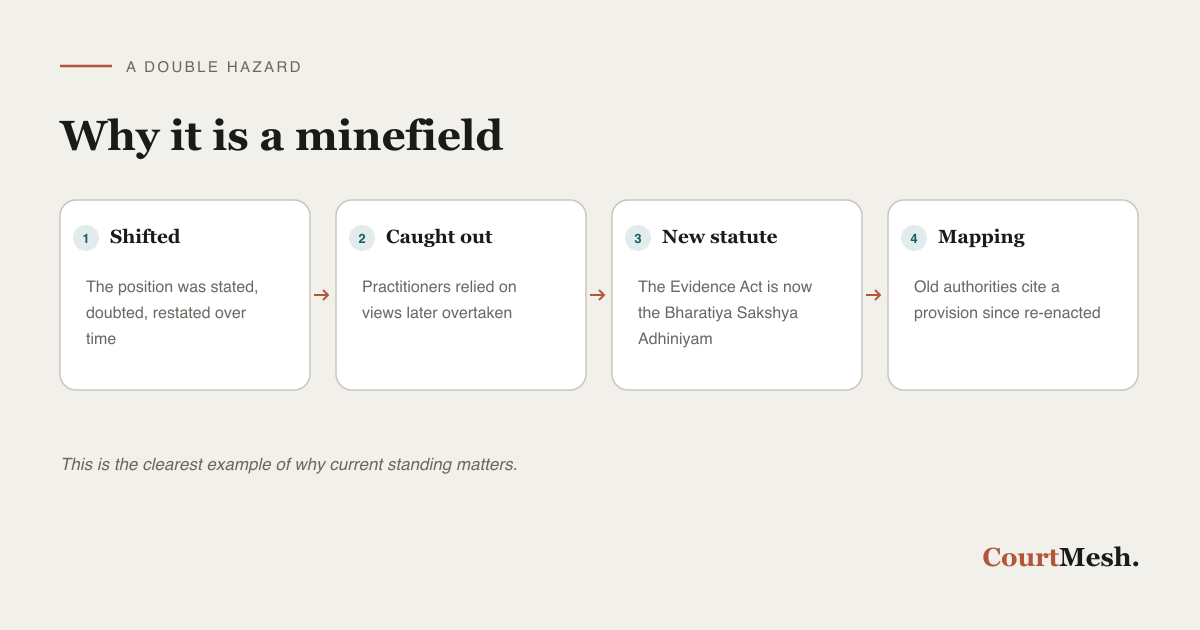
For a long stretch, the admissibility of an electronic record in an Indian court was tied to a certificate requirement associated with Section 65B of the Indian Evidence Act 1872. That provision dealt with the conditions on which a computer output could be treated as admissible, and with a certificate meant to accompany such evidence. Read cold, off the page, it looks like a single, self-contained rule that an advocate could learn once and carry for a career.
In practice it has been nothing of the sort. It was litigated heavily and reinterpreted repeatedly. The words on the page stayed still while the courts' reading of them moved, which is a particularly treacherous combination, because the text you rely on looks unchanged even as the law around it has shifted underneath.
It is not hard to see why the question kept coming back. Electronic records are now everywhere in litigation. Call detail records, emails, message threads, closed-circuit footage, server logs, screenshots, spreadsheets, and the contents of phones and laptops surface in matters of every description, civil and criminal alike. The more central this material became to proof, the more the rules for admitting it were tested, and the more often a bench was asked to refine, qualify, or reconsider what an earlier decision had said.
A requirement whose reading kept moving
The certificate requirement did not hold a fixed shape. At different points the same basic questions received different answers. Was the certificate an indispensable precondition to admitting an electronic record, or could that record be proved by secondary evidence without it? At what stage of the proceeding did it have to be produced? Who was competent to issue it? Could a party genuinely unable to obtain it be excused, and if so, on what terms? Each of these has, at one time or another, been answered one way, then doubted, then answered differently.
Setting out the exact sequence of decisions is beside the point of this article, and naming any single judgment would risk freezing a snapshot that may itself have been overtaken. What matters is the shape of the story rather than its cast. A position was stated, relied upon, later questioned, and then restated in terms that changed what practitioners actually had to do. Anyone who stopped reading at the first chapter walked into court carrying a rule the later chapters had already amended.
Interpretation drifts
The words of the provision stay identical while the courts' reading of them changes. What counted as sufficient compliance at one time can be read more strictly, or more forgivingly, at another, with nothing on the face of the section to warn you.
Benches diverge
Benches at different points in time, or of coordinate strength, take positions that do not sit easily together. Until a larger bench or a later judgment settles the tension, both views float around in the reports, each quotable, only one of them safe.
A relied-on view is overtaken
The decision everyone treated as the anchor is later distinguished, narrowed, or displaced on the very point. The citation survives in old written submissions and precedent banks long after it has stopped being safe to lean on.
When this goes wrong, it goes wrong late and in public. Admissibility is frequently decided at the stage where evidence is tendered, and a ruling that a crucial electronic record cannot come in can hollow out a case that looked strong on its merits. The point rarely announces itself in advance. It surfaces when the opposing advocate rises to object, and by then the time to have checked the current position has already passed.
The problem is timing, not knowledge
The failure here is almost never ignorance of the subject. It is a timing problem. The advocate knew the law, and knew it well, but knew it as of a date that has since passed. On a settled question that hardly matters. On this one, where the position has moved more than once, a view that was correct when it was learned can be wrong by the time it is used, with nothing visible to signal the change.
And Then the Statute Itself Was Replaced
As if a moving body of case law were not enough, the ground beneath it has now shifted as well. The Indian Evidence Act 1872, the statute that housed Section 65B, has been replaced by the Bharatiya Sakshya Adhiniyam 2023, which came into force on 1 July 2024. The old Act is no longer the governing law of evidence, and that single fact changes how every older authority on this subject has to be read.
What can be stated, and where the caution actually belongs
Some of this is fixed public record and there is no reason to be coy about it. Section 65B was a provision of the Indian Evidence Act 1872 concerning the admissibility of electronic records and an associated certificate. That Act has been replaced by the Bharatiya Sakshya Adhiniyam 2023, in force from 1 July 2024, and the corresponding provision on the admissibility of electronic records is Section 63, which carries its own certificate requirement in the form set out in the Schedule to the Adhiniyam. An article about researching this provision that will not name it is not being careful; it is being unhelpful. The caution belongs one step further on. Read Section 63 and the Schedule in the bare Act rather than from any summary, do not assume the language is identical to Section 65B merely because the subject is the same, and treat how the courts are reading the new provision as an open and developing question rather than a settled one.
This creates a specific and easily missed hazard. Every authority decided before the changeover refers to Section 65B of the 1872 Act. Those judgments do not vanish, and much of their reasoning may well carry over. But an advocate reading them today has an extra piece of work to do. You must establish what the new statute provides on the same subject, and then ask whether the reasoning still holds under that language, or whether the wording has changed in a way that matters to the point being argued.
It is tempting to assume that a new enactment simply renumbers the same rule and moves on. Sometimes that is all it does. But the only safe assumption is that you do not know until you have compared the old provision, the new text, and any decision interpreting either. A change of numbering is not itself the risk. The risk is treating it as cosmetic without checking whether anything of substance travelled with it.
Old authorities do not become useless, they become conditional
It would be just as much a mistake to swing the other way and dismiss every pre-2023 decision as obsolete. A great deal of the reasoning developed under the old Act may continue to apply, because the underlying concern, that a court should satisfy itself an electronic record is authentic and reliable before acting on it, has not gone anywhere. Where a later provision is cast in substantially similar terms, reasoning developed under the earlier one is commonly pressed into service, though whether it holds in a given matter is something to be argued rather than assumed.
The right posture is therefore neither blind reliance nor blanket rejection. It is conditional reliance. An older authority is useful to the extent that its reasoning survives the new language and has not been overtaken by a later decision, and that condition has to be tested for each authority, case by case, rather than presumed in either direction.
There is a further layer that has to be checked rather than guessed. When a governing statute is replaced, questions arise about which law applies to matters already underway, to evidence already led, and to proceedings begun under the old Act. These are exactly the kind of transitional questions answered by the new statute's own provisions and by early decisions interpreting them. This article does not answer them, and the intuitive answer should not be assumed. It is one more thing to confirm from primary sources for the specific matter before you.
| What an older Section 65B authority gives you | Why it may not be enough now | What to confirm at source |
|---|---|---|
| A bench's reading of the certificate requirement under the 1872 Act | It was decided under a statute that is no longer the governing law of evidence | Whether that reading survives under Section 63 of the Bharatiya Sakshya Adhiniyam 2023 and the certificate form in the Schedule |
| The section number cited throughout, as Section 65B | The old judgment could not refer to a provision that did not yet exist, and the successor provision is Section 63 of the Adhiniyam | The text of Section 63 and the Schedule in the bare Act, compared clause by clause against the old Section 65B rather than assumed to match |
| The proposition the case is quoted for in a headnote or a digest | A summary compresses, and the qualification you needed is often what got dropped | The operative reasoning in the judgment itself, read in full at source |
| That it was good law on the day it was delivered | The position has moved more than once since, at times without the earlier case being named | Whether a later bench has followed, distinguished, doubted, or overtaken it on this point |
How to Research a Shifting Area Without Getting Burned
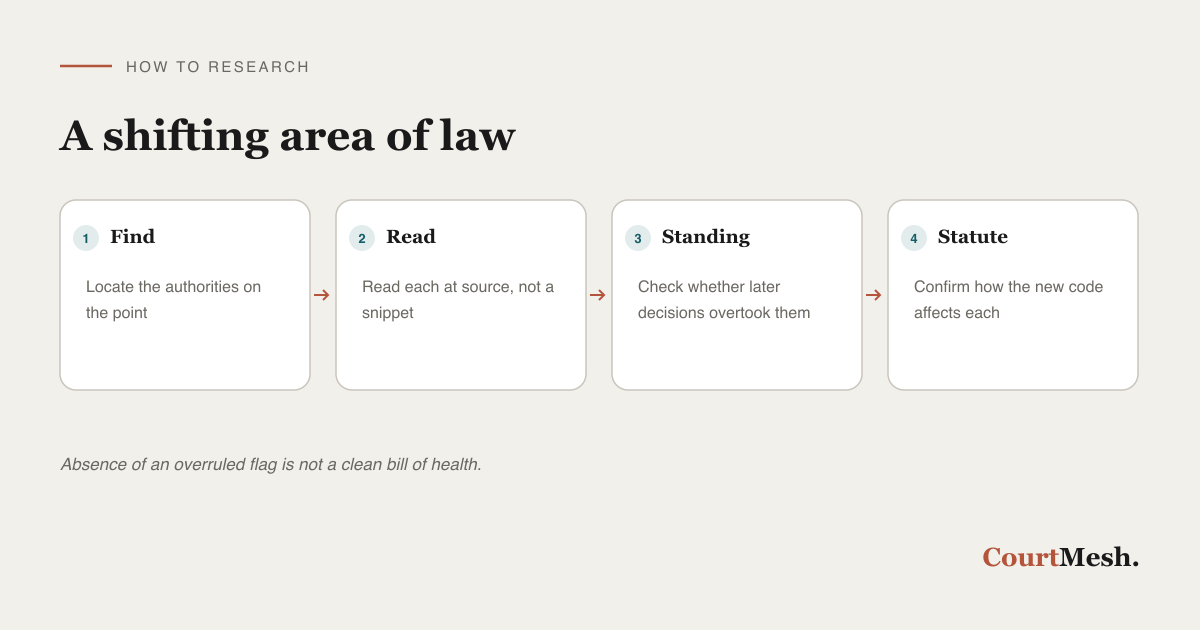
The method for an area like this is not exotic. It is ordinary good research discipline, applied with more care than usual because the cost of an error is higher. The aim is never to remember the rule and reach for it later. It is to reconstruct the current position from primary sources every time the matter genuinely turns on it.
Before you rely on any authority in this area, you are really asking four questions at once:
- Is this the current statement of the position, or an earlier one that has since moved?
- Does it survive the shift from Section 65B of the Indian Evidence Act 1872 to Section 63 of the Bharatiya Sakshya Adhiniyam 2023, in force since 1 July 2024?
- Am I reading what the bench actually held, or someone's summary of it?
- Has a later decision followed it, or quietly taken it apart on the point I need?
Find the authorities, not just the one you remember
Start by locating the line of decisions on the point, not the single case you already half recall. A search across courts and years surfaces the early statements, the decisions that doubted them, and the ones that restated the position. You are mapping a conversation between benches, not looking up a fact.
Read each one at source
Open the judgment itself and read the operative portion, not a headnote, a digest entry, or a note in an old brief. Summaries compress, and compression is precisely where the qualification you needed gets lost. Every result should link back to the actual judgment so that reading it at source is a click away.
Check current standing
For each authority you intend to rely on, ask whether it is still good law on this point. Has it been followed, distinguished, doubted, or set aside by a later bench? A decision can remain well known long after it has stopped being safe to cite for the proposition you actually want.
Trace what came afterwards
Move forward in time, not only backwards. The decision that settles the point may be more recent than the one everyone quotes. Following the citations forward tells you whether the anchor you found is the end of the story or merely its opening.
Map the statutory change onto each authority
Because the older authorities cite Section 65B of the 1872 Act, put Section 63 of the Bharatiya Sakshya Adhiniyam 2023 and the certificate form in its Schedule alongside them, compare the language clause by clause, and ask whether each authority's reasoning survives that comparison. Treat nothing as a simple change of numbering until you have checked it.
The one-line version
Never rely on what you remember about this area. Rebuild the current position from the primary judgments and the current statute every time it matters, and confirm that each authority you cite is still good law on the exact point in issue. Everything else in this article is detail hung on that one instruction.
Read the judgment, not the headnote
A headnote is someone else's summary, written for speed rather than for the specific point you are arguing. On a question as finely balanced as the certificate requirement has been, the gap between what a bench actually held and what a headnote says it held can be the whole difference between a submission that stands and one that collapses under a single question from the bench.
There is a related trap in relying on how a case is described in a later judgment, or in written submissions filed by someone else. Those descriptions are advocacy or shorthand, shaped for a purpose that may not be yours. They are useful signposts to the primary source. They are not a substitute for it. When the point is decisive, go to the judgment and read what the bench decided, in its own words and in context.
The question that decides a matter is rarely what a court once said. It is whether the case still says it today, and whether it ever said it about the point you are citing it for.
Using Citation Treatment Without Trusting It Blindly
One of the most useful things in fast-moving research is being able to see how a judgment has been treated by the benches that came after it. When you can see that a decision was followed here, distinguished there, and doubted somewhere else, you get an immediate sense of whether it still stands and where the pressure on it is coming from. That is the layer that turns a flat list of cases into a map of the current position.
Seen this way, a few questions become answerable that a plain search never reaches:
- Who cited this authority, when, and from what strength of bench?
- How did they treat it: did they follow it, narrow it, or doubt it?
- Is the line of authority converging on one position, or splitting into a conflict not yet resolved?
- Has anything the decision itself rested on been displaced since?
This is the kind of work a research platform can genuinely speed up. CourtMesh indexes roughly 310 million cases from the Supreme Court, all 25 High Courts, the District Courts, and Tribunals, drawn only from official government portals, and every result links to the actual judgment so you can read it at source. Alongside keyword search there is AI semantic search for when you know the concept but not the phrasing, and across a part of the corpus it tracks how cases cite one another, whether a decision was followed, distinguished, overruled, or referred to. Filters for court, year, judge, the acts and sections in issue, and the disposition let you narrow a sprawling line of authority down to a set you can actually sit down and read.
An absent flag is not a clean bill of health
Two limits deserve to be stated plainly. The citation relationships are tracked over a subset of the corpus, not across all 310 million cases, so the absence of an 'overruled' or 'doubted' marker on a judgment does not prove that no such treatment exists. It may only mean the analysis has not reached that judgment yet. And a tool that helps you find authorities and see how they have been treated is not a tool that tells you the answer. It shortens the search. It does not replace the reading, the judgement, and the verification that only the advocate can perform.
Build the check into the habit, not the memory
The advocates who get caught here are rarely lazy. They are usually experienced, and it is the experience that betrays them, because they are confident they already know the answer and so do not look again. The protection is to make the verification part of the drill rather than an optional extra. A precedent bank is only as reliable as the last time each entry in it was checked, and on a shifting question an unverified note from an old brief is not a shortcut. It is a liability wearing the costume of one.
The Honest Part
This is about method, not the rule
Read everything above as a piece on how to research, not as a statement of what the law on electronic evidence currently is. Nothing here should be treated as the present rule. The whole argument is that this is precisely the area where an out-of-date view is most dangerous, because the interpretation has shifted more than once and the governing statute has itself been replaced. The only reliable position is the one you confirm for yourself, against the primary judgments and the current statute, at the time you need it. If you take a single settled proposition away from this article, let it be that one.
The discipline that protects you is unglamorous and endlessly repeatable. Find the authorities. Read them at source. Ask whether each is still good law on your point. Trace what came after. Set the old provision against the statute as it now stands. Then, and only then, build your submission on what you have verified rather than on what you remember. In an area this unstable, that is not caution for its own sake. It is the difference between an argument that holds and a certificate that sinks the case.
Research the Standing, Not Just the Case
Electronic evidence is a standing reminder that finding a judgment is only half the job, and the other half is confirming that it still stands. CourtMesh brings the Supreme Court, all 25 High Courts, the District Courts, and Tribunals into one search, draws every result directly from official government portals, links each one to the actual judgment, and, over part of that corpus, shows how a judgment has been treated by later benches. Use it to reach the authorities and whatever treatment has been mapped, then do the part no tool can do for you: read them, set them against the statute as it now stands, and decide what the current position really is.
Explore CourtMesh