Somewhere in the record of Indian jurisprudence there is very likely a judgment that decides your matter. It has been indexed. Every word of it is searchable. And there is a real chance you will never find it, because the bench that wrote it in 1987 described your legal problem using words you would never think to type in 2026.
This is not a failure of diligence. It is a structural property of how keyword search works. Boolean search retrieves documents that contain your words. It has no mechanism for retrieving documents that contain your idea. When the two coincide, it is superb: fast, exact, auditable, unbeatable. When they diverge, it fails silently, handing you a clean and confident list with nothing in it to indicate what is missing.
This article is about that gap: why it is unusually wide in Indian case law, what meaning-based search actually does about it, and, just as importantly, where meaning-based search is the wrong instrument and keyword search remains the right one. Anyone who tells you semantic search simply replaces Boolean search is selling something. The useful skill is knowing which question belongs to which tool.
The Precedent Was in the Database the Whole Time
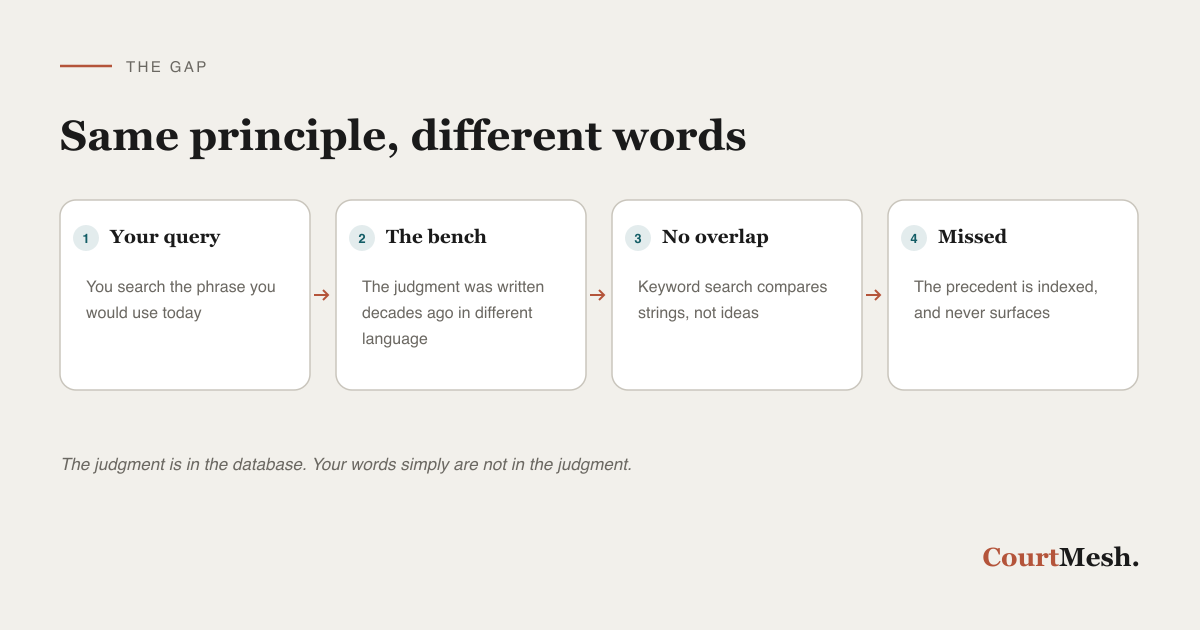
Suppose you are instructed in a service matter. Your client, a workman, was let go without an enquiry. You sit down and search for wrongful termination without enquiry. You get results. Several are useful. You draft your submissions and move on.
What you did not retrieve is everything written by benches who reached for other words: judgments about "discharge simpliciter", about "termination of service" rather than wrongful termination, about "retrenchment" as that term is defined and used in the judgments under the Industrial Disputes Act 1947, about an employer "dispensing with" a departmental enquiry, about an order innocuous in form but punitive in substance. Not one of those judgments contains the phrase you typed. Any one of them may be squarely on your point.
The judgments were in the database. They were fully indexed. The search engine did exactly what it was built to do, and did it correctly. The trouble is that what it was built to do is match strings.
Keyword search finds documents that contain your words. It cannot find documents that contain your idea. And research is precisely the activity you undertake when you do not yet know the words.
That is the whole difficulty in two sentences. Boolean search asks you to supply the vocabulary of the answer as a condition of finding the answer. For a term of art you know cold, that price is trivial. For a question at the edge of your practice, a fact pattern you have not met before, or a principle that predates the label now attached to it, the price is the research itself. And you never see the bill. A search that returns nothing at least tells you it found nothing. A search that returns eleven decent results and misses the controlling one tells you nothing at all.
Why Indian Case Law Is Especially Hard on Keyword Search
Vocabulary mismatch exists in every legal system. It is unusually severe in India, and the reasons are worth setting out, because they explain why the gap here is wider than the general problem would suggest.
Seventy years of drafting convention
A judgment from the 1950s and a judgment from last term are both citable and both may be good law. They do not read alike. Older judgments favour long periodic sentences, Latin constructions and formal circumlocution. A modern bench is far likelier to name a doctrine in a heading and get on with it. The concept is stable. The words are not.
Twenty-five High Courts, twenty-five house styles
The Supreme Court, the 25 High Courts and the tribunals have each developed their own drafting habits, preferred phrasings and registry conventions. Two benches in different states can decide the same point in the same year and share almost no distinctive vocabulary.
Transliteration and the vernacular
Land, revenue, tenancy and family matters are full of terms that arrive in the judgment straight from the record: khata, patta, jamabandi, stridhan, shamlat. None has a single settled English spelling. A keyword index treats every transliteration as a different word, because to the index it is one.
Headnotes are not written by benches
A great deal of legal research leans on headnotes and catchwords. Those are editorial products, prepared to varying depth, and absent altogether from much of the raw official record. Search the headnote layer and you are searching an editor's vocabulary, not the court's.
Statutes get recast; judgments do not
When a provision is renumbered or a statute is replaced, the judgments interpreting the predecessor remain good law and go on referring to it by its old number and old name. Search the current numbering and decades of authority quietly drop out of your results.
Text recovered from print
Any corpus that reaches back far enough contains judgments recovered from paper. Character recognition on old print is imperfect. Keyword matching is exact matching, and exact matching is unforgiving of a single misread character in the one word you searched for.
How Keyword Search Actually Works, and Why That Matters
It is worth being concrete about the mechanism, because every failure mode follows directly from it.
Tokenise
The engine breaks every judgment into tokens, roughly words, and normalises them. It lowercases, strips punctuation, and usually reduces inflected forms to a stem, so "terminated" and "termination" collapse together.
Index
It builds an inverted index: for every token, a list of every document containing it. This is why keyword search is quick. Looking up a word is a dictionary lookup, not a scan of hundreds of millions of documents.
Match
Your query is tokenised the same way and its tokens are looked up. Boolean operators, phrase matching and proximity operators combine and constrain those lists into a candidate set.
Rank
Surviving documents are scored, typically by how often your terms appear in each document weighed against how rare those terms are across the corpus, and returned in that order.
Notice what never happens. At no point does the engine form any representation of what your query means. It compares strings. A document is retrievable if and only if it contains your tokens, or a lexical variant the stemmer happens to fold in. That is not a defect in a particular product. It is the definition of the technique.
The upside of matching strings
Because it matches strings, keyword search comes with guarantees nothing else offers. Every result provably contains your terms. You can see exactly why a result appeared. The same query, run tomorrow or by your junior, returns the same list. And a query returning nothing has told you something true: those words are not in the corpus. Do not give these properties up lightly, and be suspicious of anyone who asks you to.
The Four Places Keyword Search Structurally Fails
1. Synonymy: one idea, many words
A bench can describe the same point as the suit being barred by limitation, the claim being time barred, the cause of action having arisen beyond the prescribed period, or the plaint being filed out of time. All four are ordinary judicial phrasings of a question under the Limitation Act 1963. A query built on one of them retrieves a fraction of the authority on the point, and reports no fraction at all.
2. Polysemy: one word, many ideas
The mirror image, and it costs you precision rather than recall. "Consideration" is a term of art under the Indian Contract Act 1872 and also an ordinary English word appearing in very nearly every judgment ever written, as in "on a consideration of the evidence". "Notice", "award", "party", "execution" and "service" each carry a technical sense and a domestic one. Search for the term of art and you get a haystack containing your needle plus every unrelated use of the word. Practitioners respond by adding terms to narrow the set, which improves precision and quietly cuts recall further.
3. Paraphrase: the doctrine before it had a name
Doctrines acquire their labels over time. A bench in an earlier decade may work through exactly the reasoning you need without ever using the compact phrase later attached to it, writing instead a full paragraph about what a person was entitled to expect and what fairness required before that expectation was defeated. Search the label and you find the judgments that came after the label. The reasoning that produced it stays invisible.
4. Conceptual and fact-pattern queries
These are the questions advocates actually have. "On what grounds may a court decline specific relief even where the contract is valid and subsisting?" is a real research question under the Specific Relief Act 1963, and it is not a string. No judgment contains that sentence. The answer is distributed across judgments that each use their own words for their own slice of it. Fact patterns are worse still: "my client stood surety, the principal borrower is now in insolvency proceedings under the IBC 2016, what becomes of the guarantee" is how the problem arrives on your desk, and it is nothing like how any judgment is written.
Boolean search asks you to translate that question into the vocabulary of its answer before it will let you search for the answer. That translation is the research.
What Meaning-Based Search Does Differently
Semantic search, also called vector search or embedding search, attacks the problem from the other end. Instead of indexing which words a judgment contains, it indexes what a passage of it means.
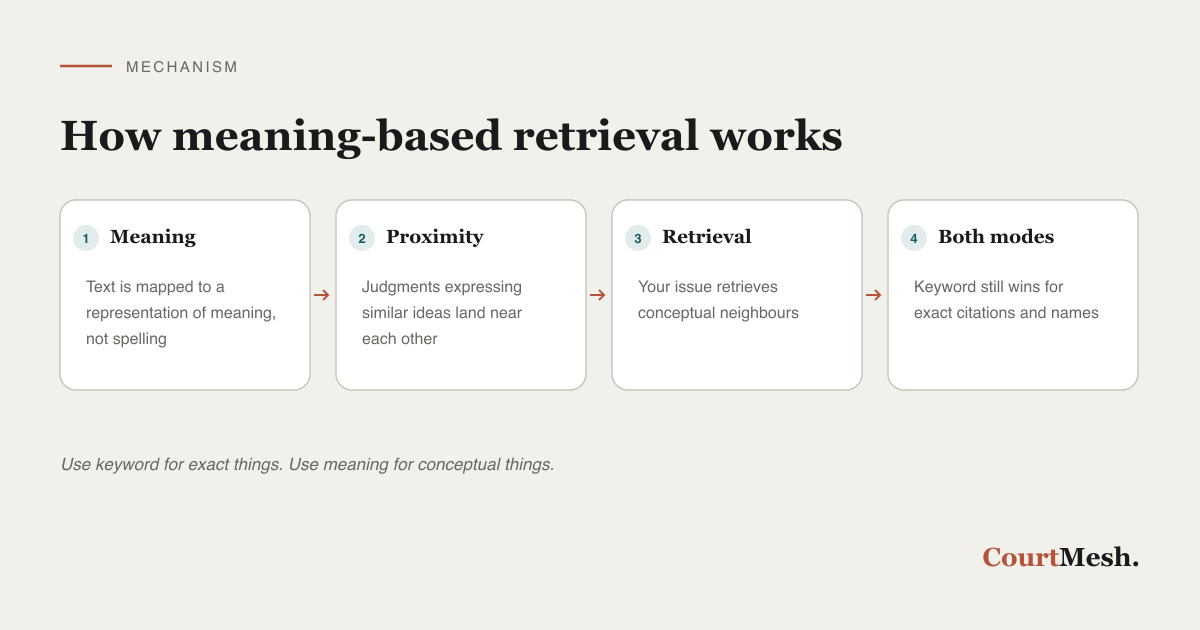
The mechanism is an embedding model: a model trained on very large volumes of text that converts a passage into a vector, a long list of numbers locating that passage as a point in a high-dimensional space. The training arranges the space so that passages with similar meaning land near one another. "Termination of service without a departmental enquiry" and "removal from employment without holding an enquiry" end up as neighbours, not because anyone wrote a synonym list, but because across the text the model learned from, those phrasings sit in the same contexts.
Long judgments are split into passages before they are embedded, so a hit points at the part of the judgment that is on your point rather than at a forty-page document you must then read in full. At query time your question is embedded by the same model, and the engine returns the passages whose vectors sit closest to it.
The property that matters
A semantic hit does not require a single shared word between your query and the judgment. That is the entire point. It is what lets a question written in 2026 vocabulary reach a bench writing in 1987 vocabulary, and what lets you search by describing a fact pattern in plain prose instead of guessing at terms of art the judgment may never have used.
Two practical consequences follow, and both are routinely missed. First, semantic search rewards sentences and punishes keywords. Typing three words into a semantic box wastes the mechanism, because there is very little meaning in three words. Describe the matter as you would explain it to a colleague: the parties, the facts, the relationship, the question in dispute. More context makes a better vector. Second, it is a vocabulary discovery tool. Even where a semantic result is not itself the authority you will eventually cite, it shows you the words the courts actually use for your problem, and those words were the thing you were missing.
Where Semantic Search Is the Wrong Tool
This is the part most vendors leave out, so let us be plain. There are whole categories of legal search where semantic retrieval is not merely no better than keyword search but actively worse, and an advocate who reaches for it there will lose time and may lose results.
Exact identifiers
A citation, a diary number, an appeal number, a case number. These carry almost no meaning for an embedding model to work with: one civil appeal number means very nearly the same thing as any other civil appeal number, so they all embed to roughly the same place. Ask semantically for a specific number and you get back a spread of documents that all merely look like they contain a number. Exact matching solves this perfectly and instantly.
Names
Party names and judges' names are the same problem, sharpened. Two surnames are semantically near identical and legally unrelated. Here semantic similarity does not just fail to help, it pulls the wrong documents in.
Negation and narrow distinctions
Embedding models are notoriously weak at negation. "Where consideration was present" and "where consideration was absent" can land very close together, because they are about the same thing. In law the distinction is frequently the entire matter. Do not trust a semantic engine to hold a "not" for you.
Exhaustiveness
Semantic search returns the nearest few passages. It does not return all matching passages, because matching is a distance here and not a yes or a no. If the task is every judgment of a given High Court under Section 138 of the Negotiable Instruments Act since 2015, that is a job for exact matching and structured filters, which can be complete over the corpus you are searching in a way nearest-neighbour retrieval cannot.
Auditability
With a keyword hit you can point at the word. With a semantic hit there may be no shared word to point at, and the honest answer to "why did this come up" is that the model placed it nearby. For work you must be able to justify, that is a real cost.
The missing negative signal
A keyword query with zero results has told you something true. A semantic query never returns zero results. It returns the nearest passages it has, even where nothing relevant exists in the corpus at all. Nearest is not the same as relevant.
The failure mode to actually worry about
Keyword search fails visibly. Semantic search fails plausibly. When Boolean search misses, you often get a thin or empty result set and you know to go again. When semantic search misses, you get ten well-ranked passages that are all roughly about your area and none of them controlling, and it reads exactly like a completed search. Treat a satisfying semantic result set as the beginning of verification, not the end of it.
Which Search for Which Question
The honest summary is that these are two instruments offering different guarantees. The skill is matching each question to the guarantee it actually needs.
| What you are trying to do | Reach for | Why |
|---|---|---|
| Pull up a judgment by its citation or case number | Keyword | An identifier is a string, not a meaning. Exact match is instant and certain; semantic search has nothing to work with. |
| Find matters involving a named party | Keyword | Names carry no useful semantic signal, and semantic similarity between surnames actively misleads. |
| List every judgment citing a given section since a given year | Keyword plus filters | The requirement is completeness. Exact matching and structured filters can be exhaustive over what has been indexed; nearest-neighbour retrieval returns the closest few, not all. |
| Locate a passage you know appears verbatim | Keyword, as a phrase | You already hold the exact vocabulary. That is the ideal condition for Boolean search. |
| Check whether a phrase appears in the corpus at all | Keyword | Only keyword search can return a meaningful zero. Semantic search always returns something. |
| Research a settled term of art you know well | Keyword first, then semantic | Start where you have the words. Widen semantically to catch benches that made the same point in different language. |
| Find authority for a principle you can state but cannot name | Semantic | The vocabulary gap in its purest form: you have the idea and not the label. |
| Research a fact pattern as the client described it | Semantic | Fact patterns are prose, not terms. Describe the situation in full sentences and let the model do the translating. |
| Reach older judgments on a concept that was named later | Semantic | The label postdates the reasoning. Only meaning-based retrieval crosses that gap. |
| Work in an area outside your usual practice | Semantic, then keyword | Harvest the real vocabulary from semantic results, then run exhaustive keyword searches with the terms you just learned. |
| Pin down a narrow point turning on a negative | Keyword, then read | Embeddings are weak at negation, and neither mode substitutes for reading the judgment. |
A Working Protocol
Here is how the two modes compose in ordinary practice. It is not complicated, but it does require deciding what kind of question you have before you start typing.
Classify the question first
Identifier, term of art, or concept. Ten seconds of classification saves twenty minutes of the wrong search. If you hold a number or a name, you hold an identifier and you are done thinking.
For identifiers, go exact and go straight there
Do not describe a citation to a semantic engine. Type it into keyword search with the court filter applied and move on.
For a term of art you know, start Boolean
You have the vocabulary, so use it. Get the core authority, and register clearly that you have almost certainly not got all of it.
For a concept or fact pattern, start semantic, and write in sentences
Describe the matter as you would to a junior: the parties, the facts, the point in dispute, the question you need answered. Not three keywords. The mechanism runs on meaning, and three words carry very little of it.
Harvest the vocabulary, then go back to Boolean
This is the step that most changes results. Read what semantic search surfaces and note the terms those benches actually used: the phrasings, the doctrinal labels, the statutory language. Then run keyword searches with that vocabulary to close the set. Semantic search solves the cold start. Keyword search delivers the completeness.
Narrow with filters, not with more words
Adding query terms silently destroys recall. Filtering by court, case type, year or date range narrows the field without touching what the engine is willing to retrieve in the first place.
Read the judgment
Neither mode has read it. Neither knows whether it has been overruled, distinguished, or is under challenge in an SLP. Retrieval finds candidates. Whether the ratio applies to your facts, and whether the passage you like is ratio or obiter, is yours alone and always will be.
How This Works on CourtMesh
CourtMesh is built on the position argued above: these are two tools, not two generations of one tool. Both are available as distinct modes you choose, over the same corpus.
- Both modes, deliberately. Keyword search and AI semantic search sit side by side as separate modes. You pick the one that fits the question, and you move between them freely on the same matter.
- The corpus. Over 310 million cases: the Supreme Court, all 25 High Courts, the district judiciary and tribunals including NCLT, NCLAT, ITAT, CESTAT, SAT, TDSAT and DRT.
- Sourced directly from official government portals. No third-party intermediaries sitting between the court's record and your result.
- Filters that narrow without costing recall. Court, case type, year and date range, judge and case number, applied to either mode. These are the parameters the search endpoints validate; acts, sections, disposition and case status come back on a result but cannot be sent as filters.
- Speed appropriate to the mechanism. Keyword results come back faster than semantic ones, because exact matching is a lookup and meaning-based retrieval is a computation. The difference is inherent to the two mechanisms rather than a defect in either, and it is not large enough to decide which one your question needs.
One thing we will not claim
Only a subset of the corpus carries full AI-derived analysis. Coverage of the raw record is one thing; depth of analysis is quite another, and any platform telling you that 310 million cases have each been analysed by a model is telling you something you should test before you rely on it. Ask every vendor, this one included, exactly what is analysed and what is merely indexed.
What This Actually Changes
The point of understanding the mechanism is not to crown a winner. It is that the two failure modes are different, and knowing which one you are exposed to right now tells you what to do next.
When you Boolean-search a term of art, your exposure is recall: there is authority out there in other words, and your result set will never mention its existence. When you search a concept semantically, your exposure is precision and completeness: plausible neighbours, confidently ranked, with no guarantee that you have everything. Each is the other's mitigation, which is why the protocol above moves between them rather than settling on one.
Neither instrument absolves you of reading. Retrieval is not research; it is the part of research a machine can do. Deciding whether a passage is ratio or obiter, whether a judgment survives later benches, whether a distinction on the facts is real or merely convenient, that work is entirely unchanged, and it is the work you are actually paid for. What changes is which judgments you get to do it on, including the one from 1987 that never used your words.
Search the way the question is shaped
Most research failures in Indian case law are not failures of effort. They are vocabulary mismatches that the search box never reports. CourtMesh gives you both instruments over roughly 310 million cases sourced directly from official government portals: keyword search for when you have the words, AI semantic search for when you have only the idea, and filters to narrow either without giving up recall. Take the question you gave up on last month and run it both ways.
Explore CourtMesh