Legal research usually treats a statute as a fixed thing. You look up the section, you read it, you cite it. The provision sits on the page looking permanent, as though it had always said what it says now. But statutes move. Provisions are amended, substituted, omitted and renumbered. Whole enactments are repealed and replaced. Different parts of the same Act are brought into force on different dates. The text you find today is the text as it stands today, and the events in your matter may have been governed by something else entirely.
This is one of the quietest and most expensive errors in practice, because it produces no symptom. Nothing on the page warns you that the words you are about to rely on arrived long after your client's cause of action did. The research looks complete, the citation looks correct, and the argument is simply built on a provision that was not in force at the relevant time. The first person to notice is usually on the other side of the table, or on the bench.
A Statute Is Not a Fixed Object
The way advocates talk about statutes conceals their temporal dimension. We say 'the section', as though the phrase named a permanent thing. It does not. A section number is an address, not a text. It tells you where in the enactment the rule lives. It tells you nothing at all about what the rule said on any particular day, and over the life of a long-standing enactment the address usually stays constant while the occupant changes several times over.
Compare this with how we treat judgments. Every judgment carries its date on its face, and nobody cites one without noticing when it was delivered. Statutory text is presented without that discipline. Open almost any source and you get the provision as it currently reads, with no indication of whether those words are original, whether an amending Act inserted them decades later, or whether they replaced text that governed for a generation before that. The presentation is timeless. The underlying reality is not.
A judgment tells you the date it was delivered. A statutory provision, as you usually find it, tells you nothing about when its words arrived or what they replaced.
Every matter, meanwhile, is anchored to dates. The date the contract was executed, the notice issued, the offence alleged, the cause of action accrued, the assessment made. Research goes wrong at the point where those dates are never checked against the dates on which the statutory text changed. Two timelines are involved and only one of them is usually visible.
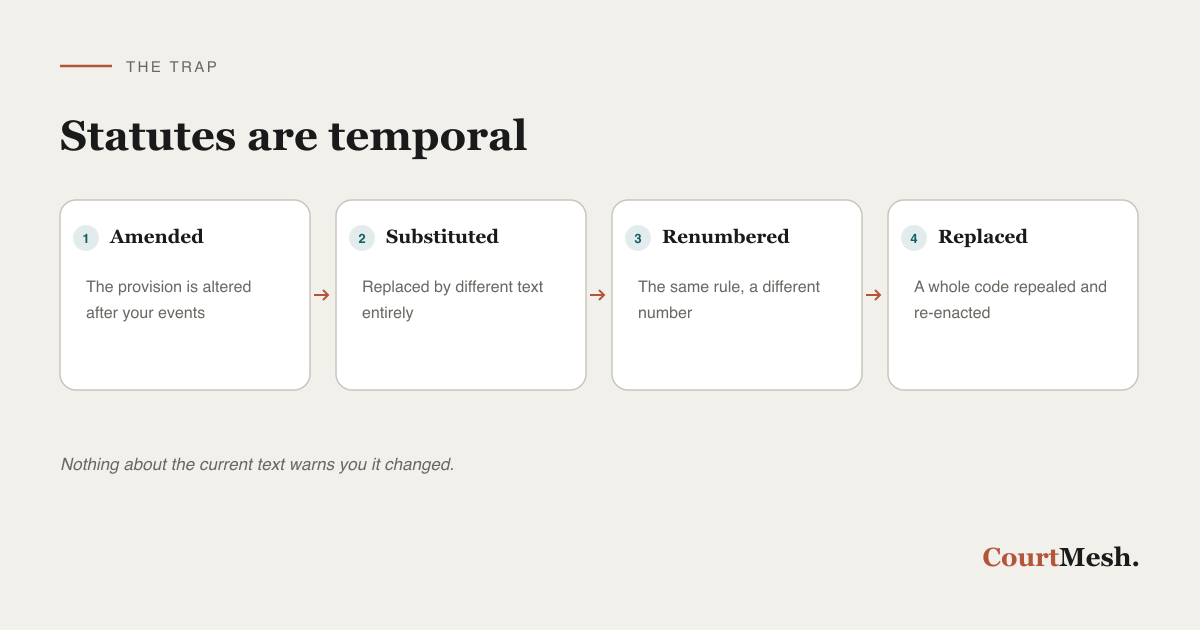
The problem is not that advocates are unaware statutes get amended. Everyone knows that. The problem is that the current text gives no signal that anything has changed, so the question never presents itself. Nobody consciously decides to skip the check. The check simply never comes to mind, because the page in front of you looks like a complete and settled answer.
The Ways a Provision Changes, and What Each Does to Your Citation
Legislative change is not a single event with a single consequence. An amending Act can do several quite different things to a provision, and each affects your citation differently. Some leave the number intact and change the words. Some leave the words intact and change the number. Some remove the provision while leaving the numbering sequence undisturbed, so the gap is easy to miss. The table below sets out the common operations and what each does to research that assumes the current text is the only text.
| Change | What the legislature has done | What it does to your citation |
|---|---|---|
| Inserted | A new section, sub-section, proviso or explanation is added to an existing enactment. | Before that amendment commenced, the provision did not exist. Citing it for earlier events invokes a rule that had not yet been made, which is the cleanest form of this error and the easiest to expose. |
| Amended | Words are added, deleted or substituted within a provision, while the rest of it continues as before. | The number is unchanged and the provision looks familiar, so the change is easy to miss. The words you quote may be precisely the words added later. |
| Substituted | The whole provision is replaced with a new one carrying the same number. | Same address, different occupant. Consolidated texts generally show only the new provision, so the version governing older events may not appear anywhere on the page you are reading. |
| Omitted | The provision is taken out of the enactment, usually leaving the number in the sequence marked as omitted. | Conduct after the omission is not governed by it. Conduct before may still be, depending on savings, and whether an omission operates as a repeal for that purpose has itself been the subject of judicial debate. |
| Renumbered | The content survives but moves to a different number, often when a chapter is reorganised or provisions are regrouped. | The same rule answers to two citations depending on the date. Older judgments discuss the old number, later ones the new, and a search built around either alone silently misses half the authority. |
| Repealed and re-enacted | The entire enactment is replaced by a new one covering the same field, usually with its own numbering and drafting. | Every citation to the old enactment needs re-examination. Which enactment governs your facts turns on the repeal, savings and transitional provisions of the new one, and on nothing else. |
| Not yet commenced | The provision has been enacted but not brought into force, or brought into force only in part or for certain purposes. | The words exist on paper and govern nothing. A provision can be printed in the Act, indexed and discussed in commentary while still not being in force on the date that matters to you. |
Enactment is not commencement
The last row deserves separate treatment, because it is the trap that catches careful researchers. An enactment is passed and receives assent on one date. It comes into force on another. Indian legislative practice routinely provides that an Act shall come into force on such date as the Government may appoint by notification, and that different dates may be appointed for different provisions. A single Act can therefore commence in instalments, with some provisions live and others dormant at the same moment.
So there is not one date to check but at least three: when the enactment was passed, when the provision was brought into force, and when any later amendment to it was itself brought into force. The General Clauses Act 1897 supplies default rules that fill the gaps, including on when an enactment comes into force where it does not say so itself and on the effect of a repeal, but those defaults yield to whatever the enactment actually provides. The default is the fallback, not the answer.
Three dates, not one
For any provision you intend to rely on, you are looking for the date it commenced, the date of any amendment that touched it, and the date that amendment commenced. Assent and commencement are different events, and the gap between them can be long. A provision that was on the statute book on your relevant date was not necessarily in force on it.
Where This Bites Hardest
The risk is not evenly distributed. There are matters where the current text is almost certainly the right text, and matters where assuming so is close to reckless. Knowing which kind you are in is most of the protection.
Old facts, current research
The further back the events, the more amendments sit between then and now. Property disputes, long running commercial matters and old assessments are researched today against text that has had years to move. That gap is where the error lives.
A field that has been rewritten
Where an entire enactment has been repealed and replaced, nothing carries over automatically. Numbering, drafting and structure change at once, and a professional vocabulary built around the old scheme keeps circulating alongside the new one.
Heavily amended regulatory provisions
Tax, company law, procedural rules and penalty thresholds attract frequent amendment. Here the text can move more than once within the life of a single matter, so the version that applied when proceedings began may not be the version reading back to you today.
The same failure repeats in each of them, and it is worth naming the forms it takes so they can be recognised on sight.
None of these is a failure of legal ability. In each, the advocate read the provision correctly and applied it competently. It was simply the wrong provision for the date, and nothing in the material said so.
When an Entire Code Is Replaced
Indian criminal practice is currently living through this problem in its most far-reaching form. The Indian Penal Code has been replaced by the Bharatiya Nyaya Sanhita 2023, the Code of Criminal Procedure 1973 by the Bharatiya Nagarik Suraksha Sanhita 2023, and the Indian Evidence Act 1872 by the Bharatiya Sakshya Adhiniyam 2023. These are not amendments to existing codes. They are new enactments, passed in 2023, replacing enactments that had been the working furniture of Indian criminal practice for generations. When each provision of each new code took effect is itself a commencement question, to be checked rather than assumed.
The consequence for research is structural rather than merely inconvenient. For decades the old section numbers functioned as professional shorthand, shared by advocates, judges, investigating officers and textbook writers alike, and an enormous body of judgments is written in that vocabulary. Now two vocabularies are in circulation at once, and which governs a given matter depends on dates and savings provisions rather than on habit.
Whatever repeal and savings provision a new enactment carries is what decides, and intuition does not, the fate of matters already underway when the change took effect. Investigations begun earlier, trials part heard, appeals pending, applications filed but undecided: the treatment of each is answered by reading the provision, and the answer is not necessarily the same for all of them. Read the repeal and savings provision before assuming which code applies. On this question assumption and verification look identical until the point is taken against you.
Two vocabularies, one question
After a wholesale replacement, research has to run in both directions at once. The old numbering is where the accumulated case law lives, and the new numbering is where the current position is being worked out. Searching only one of them produces a confident answer built on half the material, and the half you are missing is invisible from where you are standing.
The question is never which text is easier to find. It is which text was in force on the day the events happened.
The Provisions That Decide Which Version Applies
When a provision has changed between the events and the hearing, something has to decide which version governs. That decision is usually made by the least read part of the amending or replacing enactment: the repeal provision, the savings clause, and any transitional provisions. They sit at the very end, drafted in dense language, and are routinely skipped by researchers who have already found the operative section they came for.
They should not be skipped, because they frequently do the real work. A savings clause can preserve the old provision for proceedings already begun, for rights already accrued, or for a defined category of matters, while the new provision governs everything else. A transitional provision can create a hybrid position for a limited period. Where the enactment says nothing, the general rules on the effect of a repeal step in, subject always to a different intention appearing in the enactment itself.
Alongside those express provisions sit general principles of construction that any advocate arguing this point will meet. Amendments affecting substantive rights are ordinarily not read as operating retrospectively unless that intention appears, while changes that are purely procedural are more readily applied to pending proceedings. That formulation is easy to state and difficult to apply, because whether a given change is substantive or procedural is itself frequently the contested question, and a change to a limitation period, an evidentiary rule or a penalty can be argued either way with a straight face.
Limitation shows how sharp this gets. The Limitation Act 1963 governs a question that is itself entirely about dates, so any change to a limitation provision raises further date questions. Does it affect a period already running? Can it revive something already barred? Does it take away a defence that had already accrued to the other side? None of that is answered by reading the current text. It is answered from the language of the amending enactment and the settled principles about accrued rights, and it can be argued in good faith on both sides.
- Does the amending or replacing enactment contain an express savings or transitional provision?
- What category does your matter fall into: proceedings already instituted, rights already accrued, or conduct already completed?
- Was the change expressed to operate from a date earlier than its commencement?
- Does the change affect substantive rights, or only the procedure by which they are enforced?
- If the enactment is silent, what do the general rules on the effect of a repeal supply, and has anything displaced them?
What an Amendment Does to the Judgments That Read the Old Text
There is a second order effect that catches even advocates who are careful about statutory text. A judgment interpreting a provision is interpreting particular words. When those words change, the judgment does not update, retract or announce anything. It remains fully reasoned, correctly reported and entirely convincing, with nothing to reveal that the provision it construed no longer reads that way.
So an authority can be perfectly good law about a text that is no longer in force. That is a different defect from being overruled, and harder to detect, because no court has said anything about the judgment at all. There is no adverse treatment to find, no later bench doubting it, no flag anywhere. The judgment has simply drifted out of alignment with the statute beneath it, and it drifted quietly.
When you find an authority that predates an amendment, there are broadly three possibilities, and telling them apart requires reading rather than guessing. The amendment may have touched something else entirely, leaving the reasoning intact. It may have been aimed squarely at the construction the court adopted, in which case the judgment is a record of what the law used to be. Or, most commonly, it sits in between, altering part of the ground the reasoning stood on while leaving the rest standing.
- Which version of the provision was the court construing, and does the judgment reproduce those words?
- Did the amendment change the specific words the reasoning turned on, or a different part of the provision?
- Was the amendment made in response to the construction adopted in that line of authority?
- Does the reasoning rest on the language, or on a broader principle that survives a change in wording?
- Have later benches applied the judgment to the amended text, and on what basis?
Read the amendment against the judgment, not instead of it
The temptation, on discovering that a provision has been amended since a judgment was delivered, is to discard the judgment. That is as much an error as relying on it blindly. Reasoning often outlives the exact words that prompted it, particularly where it rests on the scheme of the enactment, on the mischief addressed, or on a constitutional principle. The task is to place the old text and the new text side by side, identify precisely what moved, and ask whether what moved is what the judgment turned on. That is an act of legal judgement, and it cannot be delegated to a search result.
A Method for Establishing the Version in Force
None of this requires an elaborate system, only a short repeatable sequence that runs whenever a provision is going to carry weight in an opinion, a pleading or a submission. The value of a sequence is that it fires even when nothing feels wrong, which is exactly when this error is made.
Fix the date, or dates, that matter
Identify when the relevant events occurred, and be precise about which date the provision attaches to: the transaction, the alleged offence, the notice, accrual, institution, or the order under challenge. In many matters several dates are in play and different provisions attach to different ones, so write them down before you begin.
Trace the amendment history of the provision
Establish whether the provision has been touched at all since the enactment was passed, and if so by which amending enactments and in what respects. This converts a vague awareness that statutes change into a specific list of events with dates attached.
Reconstruct the text as it stood on your date
Work back from the current text through each amendment that came after your date, so you arrive at the words actually operative then. Where a provision has been substituted, the earlier version will usually not appear in any consolidated text and has to be recovered from the enactment as originally passed together with the amending enactments that preceded your date.
Check commencement, not just enactment
For the provision and for every amendment to it, confirm when it was brought into force rather than when it was passed. Where commencement was by notification, find the notification and check whether it covered the provision you are relying on.
Read the repeal, savings and transitional provisions
Go to the end of the amending or replacing enactment and read what it says about pending proceedings, accrued rights and completed acts. Decide on that language which version applies, and note the reasoning rather than just the conclusion, because you may have to defend it.
Verify against the official published text
Confirm the wording, the numbering and the commencement against the official published text of the principal enactment and of the amending enactment. Treat consolidated, aggregated or commercially compiled versions as a research aid that points you to the source, never as the source itself.
Record the version you relied on, and why
Keep a short note on the file recording which version you applied, the date it was in force from, and the provision that governed the choice. It takes a minute, it survives handover, and it is the difference between defending a considered position later and reconstructing an assumption from memory.
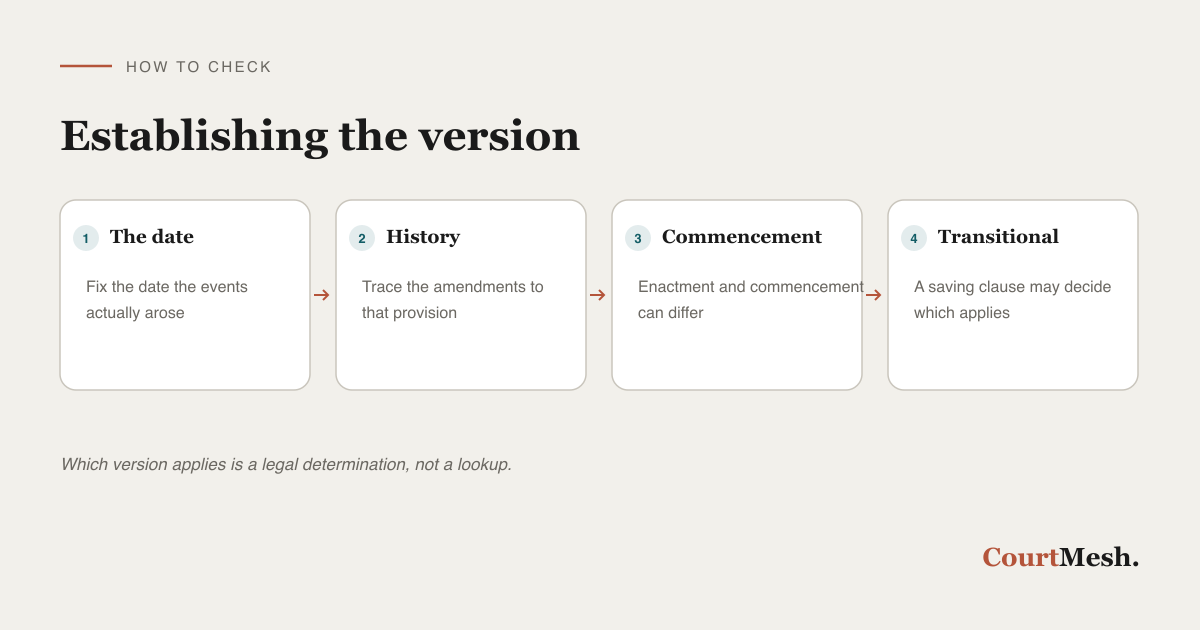
The sequence looks laborious written out. In practice, for a provision that has never been amended, it collapses into a single confirmation and takes moments. The work expands only where the provision has actually moved, which is precisely where it is worth doing. The point of the method is not thoroughness for its own sake. It is that the question gets asked at all.
Put the date into the citation
A small drafting habit removes a large amount of ambiguity. Where a provision has changed and you are relying on an earlier version, say so expressly in the opinion or the pleading, identifying the provision as it stood on the relevant date and noting the amendment that came later. It shows the reader the question was considered rather than overlooked, it makes the basis of your position visible and therefore arguable, and it protects the next person to pick up the file from quietly reading your citation against whatever the current text says by then.
What Case Law Can Tell You, and What It Cannot
Once you know which version you are working with, a second question opens up: how have courts actually read it, and over what period. That is a case law question, and one where the volume of material is the obstacle. Judgments engaging a particular provision are spread across the Supreme Court, the High Courts, the District Courts and the Tribunals, delivered over decades, and expressed in whatever numbering was current when each was written.
This is the part of the work a research platform can genuinely compress. CourtMesh indexes roughly 310 million cases from the Supreme Court, all 25 High Courts, the District Courts and Tribunals, drawn only from official government portals, and every result links through to the actual judgment so you read it at source rather than in summary. Alongside keyword search there is AI semantic search for when you know the concept but not the phrasing the court used. Every judgment record carries the acts and sections the court was working with, so once a decision is in front of you it is clear which provision it engaged, and year filters narrow the search to the period during which a particular text stood. The public judgment library goes further and groups judgments by the statute they cite, so an act can be browsed as its own list.
- Find the judgments that engaged a specific provision, rather than merely mentioning the enactment in passing
- Restrict a search to a range of years so you are reading how the provision was construed while a particular text was in force
- Run the search under both the old and the new nomenclature where an enactment has been replaced, so neither body of authority is missed
- Follow each result through to the judgment itself and read what the bench said about the words in front of it
What the platform does not do
This is worth stating plainly. CourtMesh is a case law platform. It does not maintain point-in-time texts of statutes, it does not track amendment histories, and it cannot tell you which version of a provision applies to your matter. It helps you find how courts have read a provision and over what period. The statutory text itself has to come from the official source, and the determination of which version applies remains yours.
The Honest Part
This is a legal determination, not a lookup
Establishing which version of a provision applies is not a clerical step that can be completed by finding the right page. It is a legal determination, and it can itself be contested. Which version governs may turn on a transitional or saving provision, on whether a change is substantive or procedural, on whether a right had already accrued, or on how a repeal operates in the absence of express words. Always verify against the official published text of the principal Act and of the relevant amending Act, check commencement rather than assuming it, and treat any consolidated or aggregated version of a statute as an aid to research only. Nothing in this article is legal advice, and none of it substitutes for the verification that only the advocate handling the matter can perform.
The discipline pays for itself, and not only in errors avoided. Once you are in the practice of asking which version governs, you start noticing openings others miss: an authority weaker than it looks because it construed text since substituted, a submission that quietly applies a later provision to earlier facts, a savings clause that puts your matter somewhere the other side has not considered. The question that protects you against an embarrassing correction is often the one that produces a point nobody else has taken.
So treat a statute the way you already treat a judgment: as something with a date attached. Ask what the provision said on the day that matters, not merely what it says now. The text in front of you is the current answer to a question you may not be asking, and the gap between those two things is where matters are quietly lost.
Find How the Provision Has Been Read, Then Verify the Text
Which version of a provision was in force is your determination to make, from the official text. How courts have read that provision, and over what period, is where a research platform earns its place. CourtMesh brings the Supreme Court, all 25 High Courts, the District Courts and Tribunals into one search across roughly 310 million cases, sourced only from official government portals, with keyword search over that record and AI semantic search over the roughly 2 million judgment subset that carries it, filters for court, case type, judge and the year or date range that matters, and a link through to every judgment so you read it at source. Use it to find the authority quickly, then do the part no tool can do for you: establish the version in force, and build the argument on it.
Explore CourtMesh