Every evening, in chambers and at kitchen tables across the country, a small ritual plays out. An advocate, or the clerk who really keeps the diary alive, opens one court website after another to settle a single question before the day ends: is my matter listed tomorrow?
It sounds like a trivial thing to check. It is anything but. The answer decides whether tomorrow means a pre-dawn start and a fully prepared brief, or an ordinary day at the desk. Get it right and you walk into court ready. Miss it, and your matter can be called, reached, and dealt with, all while you are somewhere else entirely.
In Indian litigation you do not set your own schedule. You read it, late, off the court itself. The cause list is where the court announces what it will hear, and it has a habit of arriving close to the hearing and then changing after it arrives. This piece is about that daily reading: what a cause list is, why listings surface so late and keep moving, why the evening check by hand fails in ways you can predict, and what it takes to make listing awareness reliable rather than a nightly test of nerve.
What a Cause List Actually Is
A cause list is the court's own published schedule of what it intends to take up on a given day. Each court, and within it each bench, puts out its list: the matters, their position on the board, the item numbers, and the stage each matter has reached. When your matter appears on that list against a date, that is the court telling everyone concerned to be present and ready.
There is ordinarily a main list, published a little ahead of the hearing day, and then there are supplementary lists, further lists issued afterwards, sometimes the previous evening and sometimes the very morning of the hearing. A matter can be missing from the main list and then appear in a supplementary one. If the only thing you ever looked at was the first list you saw, you would never learn that it had moved.
The board is not settled the moment it is published
Even once a list is out, it is not frozen. Matters are advanced when something ahead of them collapses or a bench decides to take them earlier. Matters are adjourned and pushed to a later date. Boards are reordered. And benches are sometimes reconstituted, so the bench you prepared for is not the one that sits, and the matters travel with the change. Each of these is routine. Together they mean the schedule you read at nine in the evening is a snapshot, not a guarantee.
Why Listings Surface Late, and Then Move
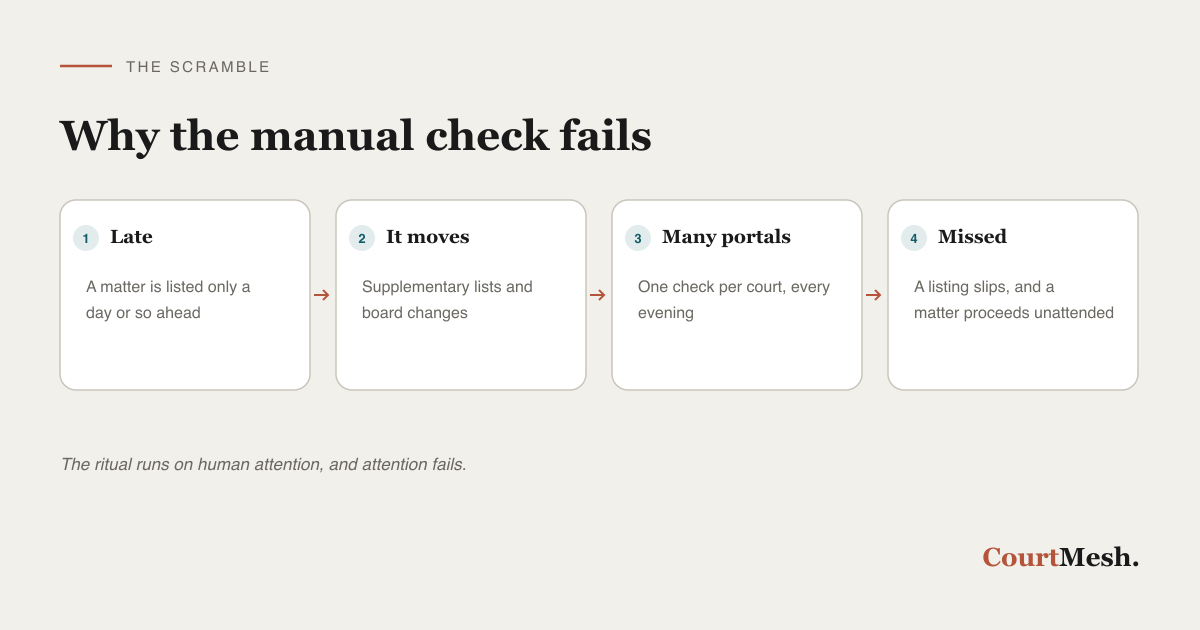
It is tempting to read the lateness as somebody's failure, a registry that ought to be quicker or a system that should give more notice. It is better understood as the natural output of how listing works. A court manages an enormous and shifting volume, and the schedule for a given day can only be assembled once the day is nearly upon it. The mechanisms below are not malfunctions. They are the ordinary weather of litigation.
Supplementary lists
The main list is not the whole list. Further matters are added afterwards, often the evening before or the morning of, and a matter that was absent at five can be listed by nine. Anyone reading only the main list is reading an incomplete document and does not know it.
Advancement
A matter can be moved earlier than expected when the board ahead of it gives way, a settlement removes an item, or a bench chooses to take it up. What you had pencilled in for next week can, occasionally, be called tomorrow.
Adjournment and reordering
Just as readily, matters are pushed back or the order on the board is rearranged. The item number you relied on to judge when you would be reached is a moving figure, not a fixed appointment.
Bench reconstitution
Benches are reconstituted, rosters are revised, and matters follow the change. The court you expected to appear before may not be the one that sits, and the listing travels with the reassignment.
The Evening Ritual, Described Honestly
Ask most litigating advocates how they know what they are doing tomorrow and the honest answer is a nightly round of checking. Someone opens the Supreme Court site, then the relevant High Court, then the district court portals, then the tribunal where a matter is pending, and reads down each list looking for the party names and case numbers that belong to the firm. On a quiet evening it takes a few minutes. On a heavy one, across several courts and several benches, it is a long, error-prone trawl performed at exactly the hour the person doing it is most tired.
It works often enough that nobody questions it. That is precisely the problem. A control that usually works, and fails silently when it does not, is the most dangerous kind, because it earns a trust it cannot always honour.
A cause list checked by a tired person at the end of a long day is a control that usually works. Usually is the entire problem.
Why the Manual Check Fails in Predictable Ways
The evening check does not fail randomly. It fails along a small number of fault lines, and once you see them named you will recognise every near miss you have ever had.
- Too many courts, too many portals. Matters sit in different courts, and each court publishes separately, on its own site, in its own format. The check is only as complete as the list of places the person remembers to open. A matter in a court nobody thought to check that evening is simply not seen.
- Supplementary lists get missed. The natural instinct is to check once. But a matter can surface in a supplementary list after that check, and unless somebody goes back and looks again, later, the second publication is invisible. One look is not enough, and one look is usually what happens.
- Board changes go unnoticed. Even a matter you correctly saw on the list can be advanced, or the board reordered so it is reached far sooner than the item number suggested. Reading the list once tells you it is listed. It does not tell you it has since moved.
- Fatigue and the single point of failure. The whole ritual usually rests on one person and one habit performed late at night. When that person is on leave, unwell, in transit, or simply overloaded, the check is thinner or does not happen, and nobody else notices, because a skipped check and a clean one produce the same artefact: nothing to report.
- Silence is ambiguous. This is the fault beneath all the others. A diligent search that finds your matter is not listed, and a search that nobody ran, produce the same result: an absence. You cannot tell them apart from the outcome, so an unattended court and a genuinely empty one feel exactly the same until the morning proves otherwise.
What a Missed Listing Costs
On the evening you fail to notice a listing, nothing happens. The cost is realised the next day, in the courtroom, and it arrives wearing a different set of clothes. It shows up as an adverse order, a matter that proceeded without you, an adjournment you now have to plead for, or a client asking why the other side seemed to know something you did not.
Courts are entitled to get on with their work, and civil procedure under the Code of Civil Procedure 1908 does not pause simply because counsel did not realise a matter was listed. A matter reached in your absence can be proceeded with, an order can be passed, and undoing that order afterwards is a harder and more uncertain exercise than being present would ever have been. You are no longer arguing the point on its merits. You are first asking to be allowed back to the point at all.
The official cause list is the authority, not any view of it
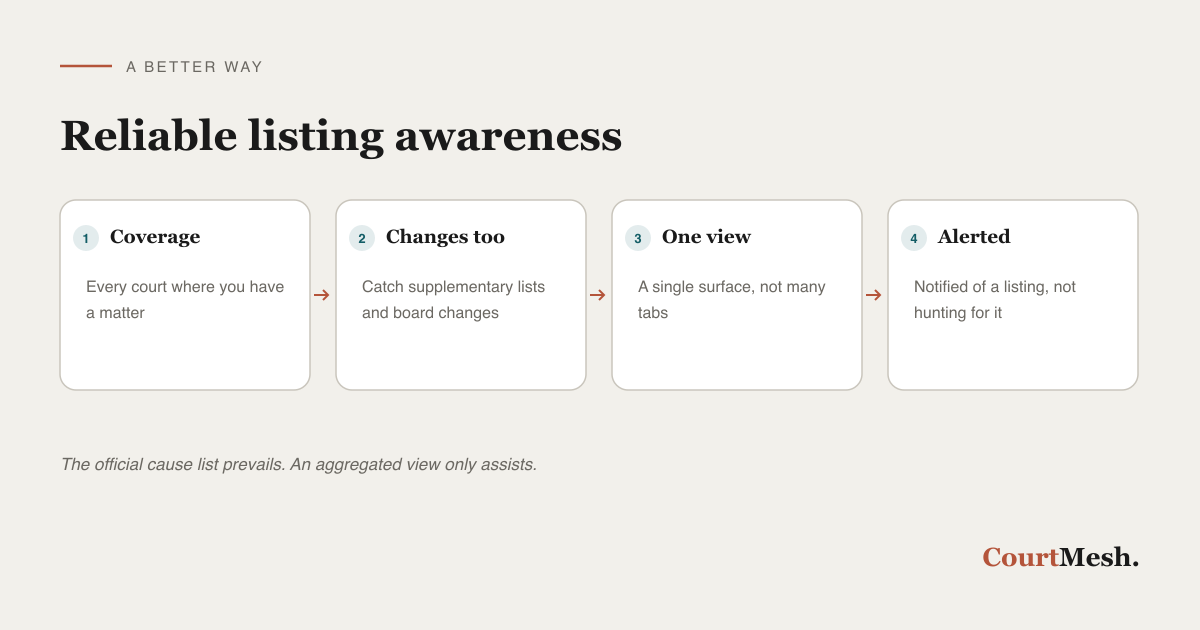
The cause list published by the court is the authoritative source, and it prevails. Any aggregated or third-party view, ours included, is only as timely and as complete as the upstream publication it reads, and that publication can be late, can be revised, and can carry a matter in a supplementary list that has not yet propagated. Treat any tool as an aid that reduces how much depends on a manual trawl, never as the last word. Above all, never read silence from a tool as confirmation that your matter is not listed. An absence of an alert means nothing matching has surfaced in the sources read so far. It does not mean nothing has been listed. When it matters, and here it always matters, confirm against the official cause list of the court concerned.
What Reliable Listing Awareness Actually Needs
If the manual evening check fails along known fault lines, then reliable awareness is simply the set of properties that close each of those lines. There are four, and a serious approach needs all four rather than some of them. The first is coverage: awareness is only as good as its least-watched court, so it has to span every forum where the practice has a matter, from the Supreme Court down through the High Courts and District Courts to the tribunals, and not only the two or three portals that are easiest to remember. The second is that it keeps looking after the first list is out, so a supplementary listing added later, a matter advanced, or a board reordered is surfaced when it happens rather than assumed away by a single early glance. The third is a single consolidated view, because reconciling many separate portals by hand is where fatigue turns into a gap. The fourth is being told rather than having to remember to look, since that is the part of the ritual a busy week breaks most quietly. Set against the check it replaces, the difference reads like this.
| Dimension | The manual evening check | A monitored approach |
|---|---|---|
| Coverage | Bounded by the courts one person remembers to open that night | Spans every court where you have a matter, checked the same way each time |
| Catching changes | Usually a single look, so supplementary lists and board changes slip through | Keeps watching, so a change in the recorded status or next date is surfaced when the registry publishes it |
| Single view | A dozen portals in a dozen tabs, reconciled by hand | One consolidated view of what is listed across all your matters |
| Reliability | Rests on one tired person and one late-night habit | Runs whether or not anyone remembered, and leaves a record of what was watched |
| When silence is safe | Never, and you cannot tell a skipped check from a clean one | Still never, but the silence is bounded by a stated source you can go and confirm |
A Practical Approach You Can Adopt This Week
None of this requires a grand project. Most of the improvement comes from a handful of deliberate habits, each of which takes one fragile part of the ritual off a single pair of shoulders.
Map every court where you have a matter
Write down, for the whole practice, each forum in which a matter is pending: the Supreme Court, the relevant High Courts, the district courts, and the tribunals. This map is the true scope of your evening check, and most firms find it is wider than any one person had been carrying in their head.
Put the matters where they can be watched together
Centralise your matters so their next dates and listings can be seen in one place rather than reconstructed nightly from a dozen portals. A consolidated view is what turns is my matter listed tomorrow from a trawl into a question with one screen for an answer.
Monitor, do not only check
Set alerts on the matters that must not be missed, so a listing or a change reaches you rather than waiting for you to go and find it. This is the single change that most reduces the dependence on somebody remembering to look.
Decide in advance what a listing triggers
Agree, before the first alert fires, what happens when a matter is listed: who confirms it, who prepares, who informs the client, and who is the second person when the first is in court. An alert with no owner is a notification, not a control.
Always reconcile against the official list
Treat any consolidated view or alert as the prompt, and the court's own cause list as the confirmation. Before you rely on a listing, or rely on its absence, check it against the official list of the court concerned. The tool narrows what you have to trawl. It does not replace the authoritative source.
Keep a light record of what you watched
Note which matters and courts are being monitored and from when. It evidences your diligence and makes gaps visible. It does not, and cannot, prove that nothing was listed, and should never be described as if it does.
How CourtMesh Fits
CourtMesh was built around exactly this problem, so here is what it does and, just as importantly, where it stops. The aim is narrow and honest: to surface hearing dates and status changes as they appear in official sources, so that fewer of your listings depend on a manual evening check.
- Case status and next hearing dates sourced from eCourts and the NJDG, so a matter you are watching shows its stage and its next date in one place. That is case status, not a cause list, and the difference is one to keep hold of.
- Coverage across the layers, spanning the Supreme Court, all 25 High Courts, District Courts and Tribunals. That is broad. It is deliberately not called exhaustive, because coverage is bounded by what the source registries publish.
- A watchlist with alerts on the dashboard and by email, raised within minutes of the information surfacing in the source registries. Within minutes of it surfacing, not within minutes of the court deciding it: that difference belongs to the court, not to us.
- My Cases as the single view, centralising matters, deadlines and documents, so what is listed across your practice can be read from one screen instead of a dozen tabs.
- Official sources only, drawn from government portals, so what you read leads back to the registries rather than through an intermediary.
Notice the shape of that claim, because the shape is the honesty. CourtMesh reduces how much of your listing awareness rests on somebody remembering to perform the check at all. It does not, and cannot, publish faster than the court, guarantee that every listing is caught, or serve as the authoritative cause list. At its very best it is bounded by what the registries have already put out, and so is every other tool of its kind.
The distinction worth holding on to
A delay imposed by the court is a constraint you inherit, and no software removes it. A missed listing caused by a check nobody ran, a portal nobody opened, or a supplementary list nobody went back for is a different thing entirely. It is within your control, and it is the part worth fixing first.
The advocate at the kitchen table tonight, reading down one cause list after another to answer a single anxious question, is doing something essential in the most fragile way available. The question is a good one. The method deserves better than fatigue and memory.
Stop letting tomorrow rest on remembering to check
You cannot make a court publish its list any sooner, and you should be wary of anyone who says they can. What you can do is stop depending on one tired person opening a dozen portals late at night, on a supplementary list somebody thought to go back for, and on a court that happened to be remembered. CourtMesh surfaces case status and next hearing dates from eCourts and the NJDG, with a watchlist and alerts that reach you shortly after the information appears upstream, and My Cases to hold your matters, deadlines and documents in one view. It will not replace the official cause list, and it will not make you omniscient. It will mean that the next time you ask whether your matter is listed tomorrow, the answer no longer depends on remembering to look.
Explore CourtMesh