A client rings and asks the simplest question there is: what is happening in my case. You know the matter well. You also know that answering it honestly means opening more than one thing, because the dispute the client has in mind has not carried a single number for years.
That is the ordinary condition of Indian litigation. A dispute reaches a registry and is given a number. It is registered and numbered again. It may be transferred and numbered afresh. It goes up on appeal and becomes a different matter, in a different court, on a different record. Applications are filed inside it, each carrying a number of its own. A decree follows, and then the part the client actually cares about, recovering something, proceeds under yet another number in execution.
So when somebody says track this case, they are asking for something considerably harder than the phrase suggests. They want one dispute followed across several numbers, several courts and often several years, with its present position known at the end of it. A single case number cannot deliver that, and it was never designed to. A case number identifies a stage. A dispute is a sequence of stages.
This piece is about the distance between those two things: why one dispute accumulates so many numbers, what each of those moments means for anyone trying to follow it, what a stable case identifier genuinely fixes and what it leaves entirely untouched, and a practical method for building and maintaining the chain for the disputes you care about.
A Dispute Is Not One Number. It Is a Sequence of Them
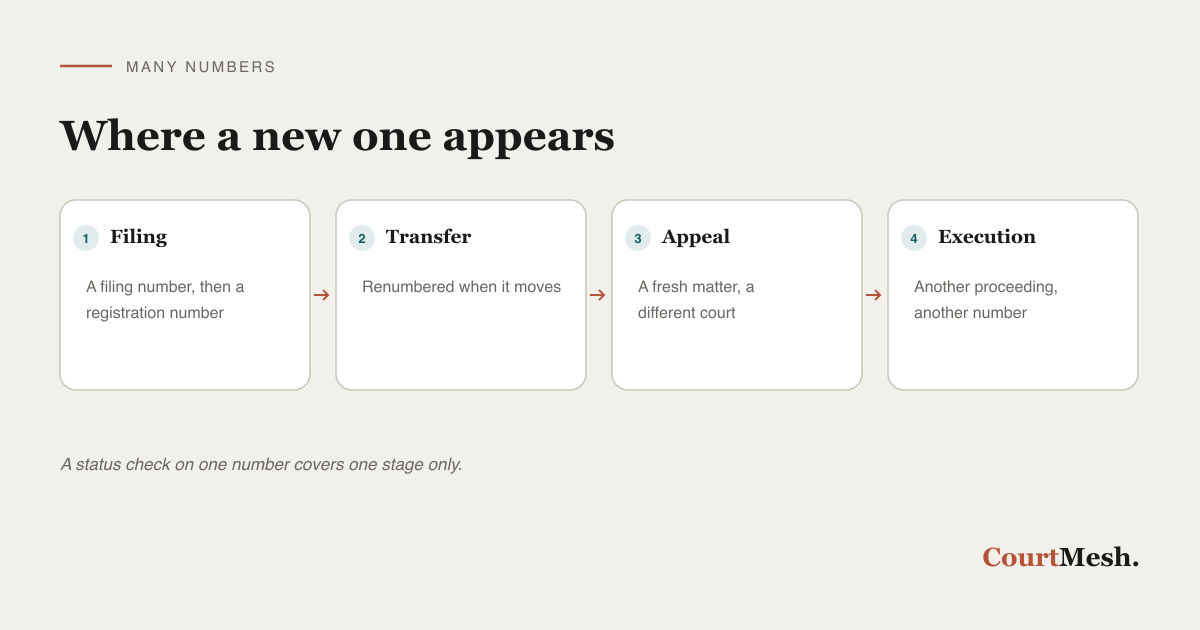
The first thing to unlearn is the instinct that a case has a number the way a person has a name. It does not. A number is issued by a particular registry, in a particular series, for a particular proceeding. When the proceeding changes character, or moves, or spawns another proceeding, the registry issues another number. Nothing is lost or hidden by this. It is simply how court records are organised, and it is entirely rational from the registry's point of view. The difficulty is that it is organised around proceedings, while you and your client think in terms of the dispute.
Filing and registration are two different events
When papers are presented, the registry ordinarily issues a filing or diary number. That number identifies the bundle of papers that has been lodged, not a registered matter. It carries the file through scrutiny, through objections raised by the registry, and through whatever curing of defects is required. Search against it at this stage and what you learn is about the paperwork: whether it has been taken on board, whether objections are outstanding, whether it is waiting on a court fee or an affidavit.
Once the matter is registered, it enters the court's regular series and takes a case number with a case type and a year attached to it. That is normally the number the cause list will carry, the number the bench will call, and the number everyone in the matter will use from then onwards. If you recorded only the filing number and never went back, you will lose the matter at precisely the moment it stops being paperwork and becomes live litigation.
Renumbering and transfer, where a matter changes number without changing substance
Matters are also renumbered. It happens for reasons internal to the registry: a proceeding is converted from one case type to another, a series is reorganised, a matter registered provisionally is regularised. Substantively, nothing about the dispute has changed. Practically, a search against the old number can go quiet, and quiet is the most misleading signal in the whole system, because it looks exactly like a matter that has stopped moving.
Transfer produces the same effect for a different reason. When a matter goes from one court to another, it is taken on the receiving court's file and given a number in that court's series. The dispute is unchanged. Its home has moved. If your monitoring was pointed at the original court, it will faithfully report nothing further, forever, and it will be technically correct while being completely useless.
An appeal is not the same case continued. It is a new matter
This is the point that catches out even careful people. When a decision is challenged, what comes into existence in the higher court is a fresh matter with its own number, its own record and its own life. It is related to what came before, and the appellate court will call for the record below, but as far as the registry and the case tracking system are concerned it is a distinct proceeding. The original number will show you the decision and then fall silent. The dispute is very much alive. It has simply moved upward.
And this can repeat. A first appeal can be followed by a further challenge in a higher forum, each time producing another matter and another number. There is no automatic thread visible from the bottom of that chain to the top. The connection exists in the record and in the parties' knowledge. It does not announce itself to somebody searching one number.
Connected applications and execution
Inside a live matter, applications are filed and numbered separately: interlocutory applications, miscellaneous applications, and the rest. This matters more than it sounds, because a great deal of what actually affects the parties happens there. An interim arrangement that governs how the parties behave for the next two years may sit in a connected application, while the status of the main matter reads, accurately and unhelpfully, as pending.
Then there is execution. A decree in your favour is the end of one proceeding and the beginning of another, and execution proceeds under its own number. The main matter, by then, reads as disposed. Anybody tracking only the main number sees a finished dispute. The client, who has still not recovered anything, would describe the position rather differently.
A case number tells you what happened to a proceeding. A client is asking what happened to their dispute. Those are not the same question, and only one of them has a number.
The Stages, and What Each One Means for Tracking
It helps to lay the whole life out in one place. Each row below is a legitimate, everyday event. Read the third column as the practical instruction, because that is where the tracking failures actually live.
| Stage | What number appears | What it means for tracking |
|---|---|---|
| Filing | A filing or diary number issued when papers are presented at the registry | Status against it describes paperwork, scrutiny and objections rather than hearings. It is a temporary handle, and it stops being the number people use once the matter is registered. |
| Registration | A case number in the court's regular series, with a case type and a year | This is normally the number the cause list carries. Capture it at the moment it is issued, because this is the number the rest of the matter will be conducted under. |
| Renumbering | The same matter carried into a different number or case type | Nothing about the dispute has changed, but a search on the old number can go quiet. Silence here is a numbering event, not a disposal, and the two look identical from outside. |
| Transfer | A fresh number in the receiving court's own series | The matter now sits in a different registry and appears in a different cause list. Monitoring aimed at the original court will report nothing further and will be correct in doing so. |
| Connected applications | Interlocutory and miscellaneous applications, each numbered separately against the parent matter | Much of what affects the parties day to day is decided here. The main matter can read as pending while the position on the ground has been changed by an application. |
| Appeal or revision | A new matter in a higher court, with its own number and its own record | The number below shows the decision and then stops moving. Following the dispute means finding and recording the new matter, which will not surface from the old number. |
| Further challenge upward | Another matter, in another forum, with another number | The chain does not end at the first appeal. Checking upward has to be a recurring habit rather than a single act performed once after judgment. |
| Execution | An execution proceeding with a number of its own, after the decree | The main matter reads as disposed while the question the client actually cares about, whether anything has been recovered, is being decided under a number you may never have recorded. |
What Someone Really Means by Track This Case
Once the table above is in front of you, the request looks different. Almost nobody asking for tracking wants the status of a proceeding. They want an answer to one of three questions, and each of them requires the chain rather than a number.
The client's question
What is happening in my case, and what happens next. The honest answer spans the main matter, whatever applications are live within it, and any challenge pending above. A status pulled from one number answers a part of it and sounds like the whole.
The diligence question
What litigation is this counterparty carrying. A search that finds a matter decided in their favour, and stops there, can miss entirely that the decision is under challenge and the position is far from settled.
The internal question
Where does this matter stand and what is due. When a file moves between colleagues, only the numbers that were actually written down travel with it. Everything held in one person's memory quietly does not.
The common thread is that each question is about a dispute, while every tool, portal and registry answers in terms of proceedings. Bridging that gap is not a technical problem. It is a record keeping discipline, and the tooling can help you keep it, which is a much narrower claim than resolving it for you.
What Goes Wrong When You Track a Number Instead of a Dispute
The failures here are not exotic. They are the same handful, repeating, and every one of them is quiet at the moment it occurs. That is what makes them worth naming.
- A status check on one number tells you about one stage only. It is accurate and it is partial, and partial information that presents itself as complete is worse than no information, because it stops you looking further.
- Silence is ambiguous. A number that has stopped producing updates might mean a matter that is genuinely dormant, or a matter renumbered, transferred, disposed and appealed. From the outside, all of these look the same: nothing new.
- A disposal reads as an ending. The word disposed against the number you have been watching feels conclusive. It may only mean the dispute has moved to a court you are not watching, under a number you do not have.
- Diligence stops one tier too low. A counterparty search that finds the matter below, and never checks whether it was carried upward, can conclude that a liability is settled when it is squarely in issue on appeal.
- Deadlines are computed against the wrong stage. If you believe the live proceeding is the main matter when it is actually an application or an execution, the dates you are working to belong to a stage that has already passed.
- Handover loses the chain. The numbers that survive a colleague leaving, or a file being reassigned, are exactly the numbers somebody bothered to record. The rest are reconstructed later, slowly, from the papers.
What a Stable Case Identifier Does, and What It Does Not
This is the context in which a stable identifier earns its keep. Through the eCourts system, a matter is assigned a unique case identifier, commonly referred to as the CNR, or Case Number Record. Unlike the human readable case number, which is a combination of case type, serial number and year and therefore repeats across courts and across years, the identifier is meant to point to one specific matter without ambiguity.
That is genuinely useful, and it is useful in a specific way worth being precise about. It gives you a single value you can write down for a matter and come back to later without having to remember which court, which case type abbreviation and which year formatting convention were involved. It survives the ordinary confusion of a case number that looks very much like several other case numbers in other courts. For anyone maintaining records over years, that is not a small thing.
What it genuinely solves
- It identifies a matter reliably within the system, rather than relying on a case number that can be ambiguous once you are looking across courts.
- It gives you one stable value to store in your own records, so a matter can be found again years later without reconstructing how its number was formatted.
- It removes the need to fall back on party names and case type abbreviations, which are the usual source of mistaken identity when someone searches by hand.
- It makes a status check repeatable, so the thing you checked last quarter is unambiguously the same thing you are checking today.
What it does not solve
- It identifies a matter, not a dispute. A fresh appellate matter is a different matter, and it has its own identifier.
- It does not assemble the chain. Nothing about having one identifier tells you that a related proceeding exists somewhere above, below or alongside it.
- It does not surface connected applications or execution proceedings for you. Those are separate proceedings and you have to know to look for them.
- Not every forum or every older record will present an identifier in the same way, so treat its presence as something to check rather than assume.
Where all of this information actually comes from
Case identifiers and status information originate with the court registries. Anything you read anywhere else, including here and including in any tool, is a view of what those registries have published, and it is only as current and as complete as that publication. Registries update at their own pace, records can be incomplete, and a stage can exist in the papers before it appears online. Before you act on a status, advise a client on it, or record it as a fact, confirm it against the official record of the court concerned. Treat every aggregated view as a way of narrowing where to look, never as the authority on what is true.
Building the Chain for a Dispute You Care About
If no identifier assembles the chain for you, then the chain is something you build and maintain deliberately. The good news is that it is cheap to do while a matter is running and expensive to reconstruct afterwards, which means the whole discipline comes down to capturing things at the moment they happen. Here is a method that holds up.
Decide that the unit you track is the dispute
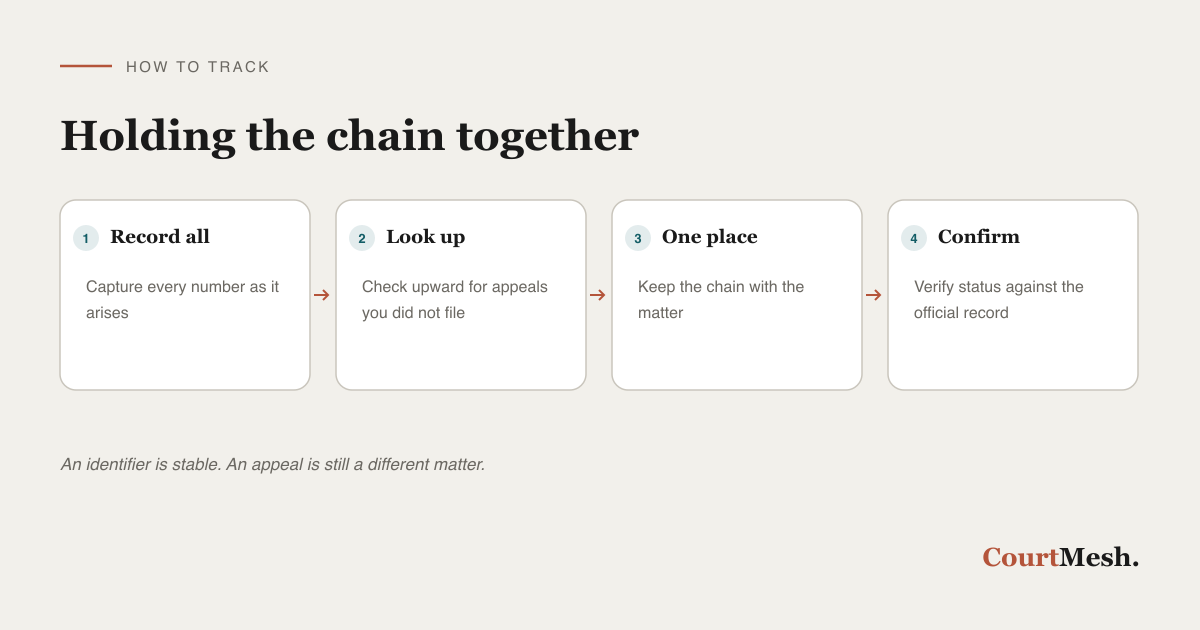
Not the case number, not the proceeding, the dispute. One file, one matter record, one place where every number that has ever belonged to this fight is listed. This single decision changes what your records are capable of telling you, because it makes room for the fact that numbers change while disputes do not.
Record every number at the moment it is issued
Filing number when the papers go in, case number when the matter is registered, the unique identifier when it is available, and the same for every application, transfer and appeal. Note the court, the case type, the year, and the date on which you recorded it. Ten seconds at the counter or on the portal saves a genuinely painful afternoon two years later.
Treat every numbering event as a diary entry
Registration, renumbering and transfer are the three moments where a matter changes number without changing substance, and they are exactly the moments a chain breaks. When one happens, update the record the same day and keep the superseded number in the file rather than replacing it. The old numbers are how you will read historical documents and old correspondence.
Keep connected applications attached to the parent
List each application against the matter it belongs to, with a line on what it seeks. When somebody asks what is happening, the live applications are frequently the honest answer, and they are the part most often missing from a status assembled from the main number alone.
Check upward on a schedule after every decision
The period during which a decision can be challenged is the window in which a fresh matter may appear above, and nothing about your existing record will tell you when it does. Set a recurring check for the weeks following a judgment or decree, and again afterwards, because delayed filings happen. A single check on the day of the judgment proves very little.
Watch the party, not only the number
When you do not know the number of a proceeding that does not exist yet, the party name is the only handle you have. Monitoring new filings involving the parties to a dispute is the practical way a fresh appellate matter, a connected proceeding, or an execution petition first comes to your notice.
Follow the decree into execution
The moment a matter is decided in your client's favour, add a standing item to track the execution proceeding, because that is where the outcome the client wanted is actually delivered or frustrated. A file closed at decree is a file closed one stage early.
Timestamp every status and reconcile before you rely on it
Write down what you saw, where you saw it, and when. A status without a date is not a fact, it is a memory. Before advising, filing, or telling a client something is finished, confirm the position against the official record of the court concerned.
The habit that does most of the work
If you adopt only one thing from this piece, make it capture at the moment of change. Almost every broken chain traces back to a number that existed, was visible to somebody, and was not written down. Reconstructing a chain later means reading old papers and ringing the registry. Maintaining it means ten seconds at the moment the number appears. The difference between the two compounds over the life of a practice.
How CourtMesh Fits
Software is helpful here in a narrower way than most tools would like to admit, so it is worth being exact about where it helps and where the practitioner is still doing the work.
- Case status tracking, including next hearing dates and disposals, sourced from eCourts and the NJDG, across the Supreme Court, all 25 High Courts, District Courts and Tribunals, covering roughly 310 million cases from official government portals only.
- My Cases for matter management, so the several numbers belonging to one dispute can be held together in one place along with the documents and the deadlines that go with them, rather than scattered across files and memories.
- Watchlist alerts on new filings involving a party you are monitoring, which is the practical mechanism by which a fresh appellate matter, or another proceeding involving the same counterparty, can first surface to you.
- Official sources only, so what you read leads back to the government portals rather than through an intermediary of unclear provenance.
Now the boundaries, which matter more than the features. CourtMesh does not automatically link every stage of a dispute into a single chain, and it does not resolve identifiers across courts to tell you that this appellate matter is the continuation of that suit. The chain is maintained by you. What the platform does is make maintaining it far less laborious: the matters sit in one place, status and next dates are surfaced from official sources, and a watchlist can tell you that something new has been filed involving a party you are watching, at which point you record the new number in the chain yourself.
Nor is coverage complete, and you should be suspicious of anyone claiming otherwise. What is visible is bounded by what the source registries publish, and that is uneven across courts and across time. A tool of this kind is a way of reducing how much of your tracking depends on remembering to open the right portal. It is not the registry, it does not give legal advice, and it is not the last word on the position in any matter.
The dispute your client asked about is still one dispute, whatever the registries have called it along the way. Nobody hands you that continuity. You build it, one number at a time, at the moment each one appears, and then you are able to answer the simplest question there is without opening seven things and hoping you have remembered them all.
Keep the whole chain in one place
A matter picks up a new number every time it moves, and each of those numbers tells you about one stage of a dispute that has many. The chain is still yours to maintain, and the official record of the court concerned is still what you confirm against before you act. What CourtMesh changes is the cost of keeping it: the numbers belonging to one dispute sit together with the documents and the deadlines, status comes from the official portals rather than from memory, and a new filing involving a party you are watching arrives instead of waiting to be discovered. Maintaining the chain becomes a habit that costs seconds. Reconstructing it later never did.
Explore CourtMesh