A conflict of interest is rarely discovered by a firm that was careless about ethics. It is usually discovered by a firm that was careful about ethics and simply could not recall, across thirty advocates and nine years of matters, that it had once acted for the company now sitting on the other side of the table. The rule was never the difficulty. The difficulty is the factual question the rule depends on: have we, at any point, acted for or against this party, or anyone connected to it? In a small practice that question is answered by memory. At scale, memory is the wrong instrument.
What makes conflicts unusual, as professional risks go, is how sharply the cost changes with timing. Found at intake, a conflict costs a polite conversation and a declined brief. You explain that the firm is unable to act, and the prospective client goes elsewhere with no harm done to anyone. Found three months in, the same conflict costs something else entirely.
By then you may have to return the matter. A client who briefed you in good faith has to find fresh counsel partway through, possibly close to a hearing. The other client, the one the rule existed to protect, has to be told that the firm they trusted took a brief against them. And there is the part no apology repairs: you may already have received information you were never entitled to see. Candid instructions, an assessment of weaknesses, a settlement range. That cannot be un-received. It sits inside the firm permanently, and it is exactly what the rule was designed to prevent.
This article is about the operational problem rather than the ethical one. The ethical position is settled: advocates in India practise under the professional conduct framework flowing from the Advocates Act, 1961, with the Bar Council of India as the regulator, and the duties of loyalty and confidentiality it carries are not in dispute among practitioners. What is genuinely in dispute, inside most growing firms, is whether the firm can actually answer the factual question at the moment of intake. That is a records and search problem wearing an ethics costume, and it is solvable.
The core of it
The ethical rule is clear and every advocate knows it. What fails at scale is not judgement, it is recall. A conflict check is only as good as the firm's ability to search, in minutes, every party it has ever acted for or against, including parties from closed matters, parties known under other spellings, and parties sitting inside a corporate group. Most firms hold that information somewhere. Very few hold it in a form anyone can search.
What a Conflict Check Is Actually Trying to Catch
Before you can build a check that works, it helps to be precise about what it is hunting, because the phrase conflict of interest covers several quite different situations. They do not carry the same weight, they are not cured the same way, and a system tuned to catch only the most obvious one will sail past the rest.
A conflict check is really asking three questions at once. The first is about loyalty: is the firm being asked to act against someone it owes a duty of loyalty to right now? The second is about confidentiality: does the firm hold information from a past engagement that could be used, even inadvertently, against the person who gave it? The third is about knowledge inside the building: does any individual advocate carry information or an interest that makes their involvement improper, whatever the firm as a whole has done?
Loyalty to a current client
The starkest case. The firm is asked to take a brief against a party it already acts for in some other matter, even an unrelated one. The unrelatedness does not soften it much: a client who finds their own firm on the other side experiences it as a breach of trust, whatever the file numbers say.
Confidentiality owed to a former client
The engagement ended. The duty did not. If the firm learned things about a former client that bear on the new matter, its commercial strategy, its weaknesses, how it behaves under pressure, then acting against that client risks misuse, even where nobody intends any.
Knowledge held by an individual
Firms move people. An advocate joining from another chambers brings knowledge of matters your records have never seen, as does an associate who worked on the counterparty's side two employers ago. The firm can be clean while a person inside it is not, and that person may not connect the names themselves.
Cutting across all three is the group problem, where most modern conflict checks quietly fail. The prospective client may be a special purpose vehicle whose parent you litigated against last year. The counterparty may be a sister concern of a company you advise on tax. Nothing in the names announces the relationship. A group like a hypothetical Acme Holdings may litigate through a dozen entities sharing no common word, and a check that matches on names alone will not see the connection at all.
The table below sets out the main categories, what each looks like when it walks through your door, and what each typically demands of the firm. Read the third column as a description of how firms respond in practice, not as a substitute for the professional judgement the situation calls for.
| Type of conflict | What it looks like at intake | What it typically requires |
|---|---|---|
| Current client adverse | You are asked to act against a party the firm currently represents in another live matter, related or not. Often invisible because that matter sits with a different team, in a different practice area, in a different city. | The most serious category and usually the least curable. Ordinarily the firm declines. Any other course turns on informed consent from both clients and on the firm's own judgement about whether it can properly discharge its duties to each. |
| Former client | The counterparty is someone the firm acted for in the past. The file is closed, the advocate who ran it has left, and nothing in the current system surfaces the relationship. | Whether the firm holds confidential information from that engagement which bears on the new matter. That turns on what the firm actually learned, which is why the old file, and not just the old party name, has to be opened. |
| Group or affiliate adverse | The prospective client is a subsidiary, holding company or sister concern of a party on the other side of another matter. The names may share nothing and the link may sit two levels up. | Establishing the corporate relationship before anything can be assessed. Firms differ on how far up and across a group their checks reach, but the line has to be drawn deliberately and applied consistently rather than case by case. |
| Positional | The firm is asked to argue a position that, if accepted, would weaken another client's position in a different matter. No shared parties and no shared file, so nothing a name search will ever catch. | Usually commercial and reputational judgement rather than an absolute bar. It needs a human to spot, which means someone senior looking at what the firm argues across its portfolio, not only at whom it argues against. |
| Joint retainer drift | Two clients retained together on the same side, co-accused, joint venture partners, co-guarantors, whose interests were aligned at intake and have since diverged. | Nothing surfaces at intake, because at intake there was no conflict. It requires the engagement to be revisited when the split appears, and often means the firm can continue for one client at most. |
| Personal interest of the advocate | A shareholding, a family relationship, a prior involvement in the same dispute in another capacity, or a directorship held by an advocate in the firm. | Disclosure inside the firm first, then a decision on whether that individual can be involved at all. No search of client records finds this. It depends on advocates declaring interests, and on the firm asking often enough that declaring becomes normal. |
The question a conflict rule asks is ethical. The question that defeats a firm is clerical: whose names are already in your files?
Why the Check Degrades as the Firm Grows
In a practice of three or four advocates, conflict checking works and needs almost no machinery. Everyone knows every matter. The question is asked out loud, someone remembers the name, and a single shared memory covers the whole practice. The trouble is that nobody notices the point at which this stops being true. There is no day on which the informal check fails visibly. It simply becomes less complete every year, silently, while everyone continues to trust it exactly as much as they always did.
Knowledge spreads out and then walks away
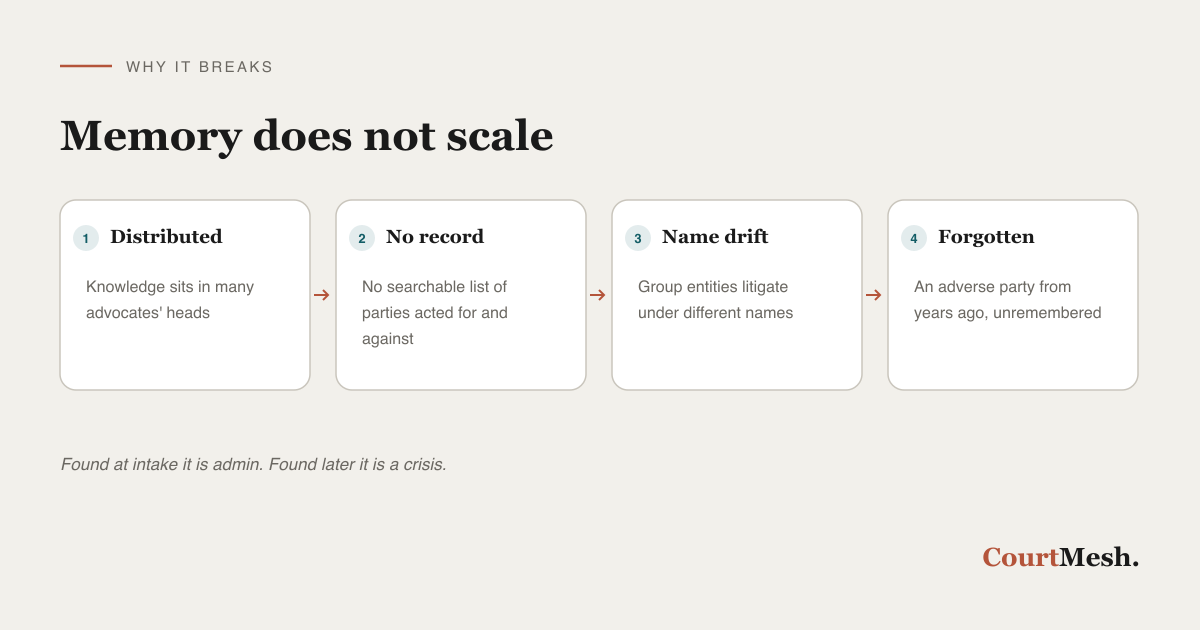
The first thing to break is the shared memory itself. At thirty advocates across three offices, no one person knows the full matter list, and the partners' meeting is no longer a reliable place to test a name. Worse, the memory is not merely distributed, it is perishable. The advocate who ran the 2019 arbitration against a particular group has moved on and taken the association with them. What remains is a file named after the matter rather than the parties, which nobody will think to open because nobody remembers it exists.
The firm's own records are not organised by party
This is the structural fault at the centre of the problem, and it is worth stating plainly. Most firms record matters, not parties. A matter has a name, a number, a client, a billing code and a folder. What it usually does not have is a searchable list of every party involved, with each party's role recorded: the client, the counterparty, the co-respondents, the guarantors, the directors named personally. Those names sit inside pleadings and cause lists and engagement letters, but they are not indexed anywhere as parties. So the natural question at intake, has this firm ever encountered this name, has no place to be asked.
Names do not stay the same
Even where a party record exists, the name is a slippery key. The same company appears as Acme Traders Pvt Ltd in one matter, Acme Traders Private Limited in another, and plain Acme Traders in a third. Transliterated names can be spelled several defensible ways, and different people at different times chose differently. Companies rename themselves after a restructuring, so the entity you fought in 2021 signs your engagement letter in 2026 under another name. Individuals appear with initials in one filing and in full in the next. Every variant is a way for a real conflict to sit in your records and never be retrieved, while the search box reports nothing wrong, because from its point of view nothing is.
The party set per matter is larger than it looks
Firms tend to think of a matter as having two sides. The record rarely agrees. A single commercial dispute can involve a petitioner, several respondents, an intervenor, two guarantors and a handful of directors joined personally. Multiply that across several hundred matters and a mid-sized firm has quietly accumulated thousands of names, only a small fraction of whom were ever clients, and almost none of whom are searchable in any one place.
History accumulates and never expires
The duty owed to a former client does not close when the file closes, but the firm's practical memory does. This produces the commonest shape of a late discovered conflict: not a live matter anyone should have spotted, but a closed one from six or seven years ago that nobody in the current system knows about. The longer a firm operates successfully, the larger this invisible archive grows, and the likelier it is that any given new brief brushes against it. Success makes the problem worse, which is an uncomfortable property for a professional risk to have.
Intake runs faster than checking
Finally there is the pressure that makes all of this bite. Clients arrive with urgency, sometimes with a limitation date already close. A check that takes a day competes against a client who wants an answer in an hour, and against an advocate who has spent three months courting the relationship. When the check is slow, it does not get skipped openly. It gets compressed into a quick question, a quick silence, and a note that the check was done.
The Specific Ways It Fails
Those pressures produce a fairly predictable set of failures. They are worth listing individually, because most firms will recognise at least three of them, and each one has a specific fix that the next section takes up.
Notice how many of these are failures of scope rather than of effort. In most of them somebody did run a check. They ran it against the wrong set of names, or the wrong slice of the firm's history, and the result they got back looked exactly like a clean one. A conflict check that searches the wrong thing does not fail loudly. It returns nil and feels like safety.
What a Reliable Conflict Check Needs
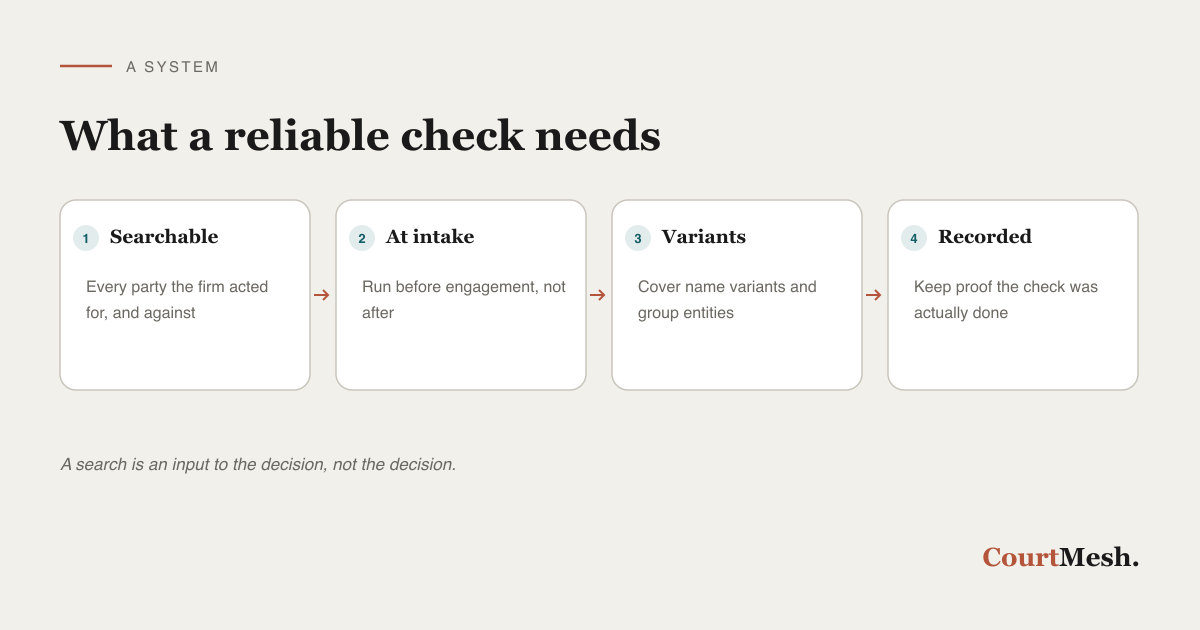
A conflict system does not need to be elaborate. It needs to be complete in a few specific ways, fast enough that nobody is tempted to route around it, and boring enough that it runs identically on the day a large client walks in and on any ordinary Tuesday. Six properties do most of the work.
One searchable record of every party
Not a folder of matters, an index of names. Every party the firm has acted for and every party it has acted against, with the matter and the role attached. This is the foundation, and no amount of process discipline compensates for its absence.
Closed matters included by default
The duty to a former client outlives the engagement, so the search has to reach the archive. A system covering only live matters is not a conflict system, it is a capacity check wearing the wrong label.
Search that tolerates variants
The check has to survive Pvt Ltd against Private Limited, a transliteration spelled two ways, a company renamed after a restructuring, and an individual recorded with initials. Whatever the firm cannot match, it cannot retrieve.
Group awareness, decided in advance
The firm needs a stated position on how far up and across a corporate group its checks reach, and the information to apply it. Settling that policy in advance is what stops it being settled, conveniently, by whoever wants the brief.
Run before information is received
The check belongs before the engagement letter and before the detailed pitch conversation. Once you have heard the prospective client's candid account of the dispute, a later discovery is no longer merely awkward, it is a confidentiality problem you cannot reverse.
A written record that the check was done
What was searched, which names and variants, by whom, on what date, and what came back, including nil results. Without this, a firm that did everything right cannot demonstrate it, and a firm that did not cannot tell the difference.
Two further properties matter less often but matter a great deal when they do. The first is an escalation path: when the search returns a possible hit, the person who decides what happens next should not be the advocate whose brief depends on the answer. The second is a way to record and actually enforce an information barrier where the firm decides, with the consents it needs, to proceed. A barrier that exists only in an email is not a barrier. It has to be reflected in who can open which matter, which is a question about access controls in whatever system holds your files.
A Practical Intake Workflow
Here is the sequence, in the order it should happen. It is deliberately unremarkable. The value lies not in any single step but in running all of them, in this order, every time, including for the clients you are most eager to sign.
Collect the full party set before the substantive meeting
The quality of the entire check is decided here. Before the detailed conversation, write down the prospective client, its parent and known group entities, the counterparty and its group, any guarantors, any directors likely to be joined personally, and the co-parties expected on either side. Then add the name variants: with and without Private Limited, the common abbreviations, plausible transliterations, and any former name after a restructuring. You are checking a web of related names, not one string, and every name you fail to list is a conflict you cannot possibly find.
Search your own matters first, live and closed
Run every name on that list against the firm's own record of parties, covering closed matters as well as current ones. This is the search that answers the question the professional duty actually asks: has this firm acted for, or against, this party or anyone connected to it? If your matters are scattered across individual drives, mail folders and personal notebooks, this step is where you will discover that fact, and better now than in month three of a live brief.
Look outward at the party's litigation history
Then check the public record of what the parties have been involved in. This does two things. It surfaces the counterparties, group entities and connected names your prospective client did not think to mention, which you can then run back through your own records. And it occasionally shows you a matter your firm was in, on the other side, that your internal records had lost.
Escalate anything that is not plainly clear
A near match, a shared address, a familiar sounding group, a director's name you have seen before: all of these go to whoever the firm has designated to decide, and that person should not be the originating advocate. Most escalations resolve in a few minutes as different entities with similar names. The point of the rule is that the decision is made by someone with no stake in the answer.
Record the result, including a nil result
Write down the names and variants searched, the sources checked, the date, the person who ran it, what came back, and the decision taken. Do this even when nothing is found, because a nil result you cannot evidence is worth very little if the question is ever raised. It is what lets a future reader, including a future version of you, know exactly what the check did and did not cover.
Re-run the check when the matter changes shape
Matters acquire parties. Someone is impleaded, a claim is assigned, a new respondent is added, a group restructures, a lateral hire joins your team. Each one is a trigger to run the check again on the new names, against the same record. A conflict check is not a gate you pass once at intake, it is a condition the matter has to keep satisfying while it is live.
If a firm adopts only two of these, make them the first and the last. Building the full name list before the meeting prevents most of the misses, and re-checking on new parties catches the ones that were genuinely unforeseeable at intake.
The Limits of Any Search
Everything above makes a conflict check more reliable. Nothing above makes it certain, and the most dangerous thing a firm can do with a better search is to start trusting it more than it deserves.
A search is an input to the decision, not the decision
A conflict search tells you what was found. It does not tell you what exists, and it certainly does not tell you what to do. The professional judgement is the firm's, and so is any duty to decline the brief, seek informed consent, or erect an information barrier, under the professional conduct obligations that apply to advocates in India. No search catches every name variant, every transliteration, every entity inside a corporate group, or every historical relationship, particularly one held in an individual advocate's head rather than in the firm's records. A nil result therefore means the search found nothing, not that there is nothing. Treat it as one input to a decision you make as professionals, alongside the file, the people who worked on it, and the rules that bind you. Nothing here is legal advice, and no tool discharges a professional obligation that rests on you.
Where a Search Tool Actually Helps
It is worth being precise about what technology can contribute here, because the temptation to overstate it is considerable. CourtMesh does not perform conflict checks. It does not maintain a conflicts database, and it cannot clear a conflict for you. What it reduces are the two mechanical problems that make the check unreliable in practice: not being able to see what a party has been involved in, and not being able to search your own matters in one place.
On the first, CourtMesh lets you search any party by name across the Supreme Court, all 25 High Courts, the District Courts and the tribunals, over a corpus of roughly 310 million cases drawn only from official government portals. Filters for court, case type, year, judge, the acts and sections cited, disposition and case status narrow a common name down to the entity you actually mean, and both keyword and AI semantic search are available for when the phrasing you remember is not the phrasing on the record. For a conflict check, the useful output is what the public record shows of the party's litigation: whom this party has litigated against, and under what names, which is the list you then run back through your own records.
On the second, My Cases keeps the firm's own matters in one place, with team collaboration and access controls, so the record you search at intake is a single record rather than fifteen inboxes and a shared drive. That is what makes the internal half of the check possible at all. Access controls are also one of the things a barrier has to rest on if it is to be more than a line in an email, though the barrier itself is something the firm designs, decides on and enforces. Where a party matters over time, a watchlist can monitor it, and it stays within your organisation.
Both of those are inputs to a check you run. The decision at the end of it remains the firm's, on the terms set out above. What the tooling changes is that the judgement gets made on the fullest picture available in a few minutes, rather than on whoever happens to be in the room and what they happen to remember.
Find it at intake, not in month three
The conflict you discover before the engagement letter costs one polite conversation. The same conflict discovered later costs you the matter, the client relationship, and information you should never have held. The difference between the two is almost never ethics. It is whether the firm could search its own history and the party's litigation history quickly enough to be worth doing every single time. CourtMesh brings party search across the Supreme Court, all 25 High Courts, the District Courts and the tribunals into one query, and keeps your firm's own matters searchable in one place with the access controls a growing team needs. It will not tell you a party is clear, because no honest search can. It will let you ask the question properly, before it becomes expensive to answer.
Explore CourtMesh