Most litigation in India is elastic. Matters get adjourned, dates move, and a case that ought to have finished long ago goes on running without anything formally breaking. Insolvency under the Insolvency and Bankruptcy Code 2016 is built on the opposite assumption. The corporate insolvency resolution process is meant to run to a timetable, with steps that follow one another in sequence, each carrying a consequence if it slips, and an outer limit fixed by the statute for the exercise as a whole. The clock is not a scheduling convenience. It is part of the design of the law.
That single difference changes the nature of the work. In an ordinary suit the calendar is background: it tells you when to appear and when to file, and if you are late there is usually condonation, an adjournment, or simply another date. The merits survive the delay. In an insolvency matter the calendar is in the foreground, and time that passes without the right step being completed is not neutral. It moves the matter closer to an outcome nobody wanted.
Insolvency practice therefore puts an unusual weight on operations. A practitioner can be entirely right on the law and still lose the process to a date that was not watched. For counsel carrying several matters at once, or a resolution professional running more than one assignment across different NCLT benches, the penalty for losing track is not a rescheduled hearing. It is a process that fails.
Why Insolvency Runs on a Clock
The Code was written around a simple economic observation: a distressed business loses value while it waits. Assets deteriorate, customers leave, employees leave, and the pool available to creditors shrinks with every month of drift. A resolution that arrives late is worth less than the same resolution arriving on time, and sometimes it is worth nothing at all because there is no longer a going concern to resolve. Speed here is not efficiency. It is the mechanism by which value is preserved.
So the statute does something most procedural law in India does not. It fixes periods for the steps of the process and an outer limit for the process itself, and it attaches a consequence to that limit which is structural rather than discretionary. Practitioners arriving from a general litigation background often find the first assignment disorienting for exactly this reason. Taking the next date as it comes, and dealing with each stage when it arrives, does not work here.
A sequence, not a diary
Once an application is admitted by the National Company Law Tribunal, whether filed by a financial creditor, an operational creditor or the corporate debtor itself, a chain of steps begins and each link depends on the one before it. An interim resolution professional takes charge and the board stands suspended. A public announcement invites creditors to submit their claims. Claims are received, verified and collated, and the committee of creditors is constituted on the basis of those verified claims. The resolution professional is then confirmed or replaced. Prospective resolution applicants are invited, plans are received and evaluated, the committee votes, and an approved plan goes before the tribunal. If no plan is approved within the period the statute allows, the matter moves towards liquidation.
Notice what that sequence is not. It is not a diary of hearings. It is a production line, and each station carries a period that must be computed on the facts of the particular matter. A delay at claim verification is not contained at claim verification. It pushes the constitution of the committee, which pushes the first meeting, which pushes the invitation of plans, which eats into the time available for the one thing nobody can compress: the negotiation of a real plan by real commercial parties.
Four features distinguish an insolvency clock from an ordinary next date, and each raises the cost of losing track:
- The process as a whole carries an outer limit set by the Code. It is a limit, not a target, and where it falls in a given matter is a question of computation on the facts.
- Running out of time does not produce another date. It changes the character of the proceeding, with liquidation as the direction of travel.
- The working clock and the clock on paper are not always the same, because exclusions and orders can move one and not the other.
- Several clocks run inside one matter at once, because applications filed within the process have timelines that do not pause for the main one.
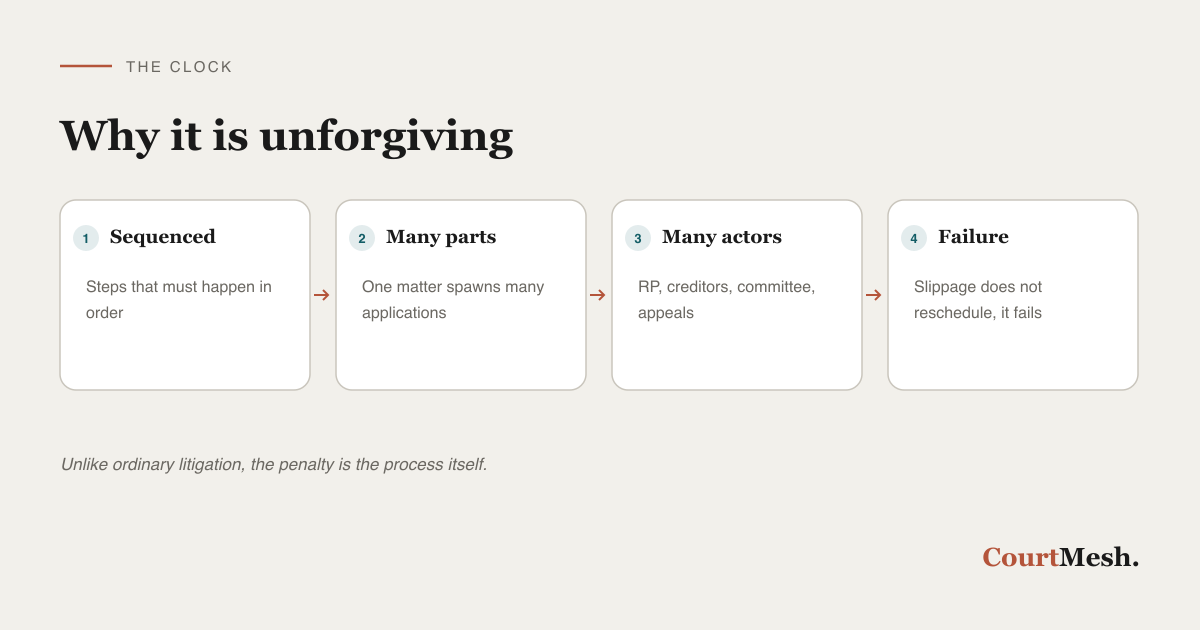
None of this makes the outcome mechanical. Tribunals deal with the reality of litigation, exclusions are sought and sometimes granted, and the position in any matter turns on the orders passed in it. But that is precisely the point. The periods are legal determinations on the facts, and they must be computed and verified in every matter. What you cannot afford is to be unaware that a period is running at all.
One Matter, Many Applications
The second thing that makes this work heavy is that the phrase the matter is misleading. In ordinary litigation a matter is broadly one file moving in a line: pleadings, issues, evidence, arguments, judgment. An insolvency matter is a trunk with branches. The company petition sits at the centre, and around it grows a set of separate applications, each with its own number, its own parties, its own listing history and its own next date.
The interlocutory traffic inside a resolution process
Not every matter produces all of the following, and some produce several of the same kind, but the categories will be familiar to anyone who has run a process:
- Applications seeking an extension of the resolution period, or the exclusion of a period from the computation
- Applications concerning the resolution professional, including confirmation, replacement, and approval of process costs and fees
- Applications by creditors aggrieved by the treatment of their claims, whether on admission, quantum or classification
- Applications for directions against the suspended management, commonly for records, assets or books of account
- Avoidance applications on preferential, undervalued, extortionate or fraudulent transactions, which often outlive the process itself
- Applications by third parties asserting that assets in the possession of the corporate debtor belong to them
- An application for withdrawal of the insolvency application, where the requisite creditor approval has been obtained
- The application for approval of the resolution plan, and any objections filed to it
- Applications relating to liquidation, if the process reaches that stage
Each of those is a separate application before the bench, listed, adjourned, part heard and disposed of on its own rhythm. So when somebody asks what the next date in the matter is, there is no single answer. There are as many answers as there are live applications, and the one that matters most on a given morning is rarely the one that comes to mind first.
Parallel proceedings that do not wait
Outside the four corners of the process sits a second layer. Orders of the tribunal are appealable to the National Company Law Appellate Tribunal, and from there a matter can travel further. An appeal is not a pause button on the process below unless an order says so, which means counsel often runs the appeal and the process at the same time, in different forums, on different calendars. Proceedings involving personal guarantors may be running under the same Code, and writ petitions, recovery proceedings, tax matters and commercial suits may be pending elsewhere. The moratorium that follows admission affects proceedings against the corporate debtor, but its precise reach in a given case is a question of law on which counsel must form a view, not an assumption anyone can make from a distance.
A single engagement can therefore put a dozen or more live files in front of you, across two or three forums, on dates that have nothing to do with one another. It is not a heavy caseload in the ordinary sense. It is a heavy caseload in which each case is itself a bundle.
The People in the Room, and the Work Each One Creates
Insolvency is also unusual in the number of parties with a legitimate claim on your attention. In a suit there are two sides. In a resolution process there is a cast, and every member of it generates correspondence, expectations and eventually applications.
The resolution professional
Runs the process, keeps the corporate debtor going, verifies claims, convenes the committee and files most of the applications within the process. Whether you hold the role or advise someone who does, this is the centre of the paper flow.
The committee of creditors
Takes the commercial decisions, meets repeatedly and votes on matters requiring approval. Every meeting produces notices, agendas, minutes and follow up actions, each with a date attached.
Operational and other creditors
Submit claims, contest how those claims are treated, and often litigate the outcome. Claim disputes are among the most reliable sources of interlocutory applications in a live process.
Prospective resolution applicants
Seek information, submit plans and negotiate. Their timelines are commercial rather than statutory, but they consume the statutory time available and rarely move faster because you need them to.
The suspended management
Retains obligations to cooperate and hand over records, and becomes the respondent when that cooperation is not forthcoming. Delay here affects everything downstream.
The tribunal and its registry
Controls listing, numbering, defects and dates. Nothing is real until it has been filed, numbered and listed, and the registry sets the pace of all three.
None of these is individually difficult. The difficulty is that they are simultaneous. A resolution professional carrying three assignments is not doing one job three times. They are holding three committees, three sets of claimants and three benches in view at once, while each constituency quite reasonably behaves as though theirs is the only matter on the desk.
The Moving Parts of a Single Insolvency Matter
It helps to see the whole thing in one view. No period is put in figures below, and that is deliberate. The periods are fixed by the statute, they are affected by the orders passed in the particular matter, and they have to be worked out and verified afresh in every file.
| Moving part | What it generates inside the matter | The tracking burden it creates |
|---|---|---|
| Admission of the application | The start of the process, the moratorium, and an interim resolution professional in charge. | The statutory clock begins here, so the order must be read, dated and recorded accurately. Everything later counts from it. |
| Public announcement and claims | Claims from financial creditors, operational creditors, workmen and employees. | Claims arrive continuously, each needing to be logged and placed on record. Late and revised claims keep coming. |
| Verification and collation of claims | The list of creditors and the voting share of each, on which the committee is constituted. | Every disputed claim is a potential application, and each revision to the list affects voting and decisions already taken. |
| Meetings of the committee of creditors | Notices, agendas, minutes, voting results and decisions requiring a specified majority. | A calendar running in parallel with the tribunal's, each meeting carrying its own notice period and action items. |
| Invitation and evaluation of plans | Expressions of interest, an information memorandum, plans received and evaluated, and the committee's vote. | Commercial parties move on their own schedule while the statutory period runs. The pressure is felt most acutely here. |
| Application for approval of a plan | A substantive application before the bench, plus any objections filed to it. | Listed, adjourned and heard like any other application, with objections adding parties. Nothing concludes until the order is passed. |
| Appeals before the appellate tribunal | Appeals against orders of the tribunal, and applications for interim relief within them. | A second forum and a second cause list, running at the same time as the process below rather than instead of it. |
| Proceedings involving personal guarantors | Separate proceedings under the same Code against those who guaranteed the debts. | Related in substance but separate in file, often before a different forum, and frequently tracked by a different person. |
| Other litigation involving the corporate debtor | Suits, writ petitions, recovery matters and statutory proceedings that predate admission. | Their status must be known even where the moratorium may apply, because its effect on each is a legal question. |
| Liquidation, if it comes to that | A fresh set of steps, appointments, applications and reporting obligations. | The file does not close. It changes shape, and a new sequence of dates begins on the same matter. |
Read down the right hand column and one sentence keeps reappearing under different names: this is a date somebody has to be watching. Now hold four such matters at once, before benches in different cities.
Why Tracking Across NCLT Benches Is Operationally Hard
The NCLT sits in benches across the country, and the bench before which a corporate debtor's matter lies generally follows the location of its registered office. For a practice with clients in more than one state, or a professional taking assignments as they come, that means a portfolio spread across benches which share a statute but not a workflow.
Separate benches, separate rhythms
Each bench publishes its own cause list and runs its own board. Filing practice, numbering, the handling of defects, the speed at which an application moves from filing to listing, and the way urgent mentioning is dealt with all vary. Working knowledge acquired at one bench does not transfer cleanly to another, and whoever tracks your matters has to check several sources on several rhythms to know where the portfolio stands.
Listings and adjournments do not respect your plan
A matter is listed, then passed over. The board runs long and it is not reached. An adjournment is granted, for a short date or a long one. Applications within the same matter get listed on different days. None of this is unusual, but it means the next date noted last month is a hypothesis rather than a fact, and the only way to know the current position is to check the official record.
A file that branches rather than runs in a line
The deepest difficulty is structural. Systems built for litigation assume one case has one status and one next date. An insolvency matter has neither. It has a main petition and a set of applications in different postures: one part heard, one awaiting reply, one reserved for orders, one just filed and not yet numbered. Any approach that stores a single date per matter will be wrong about an insolvency matter most of the time. The matter has to be treated as a container, with every application inside it tracked in its own right while remaining visible as part of the whole.
Where a Portfolio of Insolvency Matters Breaks
Failures here rarely look dramatic on the day they happen. They look like an ordinary busy week in which something quiet did not get done. The consequences arrive later, when the options have narrowed.
In most litigation, losing track costs you a date. In insolvency, losing track can cost you the process. The merits of a resolution do not survive the expiry of the time in which it had to be achieved.
The computation is yours, not the software's
Be precise about the boundary here, because the temptation to over trust a tool is strongest in exactly this area. No tool computes statutory timelines for you, and no tool can tell you whether a period has expired. Those are legal determinations on the facts of the particular matter. Periods can be affected by exclusions and by orders of the tribunal, so two matters that began on the same day can be in entirely different positions. The record of the tribunal and the official cause list prevail over anything held in your own system. Software tracks what you enter, surfaces dates from official sources, and reminds you before something falls due. What it cannot do is meet the date for you, or form the view about whether the date has already gone.
What a System Has to Surface
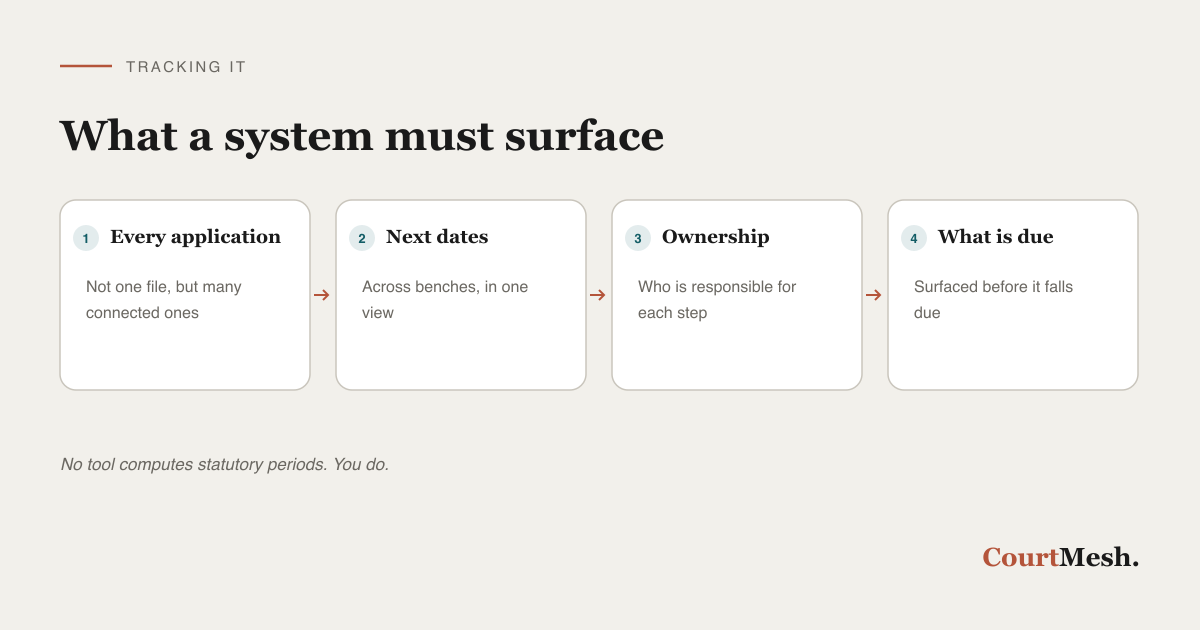
If one matter contains many live threads across more than one forum, the requirement is easy to state. Whatever you use, a product or a shared sheet maintained with discipline, it has to answer two questions without anyone opening a file to find out. What is live inside this matter, application by application, with a next date and a named owner against each? And what falls due next across the whole portfolio, in every matter and every forum, ordered so that the earliest is obvious rather than buried? Almost everything else follows from those two. The documents belong on the matter rather than in the inboxes of whoever happened to receive them, and the appeal, the guarantor proceeding and the other litigation involving the corporate debtor belong in the same picture as the process itself, because anything tracked separately is eventually tracked by nobody.
A Practical Approach for a Portfolio of Insolvency Matters
None of this needs a reorganisation of the practice. A portfolio comes under control through a small number of ordinary habits applied consistently, and the order matters.
Treat the matter as a container, not a file
Open one record for the corporate debtor and hang everything off it: the company petition, every application within the process, the appeals, and the related proceedings. A thread that cannot be seen from the container will eventually be forgotten.
Record the anchor dates from the orders themselves
Take the dates that drive the matter from the certified orders and the official record, not from correspondence or recollection. The admission order in particular should be read, dated and placed on the matter the day it is received.
Compute the periods yourself, and record your reasoning
Work out the applicable periods on the facts, note the basis on which you did so, and revisit that computation whenever the tribunal passes an order that could affect it. The note of your reasoning is as valuable as the date.
Give every application a named owner
One person answerable for each application, including the appeals and guarantor proceedings. Where work is split between counsel and the professional's team, write down who watches what rather than assuming it is understood.
Set your own reminders well ahead of each step
Build in lead time before every date and internal milestone. In a process where lost time is not recoverable, a reminder on the day itself is already too late.
Reconcile against the official record on a fixed rhythm
Check listings and status against the cause list and the official portals regularly, and before any week in which something is expected to be reached. Your own system is only as reliable as its last update.
Review the whole portfolio, not one matter at a time
Once a week, look across everything coming due in every matter and every forum. The portfolio review catches the quiet application nobody has thought about since it was filed.
The last habit does the most work. Insolvency matters fail quietly, and the application that causes the problem is almost never the one being actively argued. It is the one that was filed, listed once, adjourned, and then dropped out of everybody's field of vision while the resolution plan absorbed all the attention in the room.
Where CourtMesh Fits
Plenty of practices manage insolvency portfolios on discipline alone, and discipline remains the load bearing element whatever sits underneath it. What a system does is make that discipline cheaper to maintain.
CourtMesh covers Tribunals including the NCLT and NCLAT, alongside the Supreme Court, all 25 High Courts and District Courts, drawing on roughly 310 million cases from official government portals only. Case status and next hearing dates are drawn from eCourts and NJDG. For a practice whose matters sit before benches in different cities, that means what has already surfaced from those sources can be read in one place rather than assembled portal by portal. It does not mean the bench has been superseded. Coverage is bounded by what each source publishes, and the record of the tribunal and its cause list remain the authority on where a matter actually stands.
My Cases is where the operational side lives. It holds matters, tasks and deadlines, and urgency states mark what is close to falling due so that it does not sit at the same visual weight as everything else on the list. A document vault holds the admission order, the announcement, claim papers, minutes, plans and orders on the matter itself. Team collaboration with access controls lets the professional's team and counsel work on the same record with clear ownership. Watchlist alerts flag new filings involving a party you are monitoring, as and when those filings surface in the source registries, which is useful when a corporate debtor or guarantor is likely to appear in fresh proceedings.
Centralising the matter, not running the process
CourtMesh does not compute IBC timelines, does not track the resolution clock, and does not manage a resolution process. It centralises the insolvency matter and its many applications, and surfaces dates drawn from official sources so that what is due is visible. Every legal determination, including each period and the consequences that follow from it, stays with the professional carrying the matter.
The value of a system in insolvency practice is not that it knows the law. It is that a portfolio spread across benches, holding dozens of live applications and several parallel proceedings, can be seen in one place, by more than one person, on a Monday morning. That does not replace judgement. It decides which matter your judgement reaches while there is still time to apply it.
Keep the whole insolvency portfolio in view
Insolvency punishes lost visibility more than almost any other practice area, because what you lose is not a date but the process itself. CourtMesh brings your matters and their many applications into one place, with tasks, deadlines and urgency states in My Cases, a document vault on each matter, team collaboration with access controls, and case status and next hearing dates from eCourts and NJDG, over a corpus that covers Tribunals including the NCLT and NCLAT, the Supreme Court, all 25 High Courts and District Courts. You compute the timelines and form the legal view. CourtMesh makes sure nothing in the portfolio is out of sight while you do.
Explore CourtMesh