A matter can be won on the merits and lost on the calendar. The strongest claim in the world is worth nothing once the date to bring it has passed, and the particular cruelty of a missed deadline is that it says nothing at all until it is already too late to fix.
Every litigator knows the case that was never in doubt. The facts were with you, the law was with you, the other side knew it. Then a date slipped, and none of it mattered any more. Limitation had run. The appeal window had closed. The matter was called, nobody appeared, and it proceeded ex parte or was dismissed for default. The merits did not change. The remedy simply disappeared.
These failures are rarely about competence. An advocate who can argue a fine point of law is not undone by ignorance of the calendar. They are undone by volume: dozens of live matters, each with its own moving dates, tracked in a diary, a junior's memory, and a spreadsheet that stopped being updated the week everyone was busy. This piece is about that gap. Why it is structural rather than careless, what kinds of dates are genuinely unforgiving, and what a system that closes the gap actually has to do.
Why a Missed Date Is a Different Kind of Loss
Most professional mistakes leave room to recover. A weak argument can be strengthened on the next date. A poorly drafted clause can be redrafted. A missed limitation period offers no such second chance. Limitation does not weigh the merits of your claim. It does not ask whether you were nearly in time, or whether the delay was understandable. It bars the remedy, and a barred remedy is gone whether the underlying right was strong or weak.
A bar is not a setback, it is an ending
There is a useful distinction between a setback and an ending. A setback is anything you can still work with. An ending is a door that has closed behind you. The Limitation Act 1963 fixes, for each kind of proceeding, a period within which it must be brought, and section 3(1) states the consequence in mandatory terms: every suit instituted, appeal preferred and application made after the prescribed period shall be dismissed, although limitation has not been set up as a defence.
The power to excuse delay is narrower than the way it is usually spoken about in chambers, and the difference matters enormously depending on what you are filing. Section 5 extends the prescribed period for an appeal or an application only. Its opening words are limited to any appeal or any application, and it expressly carves out an application under any of the provisions of Order XXI of the Code of Civil Procedure 1908. It says nothing about a suit, because there is no power to condone delay in instituting one. A suit filed out of time is not a suit awaiting an indulgence: section 3 requires it to be dismissed, and Order VII Rule 11(d) CPC requires the plaint to be rejected where the suit appears from the statement in the plaint to be barred by any law. Where section 5 does apply, the power is discretionary, it must be asked for, and sufficient cause has to be shown to the satisfaction of the court.
Read those two paragraphs together and the practical rule falls out. Building an appellate practice on the hope that delay will be condoned is an exposure you are choosing to carry. Building a plaintiff's practice on the same hope is not an exposure at all. It is a decided outcome you have not noticed yet.
The merits tell you whether you should win. The calendar decides whether you get the chance to.
The same logic runs through the litigation calendar. When a matter is listed and nobody appears for a party, the court does not simply wait. It may proceed ex parte, or dismiss the matter for default. The Code of Civil Procedure 1908 provides mechanisms to set aside an ex parte order and to seek restoration of a matter dismissed for default, but those remedies cost time, money, and credibility, and they are not guaranteed. Every one of these outcomes turns a live, winnable matter into a salvage operation.
The Failure Is Structural, Not Careless
It is tempting to treat a missed date as a lapse of attention, the kind of thing that happens to people who are not careful enough. That framing is comforting and wrong. The failure is built into the shape of the work itself, and three features of litigation make it almost inevitable when the only tools are manual.
Concurrent volume
A single advocate or a small chamber may carry dozens of live matters at once, each generating its own dates. No individual date is hard to remember. The difficulty is that there are too many of them, moving at the same time, for memory to hold reliably.
Dates you did not observe
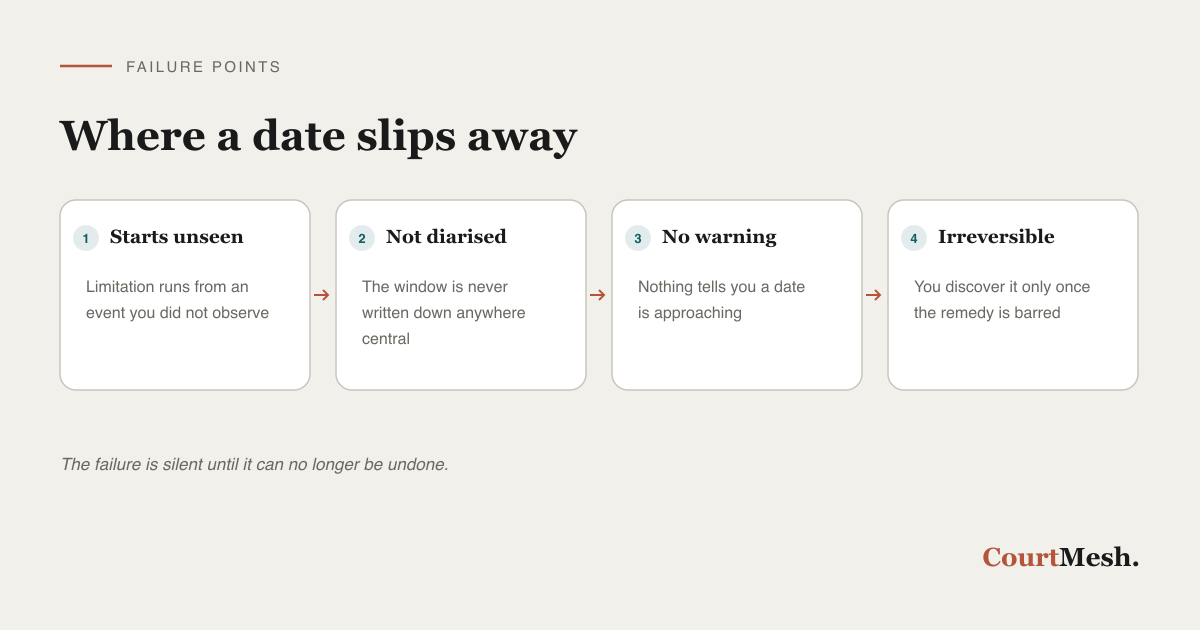
Many critical dates depend on events you were not present for: when limitation began to run, when a certified copy or order was made available, when the registry fixed the next date. If you did not see the triggering event, you cannot diarise the deadline it created.
No signal until you look
A deadline gives no warning of its own. A diary entry does not raise its hand. Unless someone actively goes looking on the right day, an approaching date stays invisible, and the first sign of trouble is often the consequence itself.
Notice that none of these three requires anyone to be lazy or incompetent. They describe a diligent office doing its work under load. The dependency on unobserved events is the most dangerous of the three, because it means a deadline can be running against you before anyone in the office even knows it exists.
A failure with no one at fault
Suppose an order is passed and the clock for an appeal begins from the date a certified copy becomes available. Imagine that copy is ready on a day when the advocate handling the matter is in another court, the intimation sits unread, and the person who would have diarised the deadline never learns the triggering event has occurred. Nothing in the office is broken. Everyone is doing their job. And yet the appeal window is now running against a date that nobody recorded.
The Categories of Unforgiving Date
Not all deadlines are equal. They differ in what sets the clock running, and they differ far more in what it costs you to miss them. Treating them as one undifferentiated pile of dates is part of the problem, because it hides the fact that some carry no soft landing at all. The table below separates the main kinds, and the sections that follow explain why the consequences are so different.
| Kind of date | When the clock typically starts | Consequence of missing it |
|---|---|---|
| Limitation to file | When the cause of action arises or the right to sue accrues, as defined for that kind of proceeding. | The remedy is barred. For a suit there is nothing to fall back on: section 3 requires dismissal and Order VII Rule 11(d) CPC requires rejection of the plaint, however strong the underlying claim. |
| Appeal and revision windows | Usually from the date of the order, or from when a certified copy of it is available. | The right to challenge the order lapses. The decision below stands, and reopening it depends on delay being condoned. |
| Condonation of delay exposure | The moment an appeal or application period has expired. Check first whether section 5 reaches your filing at all: it covers appeals and applications, it excludes applications under Order XXI CPC, and it does not extend to a suit. | Where section 5 applies, you are dependent on the court's discretion, you must show sufficient cause, the other side will resist, and relief is possible but never assured. Where it does not apply, there is no application to make. |
| Next-hearing date | Fixed by the court and updated as the matter proceeds. | Non-appearance may lead to the matter proceeding ex parte or being dismissed for default, converting a live matter into a restoration exercise. |
| Statutory notice periods | On the triggering event the statute specifies, for example the return of a dishonoured cheque under Section 138 of the Negotiable Instruments Act. | A sequence of tight, dependent deadlines. Miss the window to send notice, or to file within the permitted period, and the specific statutory remedy can be lost. |
| Compliance and procedural timelines | When an order, undertaking, or obligation fixes a date for a step to be completed. | Costs, an adverse inference, the striking off of a defence, or the loss of a procedural right, depending on what the step was. |
Limitation and appeal windows: the hard bars
These are the dates with no cushion. When limitation runs or an appeal window closes, the default position is not a penalty you can argue down. It is a door that shuts. Everything after that point is an attempt to persuade a court to reopen what has already closed, and you are asking, not entitled. This is why the hard bars deserve a different quality of attention from everything else on your calendar: the cost of missing them is total and the recovery is uncertain.
Hearing dates: recoverable, but at a price
A missed hearing is usually recoverable, and that very fact makes it deceptively easy to underrate. An order passed ex parte can often be set aside, a matter dismissed for default can often be restored. But often is not always, and recovery is never free. It consumes a fresh round of appearances, an application, an explanation the court is entitled to test, and the goodwill of a bench that has now seen your side fail to appear. A run of missed dates in one matter also shapes how seriously your diligence is taken in the next.
Statutory cascades: where one missed link collapses the chain
Some statutory remedies are built as a cascade: a triggering event, a period within which a notice must go out, a waiting period for the other side to respond or pay, and then a narrow window within which the proceeding must be filed. The remedy under Section 138 of the Negotiable Instruments Act is the familiar example. Each step is bounded by its own period, and the steps run strictly in sequence. Miss one link and the whole chain can fail, not because the claim was weak, but because a clock ran out in the gap between two steps while attention was elsewhere.
Why Manual Systems Fail Predictably
The tools most chambers rely on to hold these dates were never designed for the job. A physical diary, a shared spreadsheet, and the collective memory of the team are each reasonable for a handful of matters and each fail in the same predictable ways once the docket grows. The failure modes below are not exotic. They are the ordinary, recurring reasons a date goes missing in an otherwise competent office.
The quiet death of the spreadsheet
The spreadsheet deserves a special mention, because it fails so reliably that its failure is almost a law of nature. It starts well. Someone sets it up, the columns are sensible, everything is current. Then a busy fortnight arrives, updating it slips to the bottom of everyone's list, and because no single person owns it, no single person notices it has gone stale. It still looks authoritative. It is still open on someone's screen. But it has quietly begun to describe a state of the world that no longer exists, and the distance between the sheet and reality stays invisible right up until a date that was never entered arrives.
The Limit of Any Tool, Stated Plainly
Before describing what a good system does, it is worth being blunt about what no system can do, because getting this wrong is more dangerous than having no system at all. A tool that is trusted for something it cannot do is worse than a diary you know you have to check.
No tool computes your limitation. You do.
This matters more than any feature. No software calculates limitation for you. Limitation depends on the facts of the matter, the nature of the right asserted, the exclusions and extensions that may or may not apply, and the law as it stands, and applying all of that is legal judgement that rests with the advocate alone. Court dates pulled from public registries can be stale, incomplete, or simply wrong, and where there is any conflict the official cause list and the court record prevail. A tool can track and remind. It cannot decide whether you are in time. Anyone who treats a system's silence as confirmation that they are within limitation is making a serious mistake: the absence of a reminder is not a legal opinion, and it never will be.
The correct mental model is narrow and honest. A good system reduces how much depends on someone remembering, and it makes an approaching date hard to overlook. It does not assume responsibility for the date, and it does not relieve you of the duty to verify against the record. Keep that boundary firmly in place and everything below becomes genuinely useful. Blur it, and you have simply built a more confident way to miss a deadline.
What a Reliable Deadline System Actually Needs
With that boundary clear, the requirements of a good system are easy to state and hard to satisfy with manual tools. Each one removes a specific failure mode from the list above, and the value is in having all of them at once rather than any single feature in isolation.
A single source of truth
Every matter, and every date attached to it, lives in one place that the whole team treats as authoritative. When there is one record, there is no argument about which version is current, and nothing important survives only in a private diary.
Dates captured at intake
Deadlines are recorded when a matter is opened and as events occur, not reconstructed later from memory. A date captured at the moment it arises does not depend on anyone remembering to write it down afterwards.
Automatic surfacing of what is due
The system shows what is approaching without anyone having to go looking for it. The daily question changes from what have I forgotten to here is what needs attention, and that reversal is the whole point.
Escalation before the deadline, not after
Urgency is visible in advance. A date that is due soon must look different from one that is comfortably far off, and one that is overdue must be impossible to ignore. A warning that arrives after the date has passed is not a warning, it is a post-mortem.
Visibility across whoever might cover
Anyone who could step into a matter can see its live dates. Cover during leave, illness, or a listing clash stops depending on one person being reachable at the moment they are needed most.
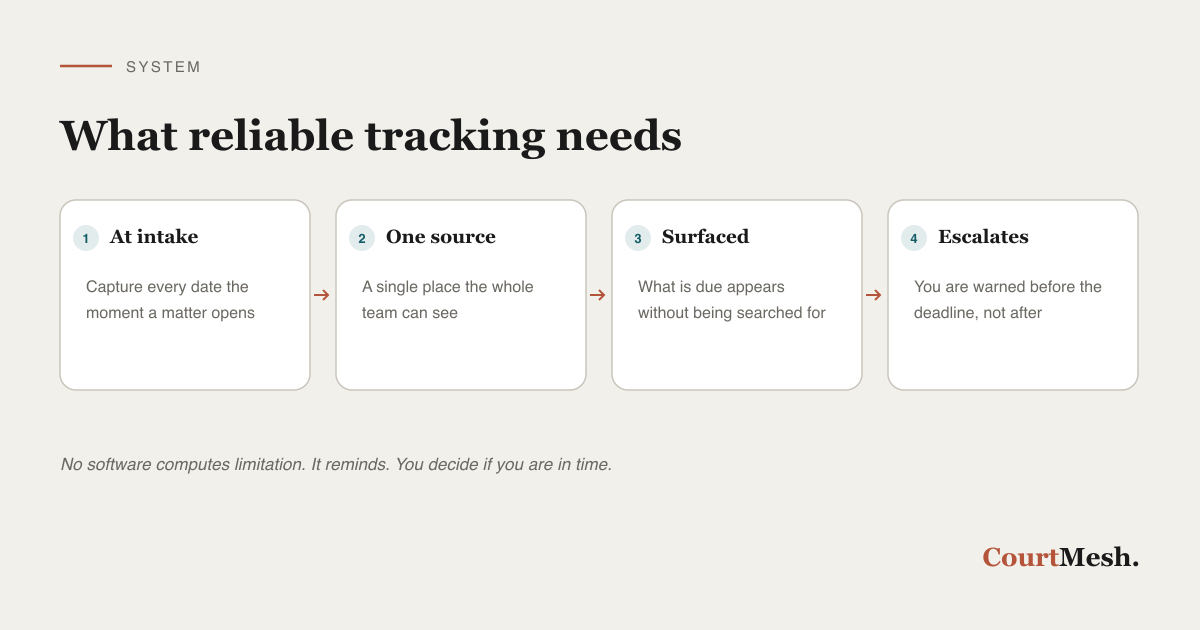
Read the five requirements together and one principle runs through all of them: a load that currently rests on individual memory is moved onto a shared record which behaves the same way whether the office is quiet or overwhelmed. Manual systems fail in precisely the second condition, and that is also the condition in which a chamber is carrying the most exposure.
Where CourtMesh Fits, and Where It Stops
This is where a tool like CourtMesh earns its place, stated plainly and inside the boundary set out above. It is not a substitute for your judgement on limitation. It is a way to make sure the raw facts of your docket, the matters and the dates on them, stop living in one person's diary.
Matters in one place
CourtMesh My Cases holds the full lifecycle of a matter with task and deadline tracking, a document vault, and team collaboration under access controls, so the record of what is due does not depend on a single diary or a single memory.
Urgency you can see
Deadlines carry urgency states such as Overdue, Urgent, and Due Soon, so what needs attention today is visibly distinct from what can wait, on a shared dashboard rather than in a mental note.
Court dates from the source
Next-hearing dates and case status are sourced from eCourts and the National Judicial Data Grid, so the next date on the file is drawn from the registry rather than transcribed by hand. What those registries have not yet published cannot appear, which is why the court record stays the authority.
Alerts when filings surface
Watchlist alerts reach you on the dashboard and by email within minutes of a new filing appearing in the source registries. The bound is worth stating plainly: minutes from publication upstream, not minutes from the filing itself.
None of this calculates limitation, guarantees that nothing will ever be missed, or replaces the official cause list. What it does is narrower and still worth having: it centralises your matters and surfaces what is due. The registry data can lag or contain errors, the court record remains the authority, and the advocate remains responsible for whether the matter is in time. The tool simply makes it far harder for an approaching date to stay invisible until it is too late.
Fewer dates that depend on memory
A missed date does not care how strong your case was. The work of staying in time is not glamorous, but it quietly protects everything else you do. If your matters, deadlines, and next dates are currently spread across a diary, a spreadsheet, and a junior's memory, CourtMesh brings them into one place and surfaces what is due, so the calendar is one less thing standing between a winning case and a lost remedy. You still apply the law on limitation. The tool just makes sure the date does not slip past unseen.
Explore CourtMesh