
Imagine the call. A client rings on a Tuesday afternoon and asks, in a tone you have not heard from them before, why they have just read about their own case in the newspaper. You have not seen a summons. You have not received a notice. As far as your file is concerned, nothing has happened. As far as the registry is concerned, the matter has existed for weeks.
The scenario is hypothetical. The mechanism that produces it is not. In India there is no reliable push notification when someone sues your client. A matter is filed, scrutinised, numbered, and entered in a registry, and from that point it is discoverable, which is a very different thing from being disclosed. It becomes known to you only if somebody goes looking, or if one of several unreliable messengers reaches you first.
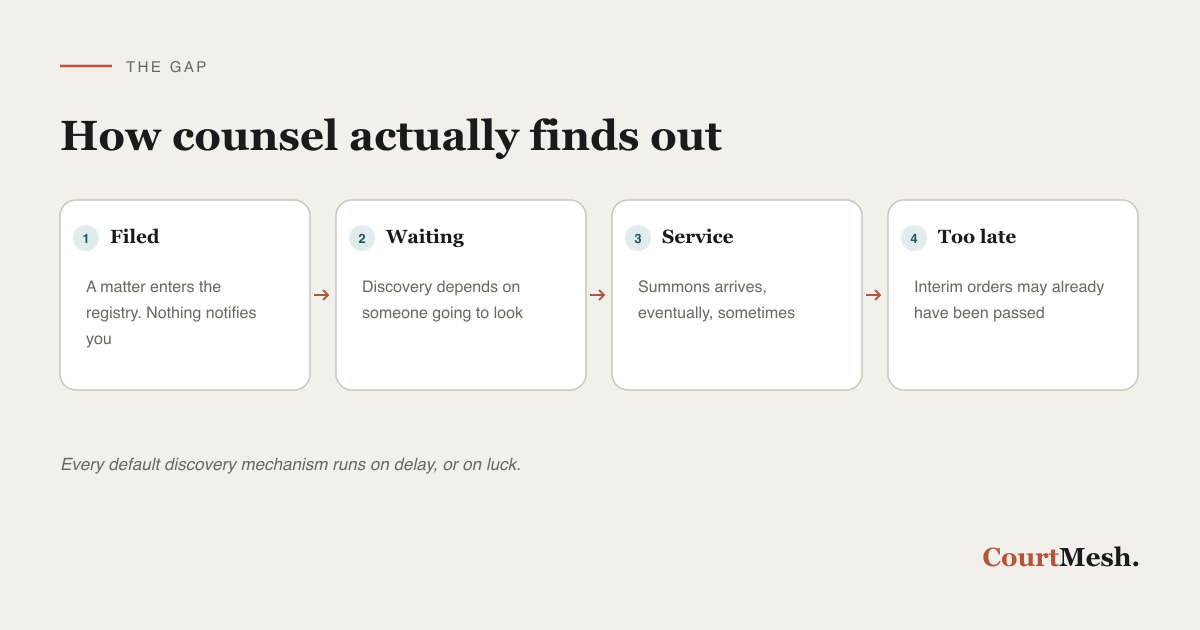
The gap between a filing and your knowledge of it has two components: one imposed by the system, one imposed by your own process. You can do nothing about the first and a great deal about the second, and it is worth being able to tell them apart.
How Counsel Actually Finds Out
Set aside how you think you find out and list how you actually do. Notice reaches an advocate through a handful of channels, and only one of them is under your control.
The channel the system intends is service. The Code of Civil Procedure 1908 provides the machinery: the court issues summons, the defendant is served. It works, often. But it depends on the address on record being correct, on the process reaching someone who understands what they have received, and on that person passing it to somebody who will act. It also has the most dangerous failure mode of the lot, because when it fails it fails silently. Nothing arrives, and nothing arriving looks exactly like nothing having happened.
The rest are worse, because each runs on somebody else's incentives. A party that wants a settlement has every reason to tell you early; a party that wants an interim order has every reason not to. A reporter who knows first is the worst case of all, because by then the information is public, your client's stakeholders have seen it, and your first act as counsel is not analysis but reassurance. And a client who finds out alone and rings you has reversed the relationship: you are now the person being informed rather than the person informing.
Which leaves the only channel you actually control: someone went and looked at the registry. Most of this article is about that channel, because it is the only one that does not depend on the goodwill, competence or timing of a third party.
| How you find out | Speed | Reliability | What it depends on |
|---|---|---|---|
| Service of summons | Slow and variable | Moderate, and it fails silently | The address on record, the process reaching someone who acts on it, and the diligence of the party effecting service |
| The opposite party tells you | Unpredictable | Low. It is a tactical choice, not an obligation | Whether their strategy is served by you knowing early |
| The press | Unpredictable, and usually too late to be useful | Low in general, damaging when it operates | Whether the matter or the client is newsworthy |
| The client calls you | Variable, and always after the client is already alarmed | Low, and it costs you standing in the relationship | The client's own discovery, which is subject to the same gap |
| Manual portal checks | Bounded by how often somebody actually checks | Depends entirely on discipline, spelling and which courts were searched | A junior's calendar, and a guess about where the matter would be filed |
| Automated monitoring | Bounded by when the registry publishes, not by your calendar | Consistent, but limited by name matching and by the upstream data | The registry's publication schedule and the name variants you configured |
Why the Discovery Gap Is Structural
It is tempting to read the gap as somebody's failure: a slow registry, a careless process server, a portal that should be better. It is not. The gap is the predictable output of how the system is built, and it would exist even if every registry in the country were operating perfectly.
No push, by design
A registry's duty is to administer the case before it and issue process to the parties. Publication on a portal is a by-product of that, not a notification service. Nobody at the court is responsible for telling you a matter concerning your client exists.
Hundreds of independent publishers
The Supreme Court, 25 High Courts, District Courts in every district, and tribunals including the NCLT, NCLAT, ITAT, CESTAT and DRT each run their own systems on their own rhythms. eCourts and the NJDG aggregate a great deal, but not everything, and not on a single clock.
Search is pull, and you must guess
To find a matter you must already know roughly where it is: which court, which bench, sometimes which year and case type. A suit filed in a district you never thought to search is, for practical purposes, invisible.
The party name is not a key
A name is typed at filing by a person under time pressure, and is not validated against a CIN or a PAN. Acme Industries Private Limited, M/s Acme Industries Pvt. Ltd. and Acme Inds Pvt Ltd are one company to you and three strings to a search box.
Groups do not litigate under one name
A client may be sued as a holding company, a subsidiary, an LLP, an erstwhile name surviving on old contracts, or through directors named personally. The name on your engagement letter is one of these.
Numbered is not published
A filing passes through scrutiny and may sit under objection before it is numbered. Between filing and the moment it becomes searchable is a window whose length is not yours to control, and is not the same at every registry.
What the Delay Actually Costs
The cost is easy to underrate, because nothing dramatic happens on the day you do not learn about a filing. It is realised later, and by then it has changed its clothes. It presents as a tight deadline, a thin application, an interim order you are now arguing to vacate, an unhappy client. It rarely presents as what it is.
Time usually runs from events, not from your knowledge
Procedural clocks generally run from events rather than from your knowledge of them: from service, from the date of an order, from a decree. The Limitation Act 1963 and the Code of Civil Procedure 1908 are largely indifferent to the state of your inbox, and a period that ran while you were unaware of the matter is not returned to you merely because your ignorance was reasonable.
There is relief, in fairness: the Limitation Act 1963 provides for condonation of delay, and Order IX of the Code of Civil Procedure 1908 allows an ex parte decree to be set aside in defined circumstances. But each such route converts a matter you would have defended on the merits into an application in which you must first argue for the right to be heard at all. That is a worse case. It costs more, it turns on the court's discretion rather than your client's rights, and it may fail.
Interim relief does not wait for you
An application under Order XXXIX of the Code of Civil Procedure 1908 can be moved at the threshold of a suit, and courts do grant ad interim relief before the other side is heard. An order restraining your client from dealing with an asset or calling upon a guarantee can be in force before your client knows the suit exists. Vacating an order is a different exercise from resisting one: you are no longer arguing whether relief should be granted, you are arguing against an order already operating, before a court that has already formed a preliminary view.
Tribunal practice compresses the problem
An application under Section 7 or Section 9 of the Insolvency and Bankruptcy Code 2016 is not something you want to learn about after admission: before admission a resolution is a commercial conversation, and after it a considerably harder one under an entirely different regime. A complaint under Section 138 of the Negotiable Instruments Act 1881 may be filed in a magistrate's court in a town your client has never visited, and the first the accused hears of it may be a warrant rather than a summons.
The costs that are not legal at all
For a client with lenders, investors, regulators or a board, litigation that surfaces publicly before its own advisors know about it forces the client to explain something they have not yet understood, and that conversation is damage regardless of the merits. Then there is the cost hardest to write into a risk register. The first time a client tells you about their own case, something in the relationship changes and does not change back. Clients do not, in the main, expect their advocates to be omniscient. They do expect not to be the source of their own legal intelligence. It is an unfair standard. It is also the standard.
The Manual Approach, and Why It Quietly Fails
Most firms that have thought about this arrive at the same answer: somebody checks. A junior or a paralegal runs through the portals every week and searches the names of the important clients. It is reasonable, and better than nothing. It is also, as usually implemented, a control that produces comfort rather than coverage. There are four failure modes and they compound.
- Coverage. The check happens where you expect the litigation to be. Your client is in Mumbai, so somebody searches the High Court and the local district courts. But a plaint is filed where a cause of action is alleged to have arisen, which may be a district neither you nor your client has thought about. Nobody searches every district court by hand, so the check has an unstated boundary, and the boundary is a guess.
- Name variants. The search is run on the name as it appears on your engagement letter. The filing spells it differently: an abbreviation, a missing M/s, a transliteration the clerk chose, a space in the wrong place. The search returns nothing. Nothing is reported. Everybody is satisfied.
- Layer gaps. eCourts covers much of the district judiciary; High Courts and tribunals maintain their own systems. A person working by hand checks the two or three portals they are used to, and the NCLT, DRT or ITAT filing will not be among them.
- Decay. This is the one that kills the process. The check is the first thing dropped in a busy week, and busy weeks are not randomly distributed: they are precisely the weeks the firm is under pressure, which correlates with the weeks something is happening. And nobody notices it stopped.
The output of a diligent search and the output of a search nobody ran are identical. Both of them are silence.
That is the structural problem with any manual process here: success and failure produce the same artefact, an absence. A task quietly not being done announces itself only once the thing it was meant to catch has already happened, and by then the process failure and the underlying event arrive together, in the same phone call.
What Monitoring by Party Name Actually Solves
Monitoring registries by party name is not a clever idea. It is the obvious one. What matters is being precise about what it changes, because the honest list is shorter than the list you will usually be sold.
What it fixes
- It takes the human out of the checking. A system does not have a busy week, and does not deprioritise the task in the month it matters most.
- It removes your calendar as the bottleneck. You stop being bounded by 'we check on Mondays' and start being bounded by when the registry publishes, which is a real constraint rather than a self-imposed one.
- It buys coverage you would never build by hand. Forums you would not have thought to search, checked continuously, at no marginal cost per name.
- It produces a record. You can say what you monitored and from when, which is more defensible than a recollection of somebody's diligence.
What it does not fix
- It does not make a registry publish faster. Monitoring is downstream of publication and can never be upstream of it. This is the hard ceiling on the entire category.
- It does not make name matching exact. The underlying data is typed by people. Any matching system trades misses against noise, and you cannot have neither.
- It does not see what is not in a registry. A pre-litigation notice, an arbitration, a regulatory inquiry, a filing not yet numbered: none generate an alert, because none generate a public record to alert on.
- It does not tell you what matters. An alert is a signal, not an assessment. Triage remains legal judgement, and legal judgement still costs somebody's afternoon.
Absence of an alert is not proof that nothing was filed
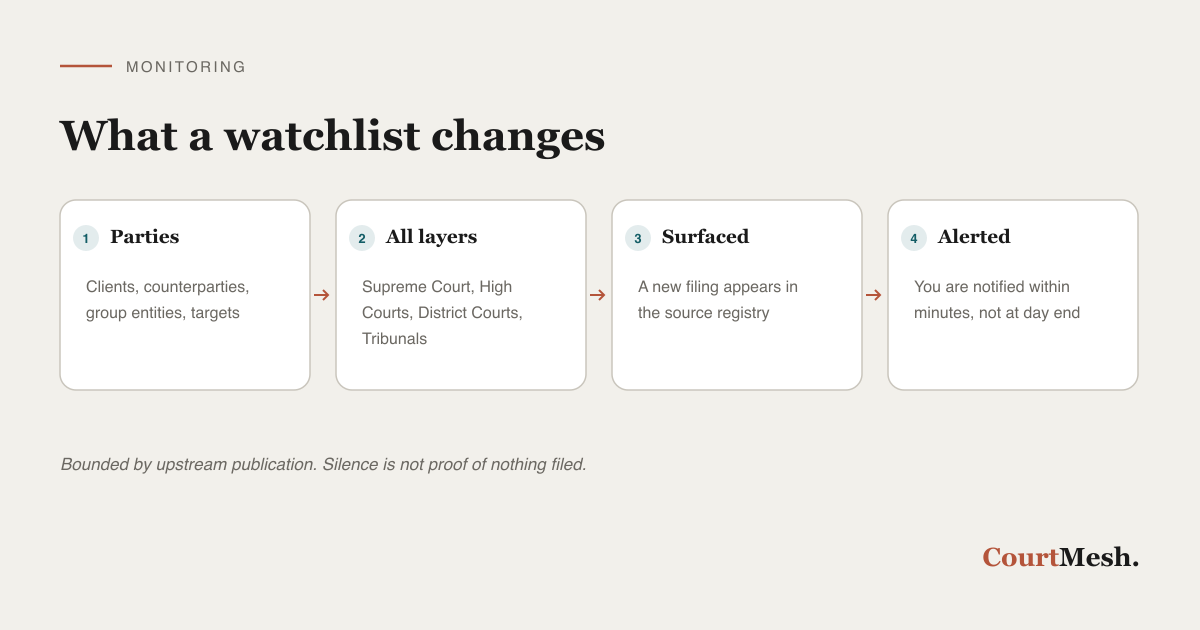
This is the most important sentence in this article. Every monitoring system, ours included, is bounded by the registry it reads. If a court portal publishes a filing three days after it is numbered, no tool in existence can tell you about it any sooner, and a tool that claims otherwise is claiming something it cannot do. Name matching adds a second bound: a common name produces noise you have to sift, and an unusual spelling or an unanticipated transliteration produces a miss you will never see, because a miss is invisible by construction. Silence from a monitoring system means no matching filing has surfaced in the sources it reads. It does not mean no matter has been filed. A practitioner who treats an empty alert feed as confirmation that a client is not being sued has not removed a blind spot. They have replaced it with a more confident one, and that is a serious mistake.
Who Belongs on a Watchlist
The instinct is to monitor clients. That is correct, and incomplete. A watchlist is not a client list. It is a map of the names through which risk can reach you, and those names are broader than the relationship that pays the bill.
Clients, and their actual entities
Not the name on the engagement letter: the names that appear on filings. Holding company, subsidiaries, the LLP that holds the property, the name used before the company was renamed, and group entities sharing a treasury or a guarantee.
Directors and promoters, personally
Individuals are named personally more often than they expect, particularly in complaints under Section 138 of the Negotiable Instruments Act 1881 and in proceedings following a corporate default. Such a filing may never touch the company's own name.
Counterparties in live matters
What your opponent files elsewhere is intelligence. A party suddenly defending several matters, or with an insolvency application pending against it, is a party whose settlement posture is about to move.
Guarantors and security providers
The party standing behind an obligation is where enforcement actually lands. They sit outside the client relationship, and almost always outside whatever monitoring anybody set up.
Due diligence targets
Before you advise on a transaction you want to know what the target is carrying. This is where the privacy of the watchlist itself matters: the names you watch disclose your client's commercial intentions.
Opposing counsel, where useful
Portals commonly allow search by advocate name. Knowing what a particular counsel files, and where, is a legitimate and occasionally useful read on the strategy you are about to face.
Building a Watchlist That Survives a Busy Practice
Most watchlists are set up with real care in the first week and then rot in silence, for the same reason the manual check rots: nothing visible happens when they stop working.
Start from entities, not relationships
Ask the client for the actual registered names: current names, former names after any change of name or amalgamation, group entities, and the LLPs and partnerships at the edges of the structure. A company secretary can usually resolve this in an afternoon, and everything downstream is limited by the quality of this conversation.
Add the variants deliberately
Add the abbreviations, the spelled-out forms, the M/s prefix, the spacing variations and the misspellings you can predict. Assume the name was typed by somebody in a hurry with no reason to care about your search. You are matching against reality, not against the certificate of incorporation.
Give every alert an owner
An alert with no named owner is a notification, not a control. Decide before the first one fires who reads the feed, on which days, and who the second person is when the first is in court. A feed everybody can see is a feed nobody reads.
Write down what happens in the first hour
Decide in advance what a match triggers: pull the case status and the next date, establish whether service has been effected, inform the client before the client informs you, diarise the date, and decide whether it needs a senior. A rule written in calm is worth several decisions taken in a rush.
Prune on a fixed cadence
Clients get acquired, entities get struck off, matters close, names change. A list that only ever grows becomes noisy, a noisy list gets ignored, and being ignored is a slower and more expensive way of not monitoring at all.
Be honest about what the record proves
Keep the record of what you monitored and from when. It evidences your diligence. It does not evidence the absence of litigation, and must never be described to a client as though it does.
How CourtMesh Approaches This
CourtMesh My Cases includes a watchlist. Since this article has spent most of its length on the limits of monitoring, here is precisely what it does and where it stops.
- Monitor any party by name. You add a name, not a case number, and alerts reach you on the dashboard and by email as soon as a matching filing surfaces in the source registry. Not a scheduled end-of-day digest, because a digest reintroduces the delay you were trying to remove.
- Coverage across the layers. The Supreme Court, all 25 High Courts, District Courts and Tribunals. That is broad. It is not the same word as exhaustive, and we would rather draw the distinction here than have you discover it later.
- Watchlists are private, and scoped to your organisation. Only your organisation can see the names you monitor. For due diligence this is not a nicety: a watchlist is a statement of your client's intentions.
- Case status, next hearing dates and disposals, sourced from eCourts and the NJDG, so an alert leads somewhere instead of merely announcing itself.
- Official sources only. More than 310 million cases from official government portals, with no third-party intermediaries between the registry and what you read.
- It sits inside the practice. Matter management, task and deadline tracking, and a document vault, so a matter that begins as an alert becomes a file rather than an email somebody meant to action.
The claim we make about speed is a bounded one, worth restating plainly: alerts fire within minutes of a filing surfacing in the source registry. Not within minutes of the filing. We do not control when a registry publishes, and neither does any other vendor. Anyone who tells you their alerts are instantaneous is describing the moment their system saw the data, not the moment the data came into existence. The distance between those two moments belongs to the court, not to the software.
The Standard Is Not Omniscience
Nobody expects an advocate to know about a plaint at the moment it is handed across a filing counter. That is not the standard, and no system on offer, ours included, can deliver it. The standard is that the failures within your control did not happen.
There is a delay imposed by the system: registries publish when they publish, and you inherit that. There is a second delay, imposed by process: the check that stopped happening in March, the name variant nobody thought to add, the tribunal nobody has ever searched, the alert that sat unread because it belonged to nobody in particular. The first is a fact about India's court infrastructure. The second is a decision your firm has made, whether or not it has noticed making it.
The distinction that matters
A delay imposed by a registry is a constraint you inherit. A delay imposed by your own process is a choice you made. Clients, in the end, forgive the first and remember the second.
The client reading about their own case in the newspaper is hypothetical. The mechanism that produces that call is not, and it is running right now across hundreds of registries that have no obligation whatsoever to tell you what they have just accepted for filing.
Close the gap you control
You cannot make a registry publish faster, and you should be sceptical of anyone who says they can. What you can do is stop depending on somebody remembering to check, on a name being spelled the way you expect, and on a court you happened to think of. CourtMesh My Cases lets you monitor any party by name across the Supreme Court, all 25 High Courts, District Courts and Tribunals, with alerts within minutes of a filing surfacing in the source registry, on a watchlist only your organisation can see. It will not make you omniscient. It will mean that the next time you find out late, it was not because nobody looked.
Explore CourtMesh