A Section 138 practice does not usually fail on the law. The elements of the offence are settled, the notice is a template, and the complaint follows a form your office has filed a hundred times. It fails, when it fails, on operations: a statutory notice sent a few days too late, a complaint that slips past its filing window, a hearing that goes unattended while the file sits in the wrong pile. At volume, the work stops being a question of legal skill and becomes a question of whether you can hold a large number of moving matters in view at once.
Cheque dishonour work has a particular shape. Each matter, taken on its own, is not hard. A cheque was given, it was presented, it came back unpaid, a statutory notice went out, the money did not come, and a complaint was filed. Most advocates who do this work could describe the sequence in their sleep. The difficulty is that you are almost never running one of these. You are running forty, or a hundred, or two hundred, each at a different stage, each with its own parties, its own cheque, its own dates, spread across different courts and different benches.
This is why a cheque-bounce practice is, at its core, an operations problem rather than a research problem. The intellectual content of any single file is low. The operational content of the whole docket is enormous. And the two failure modes that actually hurt clients, a missed statutory window and a missed hearing, are both failures of tracking, not of understanding.
Why Section 138 Work Is a Volume Problem, Not a Research Problem
Consider what the phrase two hundred files actually contains. It is not two hundred copies of the same case. It is two hundred separate legal relationships, each frozen at a different point in the same sequence. One matter is waiting on a return memo from the bank. Another is a day or two from the end of its notice period. A third is ready to be filed. A fourth is part-heard. A fifth is awaiting judgment. The template is shared. Almost nothing else is.
The same template, never the same dates
This is the trap in cheque-bounce work. Because the documents look alike, the matters feel interchangeable, and it is tempting to treat them as a single stream. But the thing that actually governs each one, its dates, is unique to it. Every matter carries its own set of variables that no template captures:
- Its own drawer and payee, and often its own guarantor or company officers
- Its own cheque, for its own amount, presented on its own date
- Its own return memo, recording its own reason for dishonour
- Its own statutory notice, with its own date of issue and date of receipt
- Its own limitation and filing windows, counted from its own facts
- Its own court, its own Magistrate, and its own string of next dates
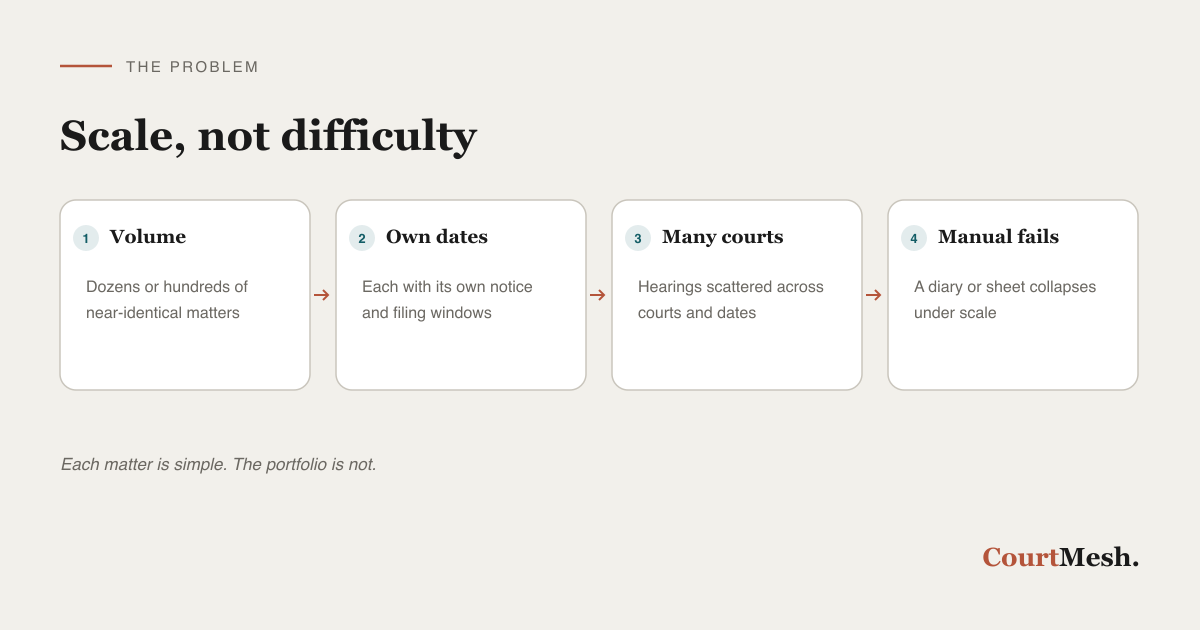
Manage forty of these and you can just about hold them in your head on a good week. Manage two hundred and you cannot, and neither can any junior, and neither can any diary that only knows about today. The volume itself is the adversary. Every additional matter you take on is not just more work; it is one more independent clock running in the background, indifferent to how busy the rest of the office is.
The Anatomy of One Cheque-Bounce Matter
To see where volume bites, it helps to walk through a single matter and notice how many dates it generates. Section 138 of the Negotiable Instruments Act 1881 sits at the centre of a sequence, and each step in that sequence carries a date you must know and act on. The exact periods are fixed by statute and must be computed on the facts of each file; what follows describes the shape of the sequence, not the day counts.
The cheque is given and presented
A cheque is issued, usually in discharge of a debt or liability, and at some point it is presented to the bank for payment. The date it is presented, and the period within which it stays valid for presentation, already matter.
The cheque is returned unpaid
The bank declines payment and issues a return memo recording the reason, insufficiency of funds being the common one. This memo is the documentary spine of the whole matter. Its date fixes when dishonour occurred and, in practice, when the clocks that follow begin to run.
The statutory demand notice goes out
The payee sends a written demand to the drawer, calling for payment of the cheque amount. The Act fixes the window within which this notice must be issued after dishonour is known. Miss that window and the specific cause of action under Section 138 can be lost, whatever the merits of the underlying debt.
The drawer's period to pay
The drawer is given a statutory period, running from receipt of the notice, in which to pay. Until that period expires without payment, no offence is complete and no complaint can be filed. You are, in effect, waiting on a clock, and you have to know exactly when it stops.
The window to file the complaint
Once the drawer has failed to pay within the notice period, a cause of action arises, and the complainant has a further statutory window in which to file the complaint before the appropriate Magistrate. This is the window most often lost at volume, because it opens quietly and closes on a date nobody diarised.
Cognizance and issue of process
The Magistrate takes cognizance, records the complainant's sworn statement, and, if satisfied, issues process to the accused. Now the matter acquires court-generated dates that you do not control and must simply track.
Appearance, accusation and evidence
The accused appears, the substance of the accusation is put, and the matter moves through the complainant's evidence, cross-examination, the accused's statement, and any defence evidence. Every stage is a hearing, and every hearing is a next date.
Arguments, judgment and what follows
Final arguments are heard and judgment is delivered. Depending on the outcome, there may be interim compensation already ordered, a sum to enforce, or an appeal to consider, each of which runs on its own fresh timeline counted under whichever provision governs it.
Now multiply that. One matter is a manageable string of dates. A hundred matters, each somewhere different along that string, is a web of hundreds of dates, most of them invisible on any given morning because they fall due weeks or months from now. That is the real subject of a Section 138 practice: not the law of dishonour, which you already know, but the arithmetic of attention.
Where Volume Turns Ordinary Work Into Risk
A few points in the sequence carry more danger than the rest, because a slip there is not just untidy but can defeat an otherwise strong matter. Two of them are statutory and unforgiving: the issue of the demand notice, and the filing of the complaint, each of which has to happen inside a window the statute fixes. Both are quiet, neither announces itself, and at volume they are lost in the same way. Notices sit half drafted while newer files keep arriving. Complaints come ripe in clusters, several of them wanting the same week of drafting attention. The remaining danger is operational rather than statutory: hearings scattered across courts and benches on dates that eventually clash, and steps done twice or not at all because work passing between hands fails at the seams.
Keeping clients informed when there are hundreds of them
There is a quieter pressure that volume creates, and it is the one clients feel most directly. Each of them wants to know what is happening on their matter, and each of them assumes theirs is the only one on your desk. At a handful of files you can carry the answers in your head. At a few hundred, updates depend on someone remembering to send them, and the client who has not heard anything for months is rarely the one whose matter is going well.
Client confidence in a recovery practice is built less on eloquence than on the sense that someone is on top of the file. Being able to say, quickly and accurately, where a matter stands and what its next date is does more for a relationship than any assurance ever could. At volume, that ability is a function of your system, not your memory.
Mapping the Pressure, Stage by Stage
It is worth laying the whole thing out in one view. The table below maps each stage of a Section 138 matter to the date pressure it carries and to the way that pressure compounds once you are running many matters at once. The periods are again described qualitatively rather than in days, for the reason given above.
| Stage of the matter | The date pressure it carries | How volume compounds it |
|---|---|---|
| Cheque presented and returned unpaid | The return memo fixes the date of dishonour and, in practice, starts the sequence of statutory clocks. | Return memos arrive a few at a time, most days. Any one of them can sit unlogged in an inbox while its clock quietly runs. |
| Statutory demand notice | The notice must issue within the window the statute allows after dishonour is known. | With many notices in draft at once, one can be dated wrong, sent late, or forgotten between the return memo and the follow-up. |
| The drawer's period to pay | You must wait out the statutory period from receipt of the notice, and know precisely when it ends. | Dozens of these periods run in parallel, each ending on a different day, none of them prompting you on its own. |
| Filing the complaint | Once the pay period lapses, the complaint must be filed within a further statutory window. | Several matters ripen for filing in the same stretch, competing for the same drafting and filing time. This is where a window is most often lost. |
| Cognizance and issue of process | Summons and appearance generate court-set dates you must follow up. | Many matters await process at once, each throwing off its own next date to chase. |
| Evidence and hearings | Every hearing is a next date that must be attended or represented. | Dates across different courts overlap and clash, and a matter left unwatched can proceed adversely. |
| Interim applications and compensation | Replies, deposits and orders each carry their own timelines. | Interlocutory steps multiply across the docket and are easy to lose against the noise of the main hearings. |
| Judgment and any appeal | Any further step runs on its own limitation, counted afresh. | Outcomes land across many matters at different times, each opening a new clock the moment it does. |
Read down the middle column and every entry is a date. Read down the right column and every entry is the same sentence in a different costume: at volume, this date is easy to lose. That is the whole problem stated plainly.
Why the Diary and the Spreadsheet Break Down
Most practices start with the tools everyone has: a diary, a spreadsheet, and the memory of whoever handles the files. Each works well enough at small scale and each fails in a predictable way as the docket grows. The failures are worth naming, because they are not about carelessness. They are structural.
The diary problem
A diary, paper or digital, is organised by date. It tells you what is happening today and this week. What it does not tell you is which matter is quietly ripening for filing next month, or which notice period ends on a date you have not yet turned to. A diary is date-forward but not matter-aware. And a diary entry, once the day passes without action, is simply gone; it does not follow up on itself.
The spreadsheet problem
A spreadsheet can hold everything, and that is exactly its weakness. It holds and it does nothing. It is only ever as current as the last person to update it, its formulas do not know the law, and at a few hundred rows nobody reads it from top to bottom. A sheet will happily show you a matter whose filing window closed last week, in the same grey font as every other row, and never say a word about it.
The memory problem
The most fragile system of all is we will remember. Memory does not scale. The junior who carried thirty matters in his head leaves, and the head leaves with him. Staff change, files get reassigned, and the one matter that is forgotten is almost always the quiet one, the file with no recent activity, which is precisely the file whose deadline is creeping up unwatched.
Put these together and the concrete outcomes are the ones every recovery practice fears:
The strength of any single cheque-bounce matter counts for nothing if the portfolio around it is not managed. A file can be perfect on the merits and still be lost to a date nobody was watching.
You compute the dates, not the software
Be clear about what any system can and cannot do. No tool computes your limitation or your statutory notice period for you. Those turn on the facts of each matter and the law you must apply to them: when the cheque was presented, when dishonour was known, when the notice was received. The official cause list and the court record always prevail over anything in your own system. Software can hold the dates you enter, surface them before they fall due, and remind you. It cannot be in time on your behalf. That responsibility stays with the advocate on record.
What a System for a Large Docket Actually Needs
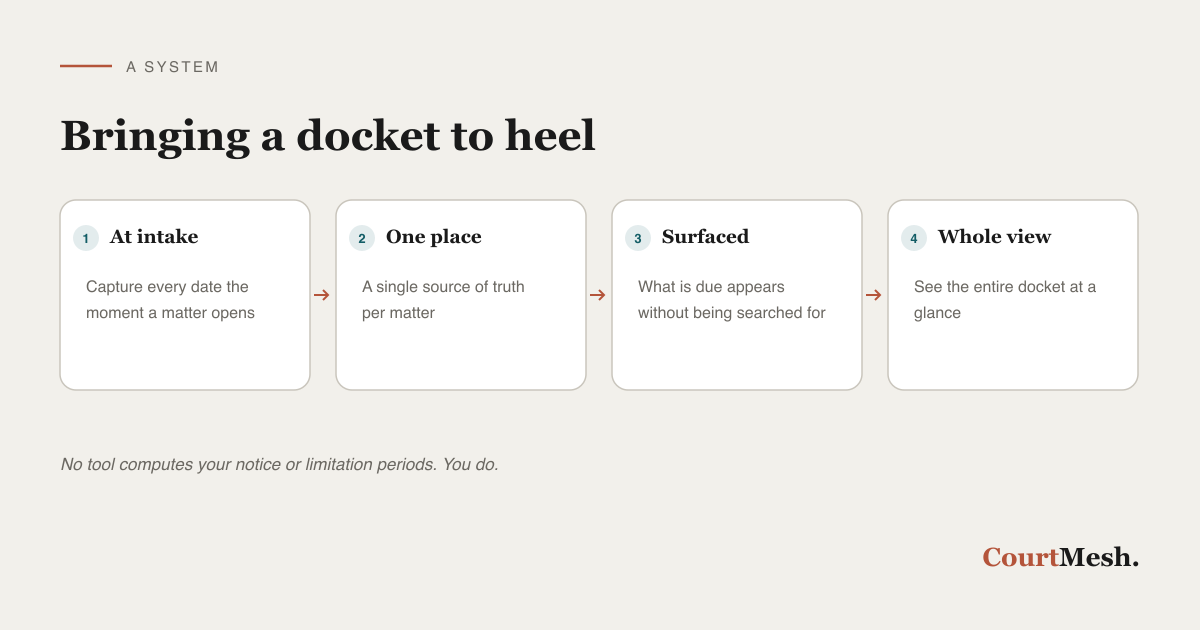
If the diary, the sheet and memory all fail in the same direction, the fix is not more effort. It is a system with a different shape, one built around the matter and around what is due, rather than around today's date or one person's recall. The test of it is simple, and it is worth applying to whatever you already use. Can anyone in the office say, without opening a file, what stage a given matter has reached and what its next step is? And can the whole docket be read at once, sorted by what falls due soonest, rather than one file at a time? A system that answers both questions has removed most of the risk volume creates, because the file that slips is rarely the one on your desk. It is the quiet one nobody had occasion to open.
A Practical Way to Bring a Large 138 Docket Under Control
None of this requires a heroic reorganisation. A large docket comes under control in a sequence of ordinary steps, done consistently. The order matters, because each step depends on the one before it.
List every live matter
Start with a complete inventory of the docket. You cannot manage what you have not counted, and a volume practice almost always has more live matters than anyone remembers when asked.
Capture the key dates at intake
For each matter, record the dates that drive it, presentation, dishonour, notice, receipt, the pay period and the filing window, at the moment the matter is opened and the documents are in hand, rather than later from memory.
Give every matter one owner
Assign a single person who is answerable for each file. Shared responsibility at volume tends to become nobody's responsibility, and the seams between people are where steps go missing.
Set your own reminders ahead of each window
Do not wait for the deadline itself. Build in a lead time before every statutory window and every hearing, so there is room to act rather than react on the last day.
Review the whole docket on a fixed rhythm
Once a week, look at everything coming due, not just the file on your desk. The portfolio review is what catches the quiet matter that would otherwise slip past its date.
Reconcile your file against the court record
Treat the cause list and the official record as the truth. Check your dates against them regularly, because your own system is only ever as reliable as its last update.
Where CourtMesh Fits
None of the above requires a particular product. Plenty of firms bring a large 138 docket under control with discipline alone. But the discipline is easier to keep when the tool is built for it, and this is the gap CourtMesh My Cases is meant to fill.
My Cases treats each matter as a live thing with a lifecycle rather than a row in a sheet. Tasks and deadlines attach to the matter, not to one person's memory. Urgency states let a matter that is about to fall due stand out from the many that are not. A document vault keeps the cheque, the return memo, the notice, the acknowledgement and the complaint together on the file, instead of scattered across email and folders. Team collaboration with access controls means a junior can be given a matter without the whole office being given everything.
For the dates that come from the court rather than from your own diary, My Cases pulls next-hearing dates and case status from eCourts and NJDG, over a corpus that spans the Supreme Court, all 25 High Courts, District Courts and Tribunals. What the registries have not yet published cannot flow in, and they do lag, so the court record stays the check. Even so, having those dates arrive rather than be typed by hand removes one large and common source of error at volume.
The point is visibility, not automation
CourtMesh does not draft your complaint, decide your limitation, or promise that nothing will ever be missed. What it does is put a large docket in one place and make what is due visible, so that the matter needing attention this week is the one you see, not the one buried at the bottom of a folder.
That distinction is the honest one. A recovery practice will always come down to an advocate applying the law to the facts of each cheque, within timelines only the advocate can compute. What a system removes is the risk that a sound matter is lost not to the merits but to the sheer number of files around it.
Bring the whole docket into view
A cheque-bounce practice lives or dies by whether you can see all of it at once. CourtMesh My Cases keeps each matter, its dates, its documents and its next steps in one place, pulls next-hearing dates and case status from eCourts and NJDG, and surfaces what is coming due so the matter that needs attention this week is visible rather than buried. The law on each file is the easy part. Managing two hundred of them is the work. If your 138 docket has outgrown the diary and the spreadsheet, CourtMesh is built to hold it.
Explore CourtMesh